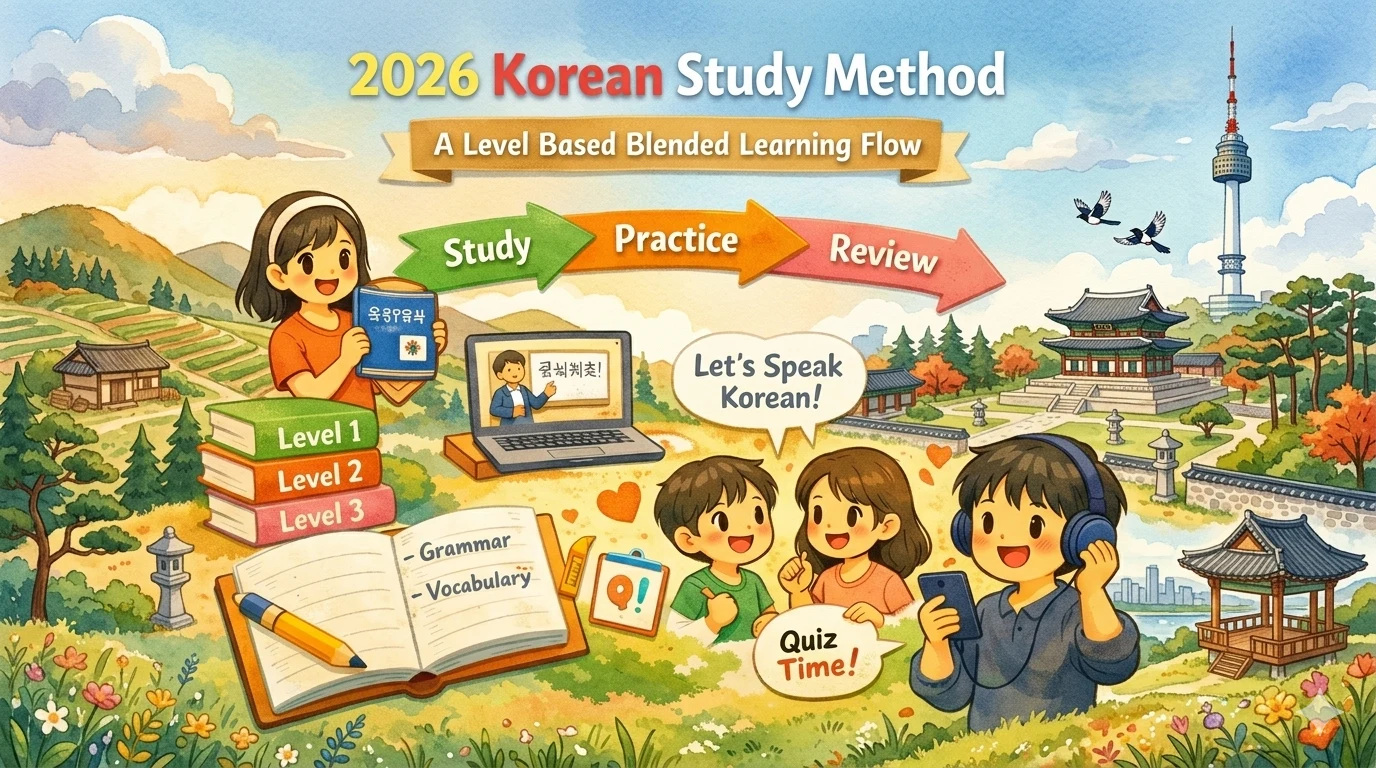
Is Korean hard to learn? Hangul isn't the hard part.
The wrong kind of hard
A lot of people ask if Korean is hard like they need permission before they even begin.Compared with Spanish or French, yes. English speakers usually have to work more. Different word order. Particles. Speech levels. Honorifics.But is that mean learning Korean is hard from beginning? No.
Hangul is the easy part
I still like seeing the moment Hangul clicks. Fourteen basic consonants. Ten vowels. Blocks that match sound more honestly than English spelling does.You can go from zero to reading cafe menus badly in a week. Badly is allowed. The writing system was built to be taught. Hunminjeongeum said ordinary people should be able to learn it.A fast student can learn the letters in a morning. A slow student in ten days. This study said that first. That's the alphabet. Not the language.If Hangul still looks like a texture to you, you have not failed. You just have not written enough syllables yet. 가 나 다. By hand. Not just taps.
Which part of Korean is most difficult
I've met more than a thousand Korean learners. Different countries. Different apps. Different teachers.The thing I hear most is verb endings. Which ending. When. How polite. How soft. How finished the sentence is supposed to sound.That pile is also one of the good parts of Korean. Meaning rides on the ending. Tone rides on the ending. Relationship rides on the ending.So yes. It's a lot. And yes. That density is part of why Korean can say so much in one short verb.Particles like 은/는 and 이/가 still trip people up. Word order still trips people up. Honorifics still feel heavy if you treat them like a test. But if I had to name one pain that shows up again and again in real conversations with learners, it would be ending choice.I keep a reference table of common endings for exactly that reason..
I've also seen the easy path
I want to say this carefully.I've also seen learners who barely did what people call "hard study." No grammar book. Almost no Hangul drills. Mostly drama for years. One recent case had been doing that for about three years. When we talked, the speech sounded natural. When I checked reading and writing, it held up. I asked how this happend. She said she did a lot of shadowing. And practiced with HelloTalk friend.I do not have a clean study proving this is the right method. I do not have a paper that says "skip grammar, watch drama." Input-heavy paths help a lot of people. I still can't tell you that drama alone is enough for everyone.If you really want to avoid that hard-study feeling, a long stretch of easy listening and watching can be a usable path. Not a guarantee. A path I have seen work for some people.Most learners I meet still need a person waiting for their answer. Understanding a scene and finishing your own sentence are different jobs. I wrote about that side here: conversation practice.
It feels harder overnight
Beginner Korean feels like progress every day. Then suddenly you understand a textbook and still miss a real reply. It feels like Korean got harder overnight.It didn't. You just left the greenhouse.This is where people decide they are bad at languages. Usually they're just under-practiced at talking, or stuck trying to pick endings under time pressure.
Hard vs long
Hard is not the same as long. Long is a separate question. I answered that here: how long it actually takes.The US State Department's language school puts Korean with Arabic, Chinese, and Japanese. About 2,200 classroom hours if you want job Korean. Spanish or French sit closer to 600 to 700 hours for the same professional finish line. That is not the same finish line as ordering ramyeon. Daily conversation sits lower than that. So don't panic at the government number.US Foreign Service Institute — classroom hours to professional working proficiency (ILR 3)
Here's the awkward pair of facts. The alphabet was built so ordinary people could learn it. The Foreign Service still budgets years of class for the language that alphabet writes. Those two facts are not fighting each other.Korean is long if your only method is apps and hope. It is still learnable if you read a little, speak a little, and stop translating every word in easy reading.You don't need to be gifted. You need a study plan you will still follow after the novelty wears off.
So is it hard
It's easier than the comment section. Hangul helps. A weekly conversation partner helps more than another theory about why Korean is impossible. Check how to find a conversation partner here: conversation practiceIf you can stand being awkward for a few months, Korean is available.