Why verb endings matter
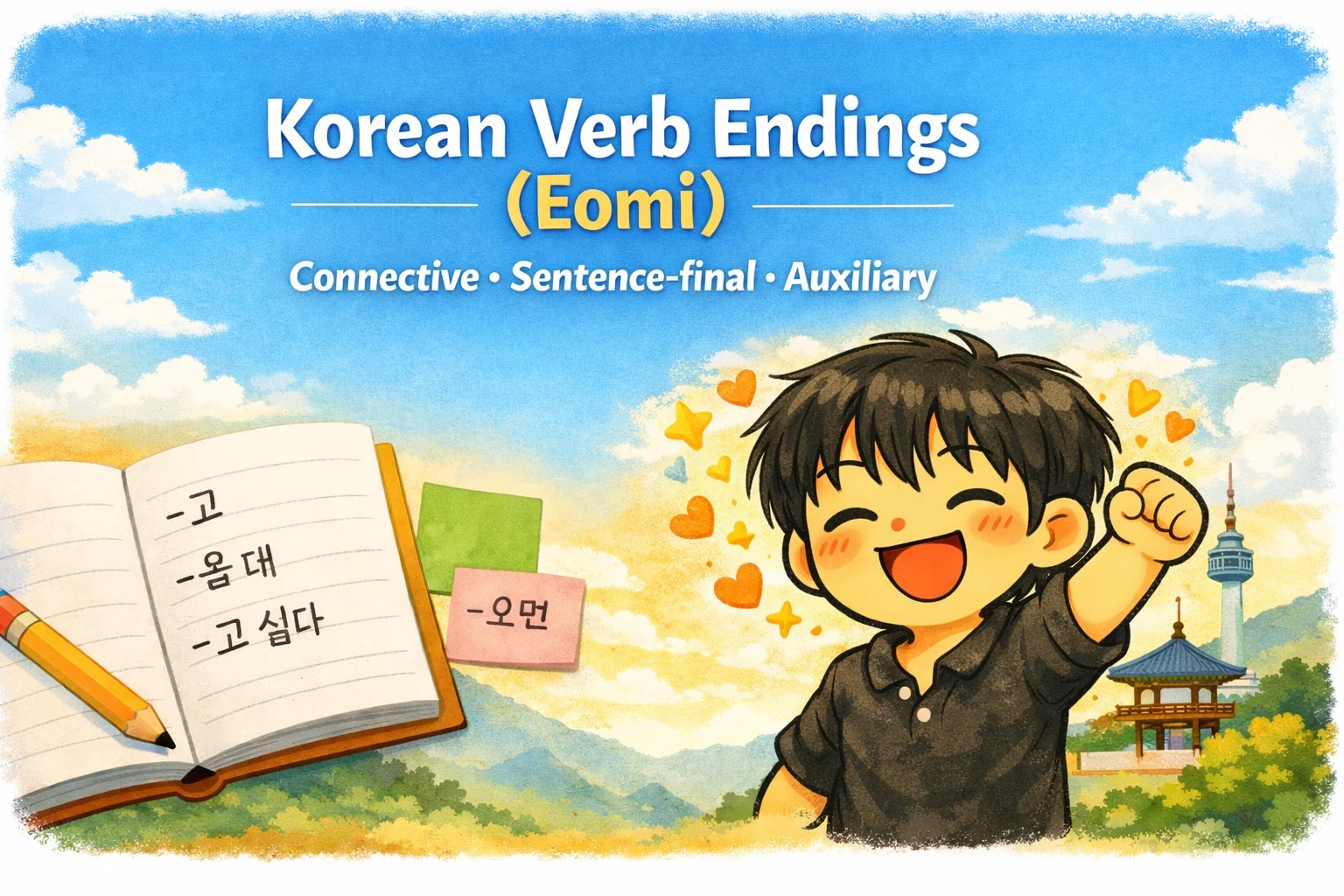
In Korean, a lot of meaning comes from endings you attach to the verb stem.
The same stem can become a statement, a question, a reason, a condition, or a wish—depending on the ending.This post is a quick reference table for some of the most common endings
connection, auxiliary, and sentence-ending forms.
The same stem can become a statement, a question, a reason, a condition, or a wish—depending on the ending.This post is a quick reference table for some of the most common endings
connection, auxiliary, and sentence-ending forms.
Reference table
Form, meaning, type, form rule, and example sentences.
| # | Form | Freq | Phonetic | Meaning | Form rule | Function |
|---|---|---|---|---|---|---|
| 1 | -고 | Very often | -go | and, then | verb stem + 고 | listing actions or sequence |
| 2 | -아/어서 | Very often | -a/eo-seo | because, so | verb stem + 아/어서 | express reason |
| 3 | -지만 | Very often | -ji-man | but, although | verb stem + 지만 | express contrast |
| 4 | -(으)면 | Very often | -(eu)-myeon | if, when | verb stem + 으면/면 | express condition |
| 5 | -는데 | Very often | -neun-de | and, but, background | verb stem + 는데 | introduce situation |
| 6 | -고 싶다 | Very often | -go sip-da | want to | verb stem + 고 싶다 | express want |
| 7 | -아/어야 하다 | Very often | -a/eo-ya ha-da | must, have to | verb stem + 아/어야 하다 | express obligation |
| 8 | -(으)ㄹ 때 | Very often | -(eu)l ttae | when, while | verb/adjective stem + (으)ㄹ 때 | express time (when) |
| 9 | -기 전(에) | Very often | -gi jeon(e) | before doing | verb stem + 기 전(에) | express time (before) |
| 10 | -고 나서 | Very often | -go na-seo | after doing, and then | verb stem + 고 나서 | express sequence (after) |
| 11 | -(으)면서 | Very often | -(eu)myeon-seo | while, as | verb stem + (으)면서 | express simultaneous actions |
| 12 | -(으)려고 | Very often | -(eu)ryeo-go | to try/intend to | verb stem + (으)려고 | express intention |
| 13 | -(으)ㄴ/는 후에 / 뒤에 | Very often | -(eu)n/neun hu-e / dwi-e | after, later | past: verb stem + (으)ㄴ 후에/뒤에, present: verb stem + 는 후에/뒤에 | express time (after) |
| 14 | -(으)거나 | Very often | -(eu)geo-na | or | verb/adjective stem + (으)거나 | express alternative (or) |
| 15 | -지 (…하지) | Very often | -ji (...ha-ji) | right?, isn't it? / (soft emphasis) | verb/adjective stem + 지 (often used as A-지, B-지…) | seek agreement or think aloud |
| 16 | -잖아/잖아요 | Very often | -jan-a/-jan-a-yo | you know, as you know | verb/adjective stem + 잖아/잖아요 | appeal to shared knowledge |
| 17 | -는데요 | Very often | -neun-de-yo | (soft lead-in), but/and (polite) | verb/adjective stem + (는)데요 | soften or introduce topic |
| 18 | -(으)ㄹ게(요) | Very often | -(eu)l ge(yo) | I will (promise / will do it) | verb stem + (으)ㄹ게(요) | promise to do something |
| 19 | -아/어 주다 | Very often | -a/eo ju-da | do for someone | verb stem + 아/어 주다 | express doing for someone |
| 20 | -아/어 보다 | Very often | -a/eo bo-da | try doing | verb stem + 아/어 보다 | express trying |
| 21 | -게 되다 | Very often | -ge doe-da | end up, come to (naturally) | verb stem + 게 되다 | express natural outcome/change |
| 22 | -(으)ㄹ 것 같다 | Very often | -(eu)l geot gat-da | seems like, I think (guess) | verb/adjective stem + (으)ㄹ 것 같다 | express guess |
| 23 | -지 않다 | Very often | -ji an-ta | not (do), do not | verb/adjective stem + 지 않다 | make negative statements |
| 24 | -아/어지다 | Very often | -a/eo-ji-da | become (change of state) | adjective stem + 아/어지다 (also verb stem + 아/어지다 for passive meaning in some cases) | express change of state |
| 25 | -아/어도 되다 | Very often | -a/eo-do doe-da | may, can (permission) | verb stem + 아/어도 되다 | ask/give permission |
| 26 | -(으)면 안 되다 | Very often | -(eu)myeon an doe-da | must not, cannot | verb stem + (으)면 안 되다 | express prohibition |
| 27 | -(으)ㄹ 수 있다 | Very often | -(eu)l su it-da | can, be able to | verb/adjective stem + (으)ㄹ 수 있다 | express ability or possibility |
| 28 | -(으)ㄹ 수 없다 | Very often | -(eu)l su eop-da | cannot, be unable to | verb/adjective stem + (으)ㄹ 수 없다 | express inability or impossibility |
| 29 | -아/어야 되다 | Very often | -a/eo-ya doe-da | must, need to | verb stem + 아/어야 되다 | express necessity |
| 30 | -지 말다 | Very often | -ji mal-da | don’t (do) | verb stem + 지 말다 (imperative: -지 마/마세요) | tell someone not to do |
| 31 | -(으)ㄴ/는 후에 / 뒤에 | Very often | -(eu)n/neun hu-e / dwi-e | after, later | past: verb stem + (으)ㄴ 후에/뒤에, present: verb stem + 는 후에/뒤에 | express time (after) |
| 32 | -기 전(에) | Very often | -gi jeon(e) | before doing | verb stem + 기 전(에) | express time (before) |
| 33 | -(으)ㄹ 때 | Very often | -(eu)l ttae | when | verb/adjective stem + (으)ㄹ 때 | express time (when) |
| 34 | -(으)면서 | Very often | -(eu)myeon-seo | while (two actions) | verb stem + (으)면서 | express simultaneous actions |
| 35 | -아/어도 | Very often | -a/eo-do | even if, even though | verb/adjective stem + 아/어도 | express concession (even if) |
| 36 | -(으)려면 | Very often | -(eu)ryeo-myeon | if you want to, in order to | verb stem + (으)려면 | express requirement for a goal |
| 37 | -(으)니까 | Very often | -(eu)ni-kka | because, so | verb/adjective stem + (으)니까 | express reason (often with suggestion/command) |
| 38 | -아/어요 | Very often | -a/eo-yo | polite present ending | verb/adjective stem + 아/어요 | make a polite statement |
| 39 | -아/어요? | Very often | -a/eo-yo? | polite question ending | verb/adjective stem + 아/어요? | ask a polite question |
| 40 | -네요 | Often | -ne-yo | I see, oh | verb stem + 네요 | reaction |
| 41 | -지요 | Often | -ji-yo | right?, you know | verb stem + 지요 | confirmation |
| 42 | -더라 | Often | -deo-ra | I saw, I experienced | verb stem + 더라 | report experience |
| 43 | -자마자 | Often | -ja-ma-ja | as soon as | verb stem + 자마자 | express time (immediately after) |
| 44 | -다가 | Often | -da-ga | while doing, then (change/stop) | verb stem + 다가 | express interruption/shift |
| 45 | -기 위해(서) | Often | -gi wi-hae(-seo) | in order to | verb stem + 기 위해(서) | express purpose |
| 46 | -(으)러 가다/오다 | Often | -(eu)reo ga-da/o-da | go/come to do | verb stem + (으)러 + 가다/오다 | express purpose of going/coming |
| 47 | -(으)ㄹ 동안 / -는 동안 | Often | -(eu)l dong-an / -neun dong-an | during, while | action: verb stem + 는 동안 / time period: verb/adjective stem + (으)ㄹ 동안 | express duration |
| 48 | -(으)ㄹ 때마다 | Often | -(eu)l ttae-ma-da | every time, whenever | verb/adjective stem + (으)ㄹ 때마다 | express repetition (whenever) |
| 49 | -거든(요) | Often | -geo-deun(yo) | because (casual explanation), you see | verb/adjective stem + 거든(요) | give a reason/explanation |
| 50 | -덕분에 | Often | -deok-bun-e | thanks to | noun + 덕분에 / verb stem + (으)ㄴ/는 덕분에 | express cause (positive/thanks) |
| 51 | -다 보니 | Often | -da bo-ni | as I kept doing, I realized | verb stem + 다 보니 | express result after repetition/time |
| 52 | -다 보면 | Often | -da bo-myeon | if/when you keep doing, eventually | verb stem + 다 보면 | express eventual result |
| 53 | -자 | Often | -ja | let’s, as soon as (written/plan) | verb stem + 자 | express immediate sequence (often written) |
| 54 | -(으)ㄴ/는 대신(에) | Often | -(eu)n/neun dae-sin(-e) | instead of, in return for | past: verb stem + (으)ㄴ 대신(에), present: verb stem + 는 대신(에) | express replacement/compensation |
| 55 | -(으)ㄹ 뿐(만) 아니라 | Often | -(eu)l ppun(man) a-ni-ra | not only ... but also | verb/adjective stem + (으)ㄹ 뿐(만) 아니라 | add emphasis (not only/but also) |
| 56 | -(으)ㄹ수록 | Often | -(eu)l-su-rok | the more..., the more... | verb/adjective stem + (으)ㄹ수록 | express proportional relationship |
| 57 | -아/어 놓다 | Often | -a/eo no-ta | do and leave it (prepared state) | verb stem + 아/어 놓다 | express preparation/result kept |
| 58 | -아/어 두다 | Often | -a/eo du-da | do and keep it for later | verb stem + 아/어 두다 | express doing in advance for future |
| 59 | -아/어 버리다 | Often | -a/eo beo-ri-da | end up doing (completely), do and finish | verb stem + 아/어 버리다 | express completion (often emotional) |
| 60 | -든지(…든지) | Often | -deun-ji(...deun-ji) | either..., or... (doesn't matter which) | verb/adjective stem + 든지 (…든지) | express open choice (either/or) |
| 61 | -거든 (설명/전제) | Often | -geo-deun | because / you see (setup tone) | verb/adjective stem + 거든, then main clause follows | provide background (pre-condition) |
| 62 | -네/네요 | Often | -ne/-ne-yo | oh, I see (discovery) | verb/adjective stem + 네/네요 | express realization |
| 63 | -더라/더라고(요) | Often | -deo-ra/-deo-ra-go(yo) | I found/experienced (recollection) | verb/adjective stem + 더라/더라고(요) | report personal experience |
| 64 | -지요/죠 | Often | -ji-yo/jo | right? / you know (polite) | verb/adjective stem + 지요/죠 | seek agreement |
| 65 | -려나 / -을까 | Often | -ryeo-na / -(eu)l-kka | I wonder if / maybe? | verb/adjective stem + 려나 / (으)ㄹ까 | express uncertainty or curiosity |
| 66 | -(으)ㄹ래(요) | Often | -(eu)l lae(yo) | want to, will (casual intention) | verb stem + (으)ㄹ래(요) | state intention or preference |
| 67 | -나 보다 | Often | -na bo-da | it seems (based on evidence) | verb/adjective stem + 나 보다 | express inference |
| 68 | -도록 | Often | -do-rok | so that, to the point that | verb stem + 도록 | express purpose |
| 69 | -게 하다 | Often | -ge ha-da | make/let someone do | verb/adjective stem + 게 하다 | cause or allow an action/state |
| 70 | -(으)ㄹ지도 모르다 | Often | -(eu)l-ji-do mo-reu-da | might, maybe | verb/adjective stem + (으)ㄹ지도 모르다 | express possibility (uncertain) |
| 71 | -아/어야지 | Often | -a/eo-ya-ji | should, I’d better (self-talk / decision) | verb stem + 아/어야지 | express resolve (self-talk) |
| 72 | -자마자 | Often | -ja-ma-ja | as soon as | verb stem + 자마자 | express time (immediately after) |
| 73 | -(으)ㄹ 때마다 | Often | -(eu)l ttae-ma-da | every time | verb/adjective stem + (으)ㄹ 때마다 | express repetition |
| 74 | -(으)ㄹ 동안 / -는 동안 | Often | -(eu)l dong-an / -neun dong-an | during, while | action: verb stem + 는 동안 / time period: verb/adjective stem + (으)ㄹ 동안 | express duration |
| 75 | -다가 | Often | -da-ga | while doing, then (change/stop) | verb stem + 다가 | express interruption/shift |
| 76 | -더라도 | Often | -deo-ra-do | even if (stronger) | verb stem + 더라도 | express strong concession |
| 77 | -기 때문에 | Often | -gi ttae-mun-e | because (more formal) | verb/adjective stem + 기 때문에 | express reason (formal) |
| 78 | -(으)ㄹ 때까지 | Often | -(eu)l ttae-kka-ji | until (a time/event) | verb/adjective stem + (으)ㄹ 때까지 | express time limit (until) |
| 79 | -도록 하다 | Often | -do-rok ha-da | make it so that / please do | verb stem + 도록 하다 | give instruction (ensure) |
| 80 | -는 한 | Common | -neun han | as long as, while (condition holds) | verb stem + 는 한 | express condition (as long as) |
| 81 | -(으)ㄹ 경우(에) | Common | -(eu)l gyeong-u(-e) | in case, if (formal) | verb/adjective stem + (으)ㄹ 경우(에) | express condition (formal case) |
| 82 | -(으)ㄴ/는 반면(에) | Common | -(eu)n/neun ban-myeon(-e) | whereas, while (contrast) | past: verb/adjective stem + (으)ㄴ 반면(에), present: verb stem + 는 반면(에) | express contrast (comparison) |
| 83 | -길래 | Common | -gil-lae | so (based on what I saw/heard) | verb/adjective stem + 길래 | explain reason (based on what was seen/heard) |
| 84 | -느라고 | Common | -neu-ra-go | because of doing (negative result) | verb stem + 느라고 | express reason (negative consequence) |
| 85 | -는 바람에 | Common | -neun ba-ram-e | because of (unexpected/negative outcome) | verb stem + 는 바람에 | express cause (unfortunate result) |
| 86 | -는 탓에 | Common | -neun tat-e | because of (blame) | verb stem + 는 탓에 | express cause (blaming tone) |
| 87 | -더니 | Common | -deo-ni | and then (change), after noticing | verb/adjective stem + 더니 | express change/contrast over time |
| 88 | -고 보니(까) | Common | -go bo-ni(kka) | after doing/looking, I realized | verb stem + 고 보니(까) | express discovery after action |
| 89 | -고서야 | Common | -go-seo-ya | only after | verb stem + 고서야 | express delayed result |
| 90 | -(으)ㄴ/는 김에 | Common | -(eu)n/neun gim-e | while you’re at it | past: verb stem + (으)ㄴ 김에, present: verb stem + 는 김에 | express doing an additional action |
| 91 | -(으)ㄴ/는 데다(가) | Common | -(eu)n/neun de-da(ga) | in addition to, on top of | past: verb/adjective stem + (으)ㄴ 데다(가), present: verb stem + 는 데다(가) | add information (often reasons) |
| 92 | -(으)ㄴ/는 이상 | Common | -(eu)n/neun i-sang | since, as long as (given that) | past: verb/adjective stem + (으)ㄴ 이상, present: verb stem + 는 이상 | express reason/condition with firmness |
| 93 | -뿐이다 | Common | -ppun-i-da | only, nothing but | verb/adjective stem + 뿐이다 | express limitation |
| 94 | -(으)ㄴ/는 채(로) | Common | -(eu)n/neun chae(ro) | while keeping (a state), without changing | past: verb/adjective stem + (으)ㄴ 채(로), present: verb stem + 는 채(로) | express maintaining a state |
| 95 | -나(요) | Common | -na(yo) | I guess / (soft suggestion or wonder) | verb/adjective stem + 나(요) | soften a statement or suggestion |
| 96 | -지 뭐 | Common | -ji mwo | well, I guess / anyway | verb/adjective stem + 지 뭐 | show resignation |
| 97 | -게끔 | Common | -ge-kkeum | so that (more casual/colloquial) | verb stem + 게끔 | express purpose (casual) |
| 98 | -(으)ㄴ/는 후에 / 뒤에 (재정리) | Common | -(eu)n/neun hu-e / dwi-e | after, later | duplicate entry placeholder | duplicate |
| 99 | -기만 하면 | Common | -gi-man ha-myeon | whenever (only if you do) | verb stem + 기만 하면 | express trigger condition |
| 100 | -기는 하지만 | Common | -gi-neun ha-ji-man | it is true that..., but | verb/adjective stem + 기는 하지만 | express concession + contrast |
| 101 | -기는커녕 | Common | -gi-neun-keo-nyeong | far from, let alone | verb/adjective stem + 기는커녕 | deny A and emphasize worse/opposite |
How to use this
Use the table to compare endings and see how they change the role of the verb in the sentence.
Connection endings link two clauses (and, but, because, if…). Auxiliary ones add meaning like “want to” or “have to.” Sentence-ending ones finish the sentence with a certain tone (realization, confirmation, recollection).
Connection endings link two clauses (and, but, because, if…). Auxiliary ones add meaning like “want to” or “have to.” Sentence-ending ones finish the sentence with a certain tone (realization, confirmation, recollection).