Unpublished draft. Not on the blog list, sitemap, or search. Anyone with this URL can still read it.
Minjae·2026년 3월 18일
Why Does Meaning Disappear When You Translate Korean?
Translation is not a zip file
Many learners hope that if they know the English "equivalent" of a Korean sentence, they have understood the Korean. Often they have only understood a summary.Meaning lives in grammar, context, relationship, and what the language forces you to notice. When you squeeze Korean into English wording, part of that information simply has nowhere to go.
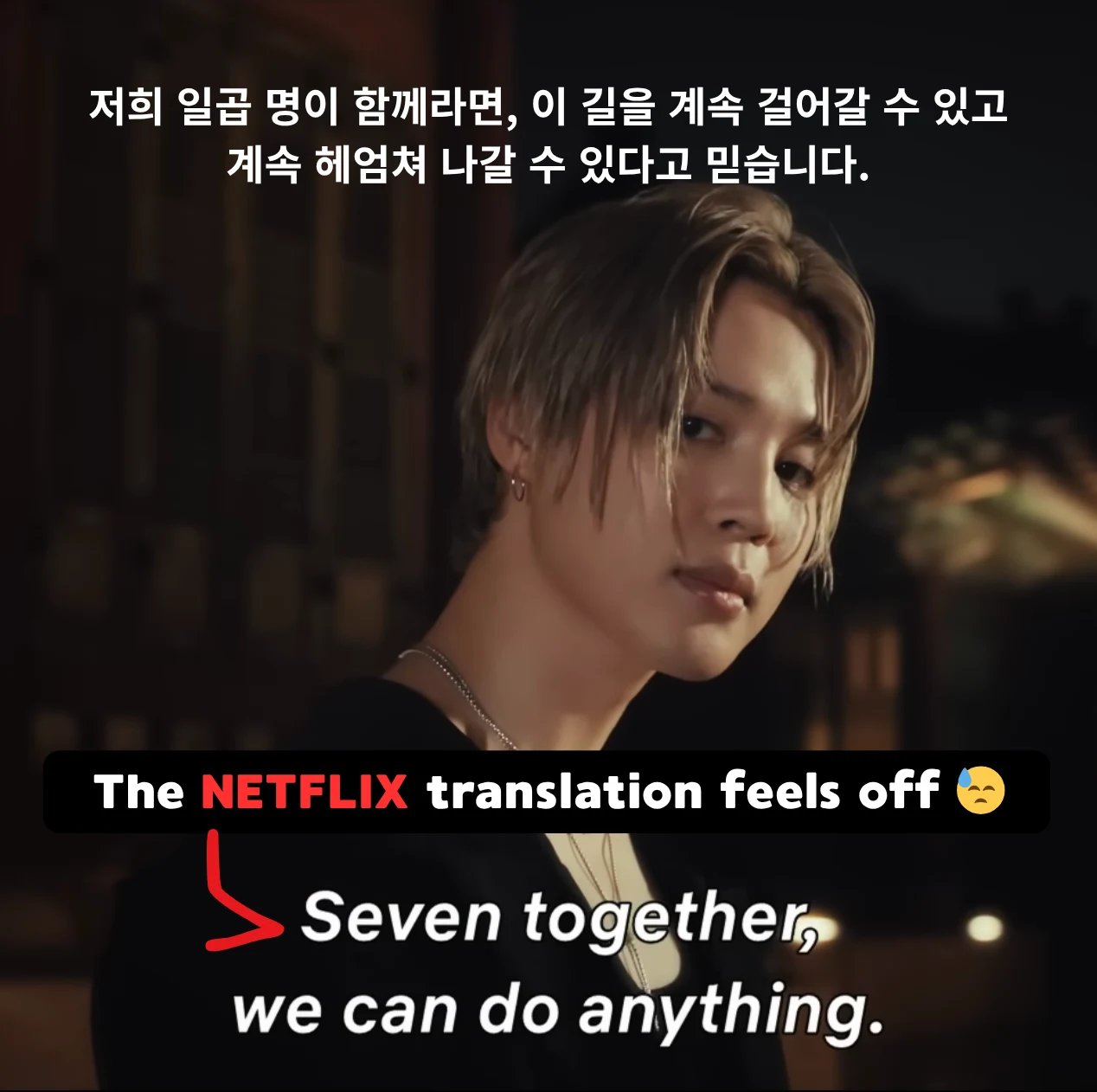
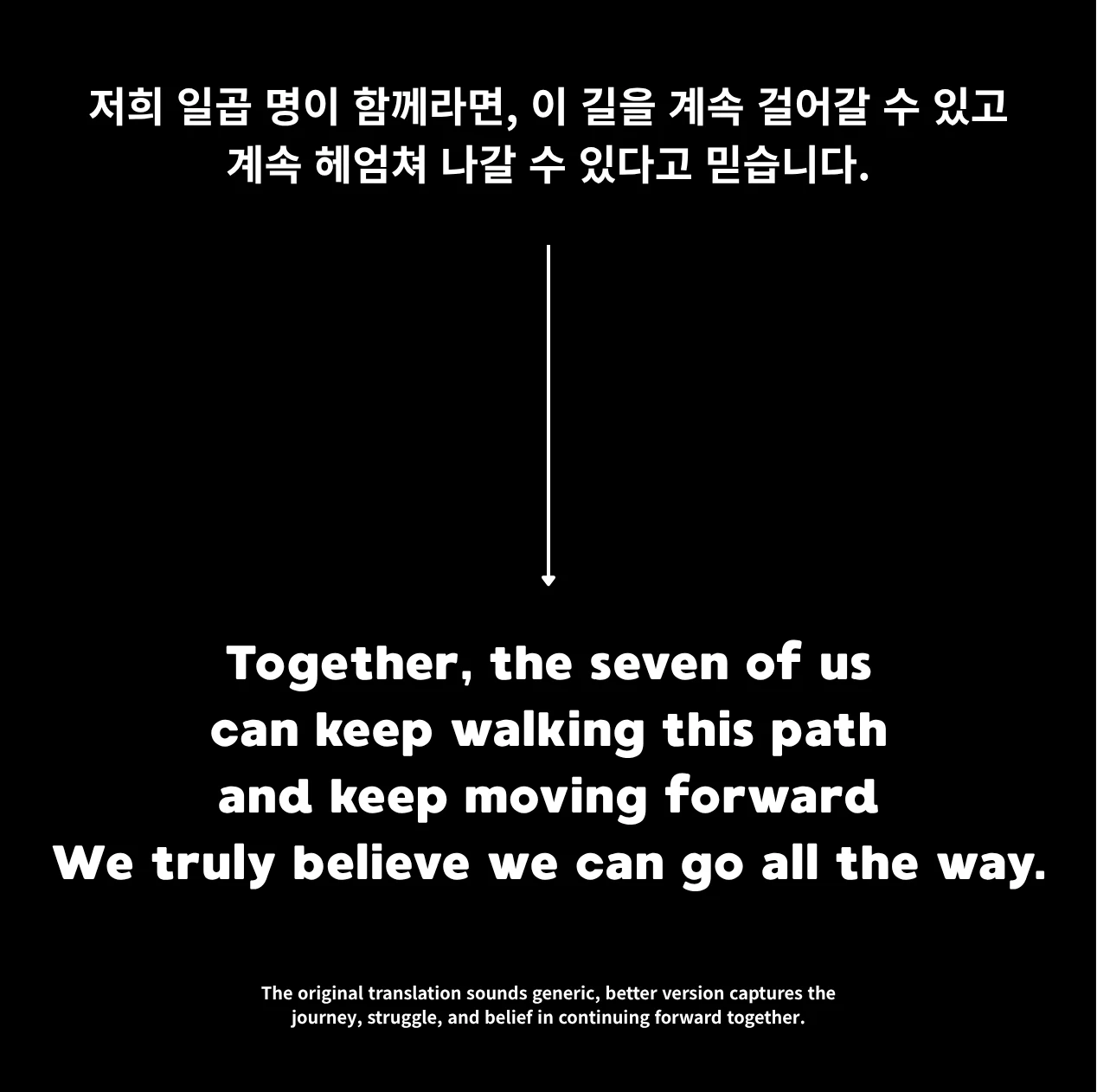
The image below is a screenshot from the Netflix video of BTS’s comeback stage.
BTS 컴백 무대 Netflix 영상 화면이다.
Korean stacks meaning in different places
English often puts the main point in subject–verb–object order and function words like the or did. Korean often uses topic–comment structure and particles such as 은/는 and 이/가 to steer what the listener should focus on.One English sentence can hide several Korean versions that differ only in particles or word order—but those versions are not interchangeable in real conversation.
What is 'left out' is still there in Korean
Korean frequently drops subjects and objects when they are clear from context. A short line like 갔어? might be "Did you go?" or "Did they go?" in English, depending on who was already in the conversation.A translation has to choose one reading. The other possibilities disappear from the page—even though Korean leaves them open on purpose.
Politeness is part of the message
Endings such as –요, –습니다, or plain speech are not "extra decoration." They tell the listener how close you are, how formal the setting is, and sometimes whether you are upset or joking.English might use tone or extra phrases to do some of this work, but the mapping is never one-to-one. If you ignore endings while translating, you lose a layer native speakers hear instantly.
Words carry culture, not just dictionary glosses
Expressions tied to food, family, school, or work in Korea often assume shared experience. A gloss like "fighting" for 화이팅 or a literal breakdown of an idiom may explain the letters without conveying why people say it here.That is not a bad translation—it is a different job. Explanation needs more room than a single replacement word.
What helps more than word-for-word
Notice who is talking to whom, what was said in the previous line, and which particle marks the topic. When you study, pair Korean sentences with situations, not only with English strings.If you treat Korean as its own way of pointing and framing—not as English wearing a different costume—much less meaning will "vanish" between the two languages.번역은 이해의 끝이 아니라, 이해를 위한 출발점에 가깝습니다.