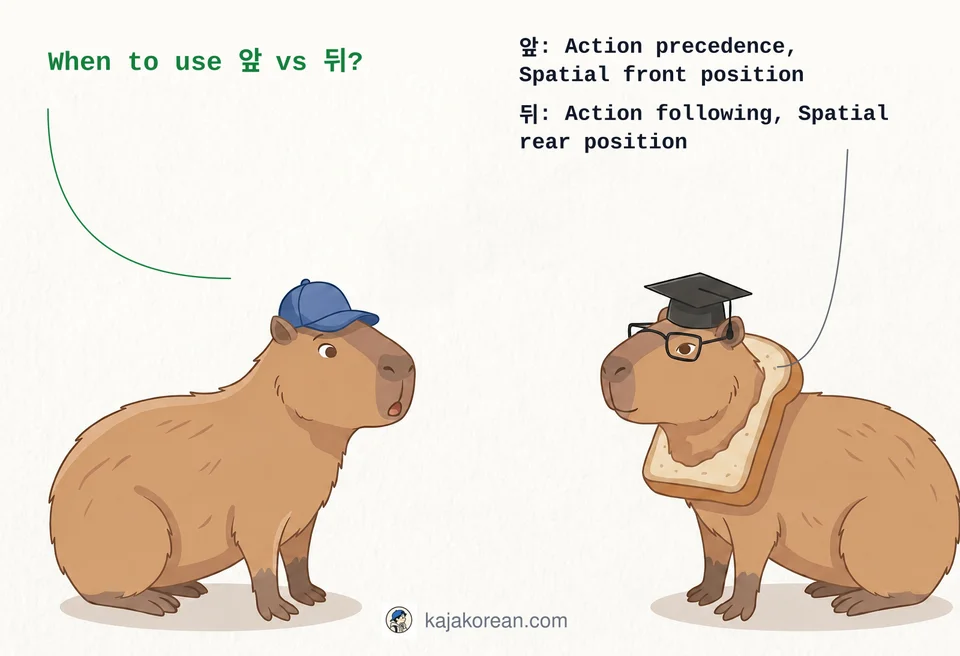
앞 vs 뒤: Differences in Position and Direction

앞 (ap) · 뒤 (dwi)

앞 and 뒤 both indicate spatial positions, but 앞 refers to the front or forward side, while 뒤 refers to the back or rear side.

Comparison of Korean words 앞 and 뒤 indicating front and back positions

Word-by-word breakdown

One lane per word — no nested boxes, just the gist.

(ap)

The front or forward side of an object or person, or the part positioned ahead from a reference point

When to use

Spatial front position, Temporal future or prior, Action precedence

The nuance

앞 is used to indicate the front or forward direction from a reference point. It can also denote future time or something occurring before another event.

(dwi)

The back or rear side of an object or person, or the part positioned behind from a reference point

When to use

Spatial rear position, Temporal past or subsequent, Action following

The nuance

뒤 is used to indicate the back or rear direction from a reference point. It can also denote past time or something occurring after another event.

Real-world examples

  • 학교 앞에 버스 정류장이 있어요.

    hak-gyo ap-e beo-seu jeong-ryu-jang-i iss-eo-yo., hak gyo ap e beo seu jeong ryu jang i iss eo yo.

    앞 correctly indicates a front spatial position here.

  • 학교 뒤에 버스 정류장이 있어요.

    hak-gyo dwi-e beo-seu jeong-ryu-jang-i iss-eo-yo., hak gyo dwi e beo seu jeong ryu jang i iss eo yo.

    뒤 correctly indicates a rear spatial position here.

  • 회의는 오후 3시 앞에 시작해요.

    hoe-ui-neun o-hu 3si ap-e si-jak-hae-yo., hoe ui neun o hu 3si ap e si jak hae yo.

    앞에 is used for future or prior time but '오후 3시 앞에' is unnatural; use '전에' instead.

  • 회의는 오후 3시 뒤에 시작해요.

    hoe-ui-neun o-hu 3si dwi-e si-jak-hae-yo., hoe ui neun o hu 3si dwi e si jak hae yo.

    뒤에 can mean later but is less common in time expressions; prefer '후에' or '나중에'.

  • 그는 나보다 앞에서 걷고 있어요.

    geu-neun na-bo-da ap-e-seo geot-go iss-eo-yo., geu neun na bo da ap e seo geot go iss eo yo.

    앞 appropriately indicates spatial front compared to the speaker.

  • 그는 나보다 뒤에서 걷고 있어요.

    geu-neun na-bo-da dwi-e-seo geot-go iss-eo-yo., geu neun na bo da dwi e seo geot go iss eo yo.

    뒤 appropriately indicates spatial rear compared to the speaker.

  • 내일 앞에 중요한 시험이 있어요.

    nae-il ap-e jung-yo-han si-heom-i iss-eo-yo., nae il ap e jung yo han si heom i iss eo yo.

    '앞에' is not used with specific dates like '내일'; use '전에' or '이후에'.

  • 내일 뒤에 중요한 시험이 있어요.

    nae-il dwi-e jung-yo-han si-heom-i iss-eo-yo., nae il dwi e jung yo han si heom i iss eo yo.

    '뒤에' is less natural with '내일'; use '이후에' instead.

Quick quiz

  1. Which sentence correctly uses '앞' for spatial position?

    공간에서 '앞'을 사용할 때 적절한 문장은?(gong-gan-e-seo'ap'eulsa-yong-halttaejeok-jeol-hanmun-jang-eun?, gongganeseo'ap'eulsayonghalttaejeokjeolhanmunjangeun?)
  2. Which sentence correctly uses '뒤' in a time expression?

    시간 표현에서 '뒤'를 올바르게 쓴 문장은?(si-ganpyo-hyeon-e-seo'dwi'reulol-ba-reu-gesseunmun-jang-eun?, siganpyohyeoneseo'dwi'reulolbareugesseunmunjangeun?)
  3. Which sentence incorrectly uses '뒤' for spatial position?

    다음 중 '뒤'를 공간적 위치로 잘못 쓴 문장은?(da-eumjung'dwi'reulgong-gan-jeokwi-chi-rojal-mossseunmun-jang-eun?, daeumjung'dwi'reulgongganjeokwichirojalmossseunmunjangeun?)

More comparisons to explore

View all word comparisons →