
거(geo)
A contraction of '것' used mainly in casual spoken Korean.
When to use
casual conversation, daily speech, spoken language expressions
The nuance
Used in informal, everyday conversation; avoided in formal writing or speech.
거 (geo) · 것 (geos)
'거' is the casual spoken contraction of '것', which is mainly used in formal or written contexts, so choosing between them depends on the situation's formality.
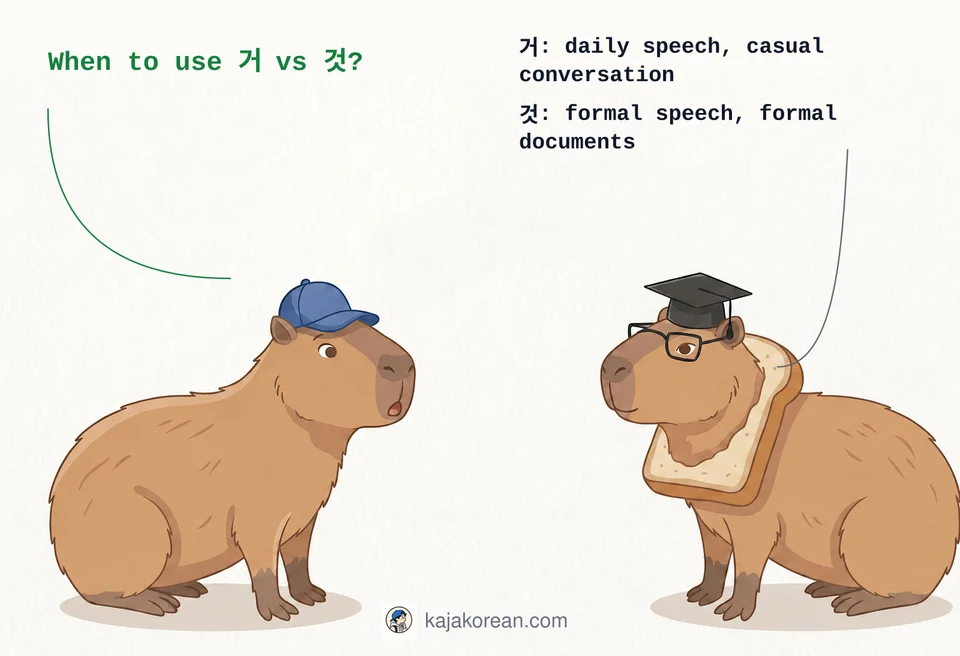
One lane per word — no nested boxes, just the gist.
A contraction of '것' used mainly in casual spoken Korean.
When to use
casual conversation, daily speech, spoken language expressions
The nuance
Used in informal, everyday conversation; avoided in formal writing or speech.
The original form of '거', mainly used in formal or written contexts.
When to use
formal documents, written language, formal speech
The nuance
Used in formal or written contexts; suitable at sentence ends or for emphasis.
이거 맛있어.
i-geo mas-iss-eo., i geo mas iss eo.
In casual conversation, '이거' is a natural expression.
이것 맛있어.
i-geos mas-iss-eo., i geos mas iss eo.
'이것' is formal and sounds awkward in casual speech; use '이거' instead.
이것은 중요합니다.
i-geos-eun jung-yo-hap-ni-da., i geos eun jung yo hap ni da.
'이것' is appropriate in formal and written sentences.
이거는 중요합니다.
i-geo-neun jung-yo-hap-ni-da., i geo neun jung yo hap ni da.
'이거' is informal and unsuitable for formal sentences.
그거 누구 거야?
geu-geo nu-gu geo-ya?, geu geo nu gu geo ya?
Natural expression in casual conversation among friends.
그것 누구 거야?
geu-geos nu-gu geo-ya?, geu geos nu gu geo ya?
'그것' sounds unnatural in informal conversation.
그것은 제 책입니다.
geu-geos-eun je chaek-ip-ni-da., geu geos eun je chaek ip ni da.
Appropriate for formal and written contexts.
그거는 제 책입니다.
geu-geo-neun je chaek-ip-ni-da., geu geo neun je chaek ip ni da.
Informal expression is unsuitable for formal sentences.
Which word should you use when speaking casually with a friend?
Which word is used in formal documents?
What is the appropriate expression instead of '이것' in daily conversation?