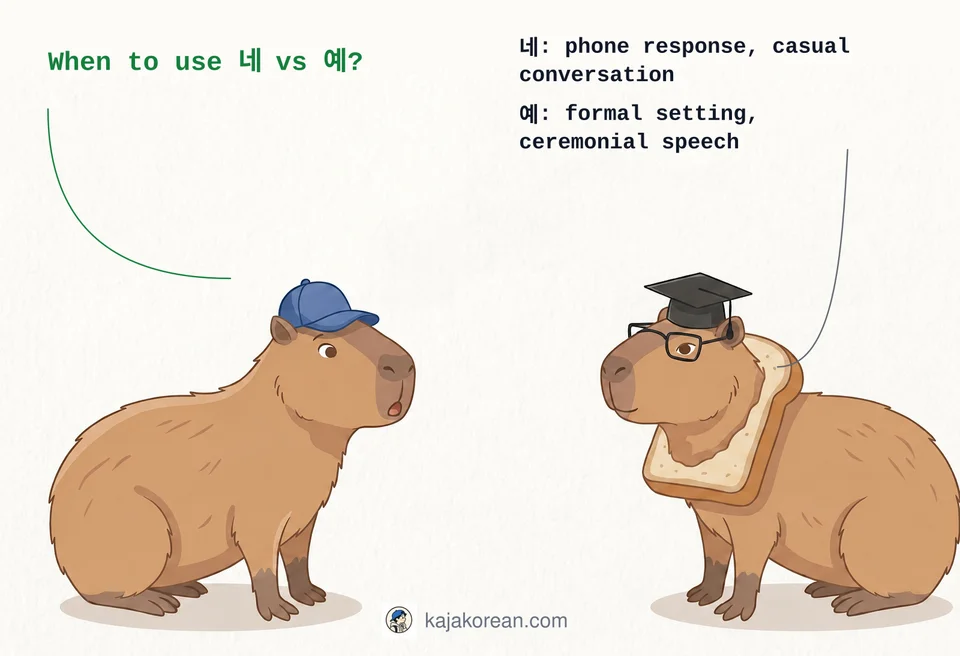
네 vs 예: Choosing Natural Affirmative Responses

네 (ne) · 예 (ye)

Both 네 and 예 mean 'yes,' but 네 is used in casual and polite everyday contexts, while 예 is reserved for formal and official situations.

Comparison of Korean affirmative responses 네 and 예

Word-by-word breakdown

One lane per word — no nested boxes, just the gist.

(ne)

Casual and polite affirmative response

When to use

casual conversation, everyday affirmation, phone response, agreement to speaker

The nuance

네 is mainly used in everyday conversations or polite settings to express affirmation with friendliness or basic respect.

(ye)

Formal and official affirmative response

When to use

formal setting, ceremonial speech, replying to superior, polite respect expression

The nuance

예 is mainly used in formal or official contexts to emphasize politeness and respect.

Real-world examples

  • 네, 알겠습니다.

    ne, al-gess-seup-ni-da., ne, al gess seup ni da.

    Appropriate affirmative response in a polite everyday situation.

  • 예, 알겠습니다.

    ye, al-gess-seup-ni-da., ye, al gess seup ni da.

    Appropriate affirmative response in a formal, official situation.

  • 전화 받았을 때 '네'라고 대답하는 것은 자연스럽다.

    jeon-hwa bat-ass-eul ttae 'ne'ra-go dae-dap-ha-neun geos-eun ja-yeon-seu-reop-da., jeon hwa bat ass eul ttae 'ne'ra go dae dap ha neun geos eun ja yeon seu reop da.

    네 is commonly used when answering the phone.

  • 전화 받았을 때 '예'라고 대답하는 것은 부자연스럽다.

    jeon-hwa bat-ass-eul ttae 'ye'ra-go dae-dap-ha-neun geos-eun bu-ja-yeon-seu-reop-da., jeon hwa bat ass eul ttae 'ye'ra go dae dap ha neun geos eun bu ja yeon seu reop da.

    예 is too formal for phone answering; 네 is standard.

  • 상사에게 '네'라고 대답하는 것은 적절하다.

    sang-sa-e-ge 'ne'ra-go dae-dap-ha-neun geos-eun jeok-jeol-ha-da., sang sa e ge 'ne'ra go dae dap ha neun geos eun jeok jeol ha da.

    네 is appropriate as a respectful response even to superiors.

  • 상사에게 '예'라고 대답하는 것은 더 공손하다.

    sang-sa-e-ge 'ye'ra-go dae-dap-ha-neun geos-eun deo gong-son-ha-da., sang sa e ge 'ye'ra go dae dap ha neun geos eun deo gong son ha da.

    예 is a more formal and respectful expression.

  • 친구에게 '예'라고 대답하는 것은 부자연스럽다.

    chin-gu-e-ge 'ye'ra-go dae-dap-ha-neun geos-eun bu-ja-yeon-seu-reop-da., chin gu e ge 'ye'ra go dae dap ha neun geos eun bu ja yeon seu reop da.

    예 is too formal and unnatural among friends.

  • 친구에게 '네'라고 대답하는 것은 자연스럽다.

    chin-gu-e-ge 'ne'ra-go dae-dap-ha-neun geos-eun ja-yeon-seu-reop-da., chin gu e ge 'ne'ra go dae dap ha neun geos eun ja yeon seu reop da.

    네 is natural in casual conversations with friends.

Quick quiz

  1. Which expression is natural when answering the phone?

    전화 받을 때 어떤 표현이 자연스러운가요?(jeon-hwabat-eulttaeeo-tteonpyo-hyeon-ija-yeon-seu-reo-un-ga-yo?, jeonhwabateulttaeeotteonpyohyeonijayeonseureoungayo?)
  2. Appropriate affirmative response to a superior in a formal meeting?

    공식 회의에서 윗사람께 긍정할 때 적절한 표현은?(gong-sikhoe-ui-e-seowis-sa-ram-kkegeung-jeong-halttaejeok-jeol-hanpyo-hyeon-eun?, gongsikhoeuieseowissaramkkegeungjeonghalttaejeokjeolhanpyohyeoneun?)
  3. Proper affirmative response to a friend’s question?

    친구가 질문했을 때 긍정 대답으로 적절한 것은?(chin-gu-gajil-mun-haess-eulttaegeung-jeongdae-dap-eu-rojeok-jeol-hangeos-eun?, chingugajilmunhaesseulttaegeungjeongdaedapeurojeokjeolhangeoseun?)

What does it mean?

More comparisons to explore

View all word comparisons →