
찾다(chaj-da, chajda)
To search for or locate something.
When to use
Everyday search, Locating objects, Information seeking
The nuance
Used when simply searching for or locating something; does not necessarily imply intensity of effort or success.
찾다 (chaj-da, chajda) · 찾아내다 (chaj-a-nae-da, chajanaeda)
‘찾다’ means simply searching or locating something, while ‘찾아내다’ emphasizes successfully discovering or solving something despite difficulties.
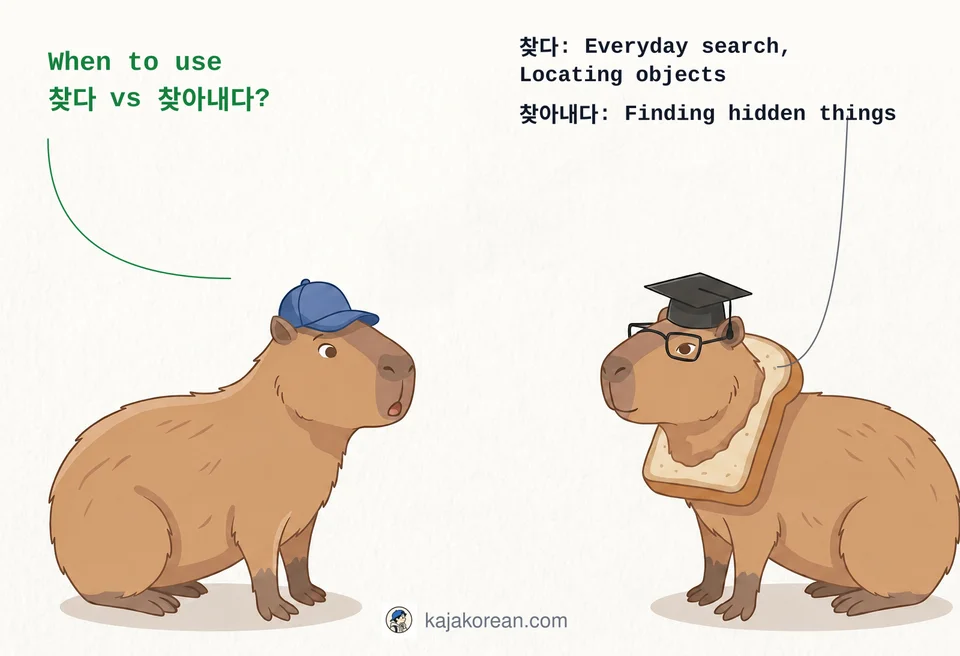
One lane per word — no nested boxes, just the gist.
To search for or locate something.
When to use
Everyday search, Locating objects, Information seeking
The nuance
Used when simply searching for or locating something; does not necessarily imply intensity of effort or success.
To discover or solve something despite difficulties or obstacles.
When to use
Solving difficult problems, Finding hidden things, Navigating complex situations
The nuance
Implies successfully discovering or solving a goal amid difficulties.
나는 열쇠를 찾고 있어.
na-neun yeol-soe-reul chaj-go iss-eo., na neun yeol soe reul chaj go iss eo.
‘찾다’ is appropriate for simply locating the key.
나는 열쇠를 찾아내고 있어.
na-neun yeol-soe-reul chaj-a-nae-go iss-eo., na neun yeol soe reul chaj a nae go iss eo.
‘찾아내다’ implies discovery amid difficulty, which is unnecessary here.
그는 범인을 찾아냈다.
geu-neun beom-in-eul chaj-a-naess-da., geu neun beom in eul chaj a naess da.
‘찾아내다’ fits because it implies discovering the criminal after difficulty.
그는 범인을 찾았다.
geu-neun beom-in-eul chaj-ass-da., geu neun beom in eul chaj ass da.
Using ‘찾다’ for a difficult target like a criminal downplays the challenge.
나는 좋은 정보를 찾았다.
na-neun joh-eun jeong-bo-reul chaj-ass-da., na neun joh eun jeong bo reul chaj ass da.
‘찾다’ fits for general information seeking.
나는 좋은 정보를 찾아냈다.
na-neun joh-eun jeong-bo-reul chaj-a-naess-da., na neun joh eun jeong bo reul chaj a naess da.
‘찾아내다’ is correct if the information was difficult to find.
그녀는 문제를 찾아냈다.
geu-nyeo-neun mun-je-reul chaj-a-naess-da., geu nyeo neun mun je reul chaj a naess da.
‘찾아내다’ suits contexts of discovering or solving problems.
그녀는 문제를 찾았다.
geu-nyeo-neun mun-je-reul chaj-ass-da., geu nyeo neun mun je reul chaj ass da.
‘찾다’ weakens the meaning when referring to problem discovery.
Which word should you use when discovering a difficult problem?
Which word is appropriate for everyday object location?
If you discovered hidden information with difficulty, which word fits?