
사과하다(sa-gwa-ha-da, sagwahada)
To admit one's fault and express apology
When to use
admitting fault, expressing regret, requesting apology
The nuance
Used when one admits their own fault and expresses regret; only for expressing apology.
사과하다 (sa-gwa-ha-da, sagwahada) · 용서하다 (yong-seo-ha-da, yongseohada)
사과하다 means admitting fault and expressing regret, while 용서하다 means accepting someone’s fault and letting go of resentment.
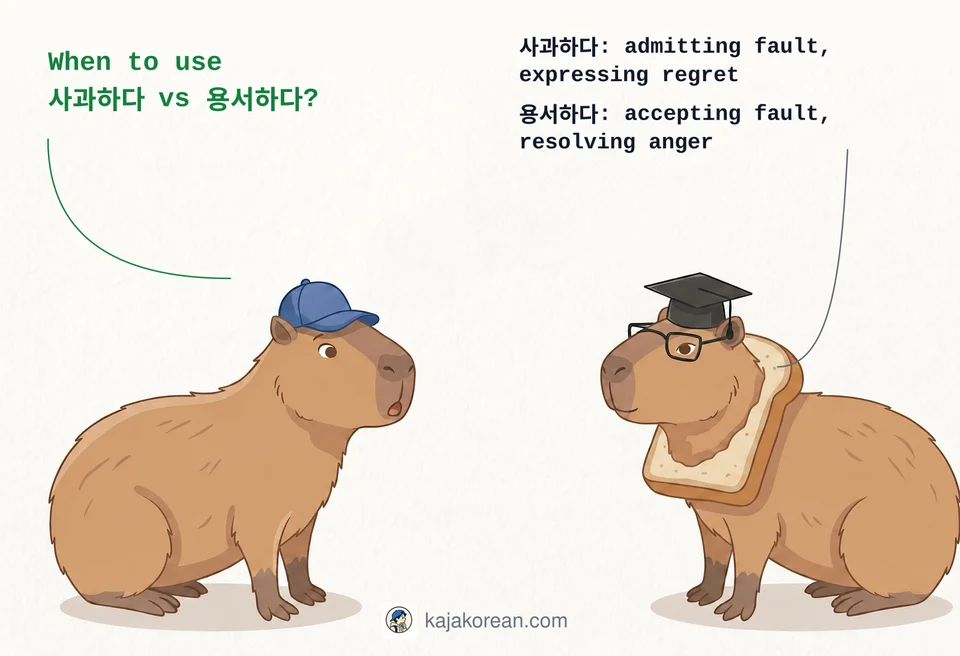
One lane per word — no nested boxes, just the gist.
To admit one's fault and express apology
When to use
admitting fault, expressing regret, requesting apology
The nuance
Used when one admits their own fault and expresses regret; only for expressing apology.
To accept someone’s fault and release resentment
When to use
accepting fault, releasing resentment, resolving anger
The nuance
Used when accepting and understanding someone else's fault; applies only to forgiving and letting go of resentment.
제가 늦어서 정말 사과합니다.
je-ga neuj-eo-seo jeong-mal sa-gwa-hap-ni-da., je ga neuj eo seo jeong mal sa gwa hap ni da.
Correct because the speaker admits their fault and expresses apology.
그의 실수를 용서합니다.
geu-ui sil-su-reul yong-seo-hap-ni-da., geu ui sil su reul yong seo hap ni da.
Appropriate for accepting someone's fault and forgiving.
잘못했으니 용서해 주세요.
jal-mos-haess-eu-ni yong-seo-hae ju-se-yo., jal mos haess eu ni yong seo hae ju se yo.
When the wrongdoer asks for forgiveness, '사과하다' should be used instead of '용서하다'.
그는 나에게 사과했다.
geu-neun na-e-ge sa-gwa-haess-da., geu neun na e ge sa gwa haess da.
Correct because the other person admitted fault and apologized.
나는 친구의 실수를 사과했다.
na-neun chin-gu-ui sil-su-reul sa-gwa-haess-da., na neun chin gu ui sil su reul sa gwa haess da.
Incorrect because one cannot apologize for someone else's fault; '용서하다' is appropriate.
부모님께 용서받고 싶어요.
bu-mo-nim-kke yong-seo-bat-go sip-eo-yo., bu mo nim kke yong seo bat go sip eo yo.
Appropriate expression for wanting to be forgiven after admitting fault.
나는 친구에게 용서를 했다.
na-neun chin-gu-e-ge yong-seo-reul haess-da., na neun chin gu e ge yong seo reul haess da.
Correct for forgiving a friend's fault and letting go of resentment.
사과를 해 주세요, 용서해 주세요.
sa-gwa-reul hae ju-se-yo, yong-seo-hae ju-se-yo., sa gwa reul hae ju se yo, yong seo hae ju se yo.
Both expressions are appropriate when requesting apology and forgiveness separately.
Which word is used to admit fault and express regret?
Which word is appropriate when accepting a friend's fault and forgiving?
What do you say to someone when you are at fault?
Which of the following sentences is incorrect?