
가능하다(ga-neung-ha-da, ganeunghada)
Indicates that something can be done or realized
When to use
Expressing ability, Permissible situations, Feasibility
The nuance
Used when an action or situation is feasible or allowed. Has a positive meaning.
가능하다 (ga-neung-ha-da, ganeunghada) · 불가능하다 (bul-ga-neung-ha-da, bulganeunghada)
가능하다 and 불가능하다 clearly distinguish whether something can be done, expressing positive possibility and impossibility respectively.
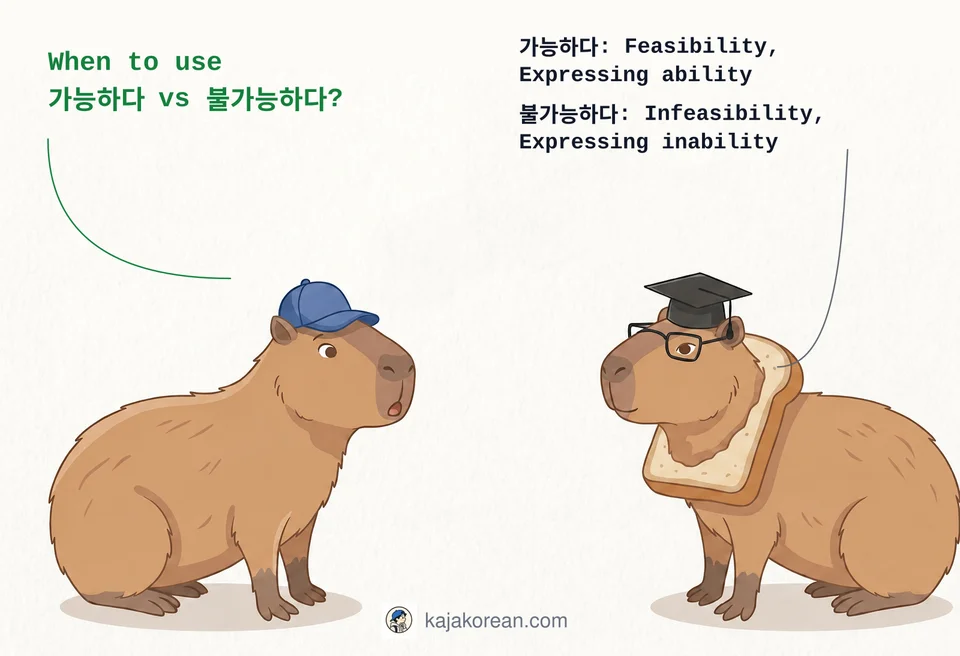
One lane per word — no nested boxes, just the gist.
Indicates that something can be done or realized
When to use
Expressing ability, Permissible situations, Feasibility
The nuance
Used when an action or situation is feasible or allowed. Has a positive meaning.
Indicates that something cannot be done or realized
When to use
Expressing inability, Prohibited situations, Infeasibility
The nuance
Used when an action or situation is not feasible or not allowed. Has a negative meaning.
이 문제는 해결 가능하다.
i mun-je-neun hae-gyeol ga-neung-ha-da., i mun je neun hae gyeol ga neung ha da.
This sentence correctly expresses the positive possibility of solving the problem.
이 문제는 해결 불가능하다.
i mun-je-neun hae-gyeol bul-ga-neung-ha-da., i mun je neun hae gyeol bul ga neung ha da.
This sentence correctly expresses the negative possibility of not being able to solve the problem.
그 일은 가능하지 않다.
geu il-eun ga-neung-ha-ji an-da., geu il eun ga neung ha ji an da.
Negative form of ‘가능하다’, correctly expressing impossibility.
그 일은 불가능하지 않다.
geu il-eun bul-ga-neung-ha-ji an-da., geu il eun bul ga neung ha ji an da.
Negative form of ‘불가능하다’, indirectly expressing possibility naturally.
이 계획은 불가능하다 할 수 있다.
i gye-hoek-eun bul-ga-neung-ha-da hal su iss-da., i gye hoek eun bul ga neung ha da hal su iss da.
‘불가능하다’ and ‘할 수 있다’ have opposite meanings, so using them together is contradictory.
그는 가능하지 않다.
geu-neun ga-neung-ha-ji an-da., geu neun ga neung ha ji an da.
‘가능하다’ is mainly used for situations or actions; directly negating a person is inappropriate.
시험에 합격하는 것은 불가능하다.
si-heom-e hap-gyeok-ha-neun geos-eun bul-ga-neung-ha-da., si heom e hap gyeok ha neun geos eun bul ga neung ha da.
Clearly expresses that passing the exam is impossible.
시험에 합격하는 것은 가능하지 않다.
si-heom-e hap-gyeok-ha-neun geos-eun ga-neung-ha-ji an-da., si heom e hap gyeok ha neun geos eun ga neung ha ji an da.
Negative form of ‘가능하다’, naturally conveying that passing the exam is difficult.
Which word is appropriate when something can be done?
Which word is appropriate to express something absolutely cannot be done?
Which sentence correctly uses the negative form of ‘불가능하다’?