
겠습니다(gess-seup-ni-da, gessseupnida)
Used to express strong intention formally and politely
When to use
formal intention, announcing decision, polite promise
The nuance
Indicates speaker’s strong will or decision, mainly in formal contexts.
겠습니다 (gess-seup-ni-da, gessseupnida) · 을게요 (eul-ge-yo, eulgeyo) · 을 거예요 (eulgeo-ye-yo, eulgeoyeyo)
겠습니다 (getseumnida) expresses strong intention formally, 을게요 (eulgeyo) shows considerate promises, and 을 거예요 (eul geoyeyo) states future facts or plans.
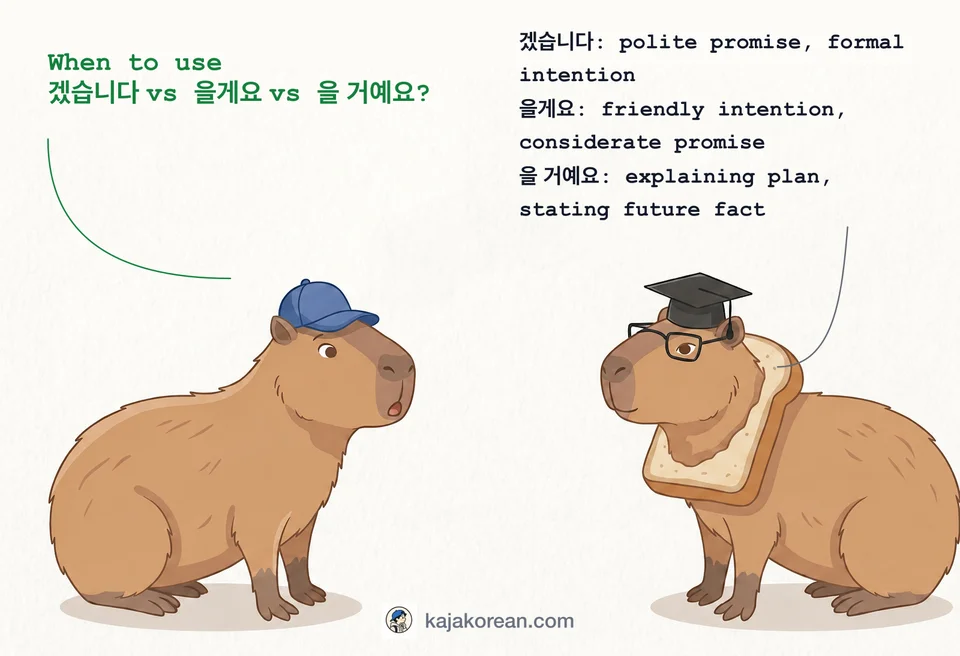
One lane per word — no nested boxes, just the gist.
Used to express strong intention formally and politely
When to use
formal intention, announcing decision, polite promise
The nuance
Indicates speaker’s strong will or decision, mainly in formal contexts.
Used to make promises or express intention considerately to the listener
When to use
considerate promise, friendly intention, casual conversation promise
The nuance
Used when speaker expresses intention or promise considering the listener’s feelings or situation.
Used to state future facts, plans, or predictions
When to use
stating future fact, explaining plan, expressing prediction
The nuance
Used to express future events, plans, or guesses.
내일 회의에 참석하겠습니다.
nae-il hoe-ui-e cham-seok-ha-gess-seup-ni-da., nae il hoe ui e cham seok ha gess seup ni da.
Appropriate formal expression of strong intention in official settings.
내일 회의에 참석을게요.
nae-il hoe-ui-e cham-seok-eul-ge-yo., nae il hoe ui e cham seok eul ge yo.
Meeting attendance is formal; 을게요 is too casual here.
내일 회의에 참석을 거예요.
nae-il hoe-ui-e cham-seok-eul geo-ye-yo., nae il hoe ui e cham seok eul geo ye yo.
Natural for stating future fact or plan.
제가 설거지하겠습니다.
je-ga seol-geo-ji-ha-gess-seup-ni-da., je ga seol geo ji ha gess seup ni da.
Appropriate for polite and strong intention.
제가 설거지할게요.
je-ga seol-geo-ji-hal-ge-yo., je ga seol geo ji hal ge yo.
Natural when making a considerate promise.
제가 설거지할 거예요.
je-ga seol-geo-ji-hal geo-ye-yo., je ga seol geo ji hal geo ye yo.
Appropriate for stating future plan or fact.
내가 먼저 갈게요.
nae-ga meon-jeo gal-ge-yo., nae ga meon jeo gal ge yo.
Friendly and considerate promise expression.
내가 먼저 가겠습니다.
nae-ga meon-jeo ga-gess-seup-ni-da., nae ga meon jeo ga gess seup ni da.
Too formal for casual, friendly context.
Which is appropriate for expressing strong will in formal settings?
Which is used to make considerate promises to a friend?
Which is most natural for stating future plans or facts?