현재 vs 과거 vs 미래: Mastering Time Expressions

현재 (hyeon-jae, hyeonjae) · 과거 (gwa-geo, gwageo) · 미래 (mi-rae, mirae)

현재 (hyeonjae), 과거 (gwageo), 미래 (mirae) all express time but specifically refer to now, past events, and future events respectively.

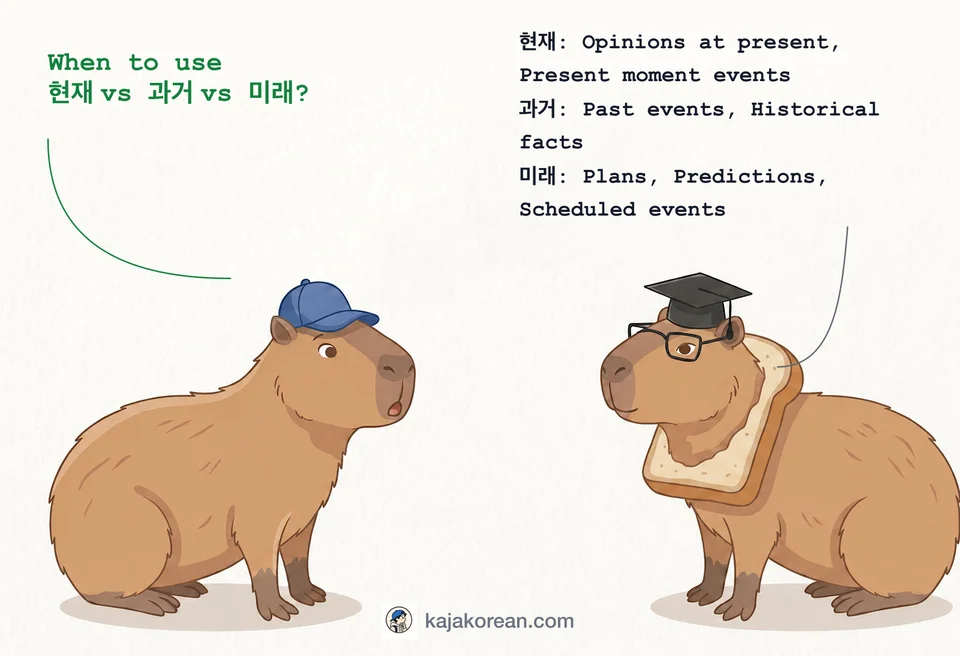
Comparison of Korean time words 현재, 과거, 미래

Word-by-word breakdown

One lane per word — no nested boxes, just the gist.

현재(hyeon-jae, hyeonjae)

Used to indicate the present moment or current state.

When to use

Present moment events, Describing current state, Opinions at present

The nuance

Use 현재 to talk about events or states happening right now; it cannot be used for past or future events.

과거(gwa-geo, gwageo)

Used to indicate time or events that have already passed.

When to use

Past events, Recalling memories, Historical facts

The nuance

Use 과거 to talk about events or states that happened before now; it cannot be used for present or future events.

미래(mi-rae, mirae)

Used to indicate time or events that will happen later.

When to use

Predictions, Plans, Scheduled events

The nuance

Use 미래 to talk about events or states that will happen after now; it cannot be used for present or past events.

Real-world examples

  • 현재 저는 도서관에 있어요.

    hyeon-jae jeo-neun do-seo-gwan-e iss-eo-yo., hyeon jae jeo neun do seo gwan e iss eo yo.

    현재 is correct because it expresses the current situation.

  • 과거 저는 도서관에 있어요.

    gwa-geo jeo-neun do-seo-gwan-e iss-eo-yo., gwa geo jeo neun do seo gwan e iss eo yo.

    과거 cannot be combined with present tense verb '있어요'.

  • 미래 저는 도서관에 있어요.

    mi-rae jeo-neun do-seo-gwan-e iss-eo-yo., mi rae jeo neun do seo gwan e iss eo yo.

    미래 requires future tense verb form, not present tense.

  • 과거에 그 영화를 봤어요.

    gwa-geo-e geu yeong-hwa-reul bwass-eo-yo., gwa geo e geu yeong hwa reul bwass eo yo.

    과거 correctly indicates a completed past event.

  • 현재에 그 영화를 봤어요.

    hyeon-jae-e geu yeong-hwa-reul bwass-eo-yo., hyeon jae e geu yeong hwa reul bwass eo yo.

    현재 cannot be used with past tense verb '봤어요'.

  • 미래에 그 영화를 볼 거예요.

    mi-rae-e geu yeong-hwa-reul bol geo-ye-yo., mi rae e geu yeong hwa reul bol geo ye yo.

    미래 correctly expresses a future planned action.

  • 미래에 나는 행복했어요.

    mi-rae-e na-neun haeng-bok-haess-eo-yo., mi rae e na neun haeng bok haess eo yo.

    미래 requires future tense, not past tense adjective.

  • 현재 상황을 잘 이해했어요.

    hyeon-jae sang-hwang-eul jal i-hae-haess-eo-yo., hyeon jae sang hwang eul jal i hae haess eo yo.

    현재 correctly refers to the current state here.

Quick quiz

  1. Choose the correct word: "I will travel in the ___ ."

    다음 문장에서 알맞은 단어는? "___에 여행을 갈 거예요."(da-eummun-jang-e-seoal-maj-eundan-eo-neun?"___eyeo-haeng-eulgalgeo-ye-yo.", daeummunjangeseoalmajeundaneoneun?"___eyeohaengeulgalgeoyeyo.")
  2. Which sentence correctly uses 과거?

    다음 중 과거를 올바르게 사용한 문장은?(da-eumjunggwa-geo-reulol-ba-reu-gesa-yong-hanmun-jang-eun?, daeumjunggwageoreulolbareugesayonghanmunjangeun?)
  3. Which sentence correctly uses 현재?

    현재를 올바르게 쓴 문장은?(hyeon-jae-reulol-ba-reu-gesseunmun-jang-eun?, hyeonjaereulolbareugesseunmunjangeun?)

More comparisons to explore

View all word comparisons →