원하다 vs 거부하다: Distinguishing Wanting from Rejecting

원하다 (won-ha-da, wonhada) · 거부하다 (geo-bu-ha-da, geobuhada)

원하다 (wonhada) expresses positive desire for something, while 거부하다 (geobuhada) expresses negative rejection or refusal; both show attitudes toward an object but in opposite ways.

Comparison of Korean verbs 원하다 (to want) and 거부하다 (to refuse)

Word-by-word breakdown

One lane per word — no nested boxes, just the gist.

원하다(won-ha-da, wonhada)

To want, wish for, or desire something.

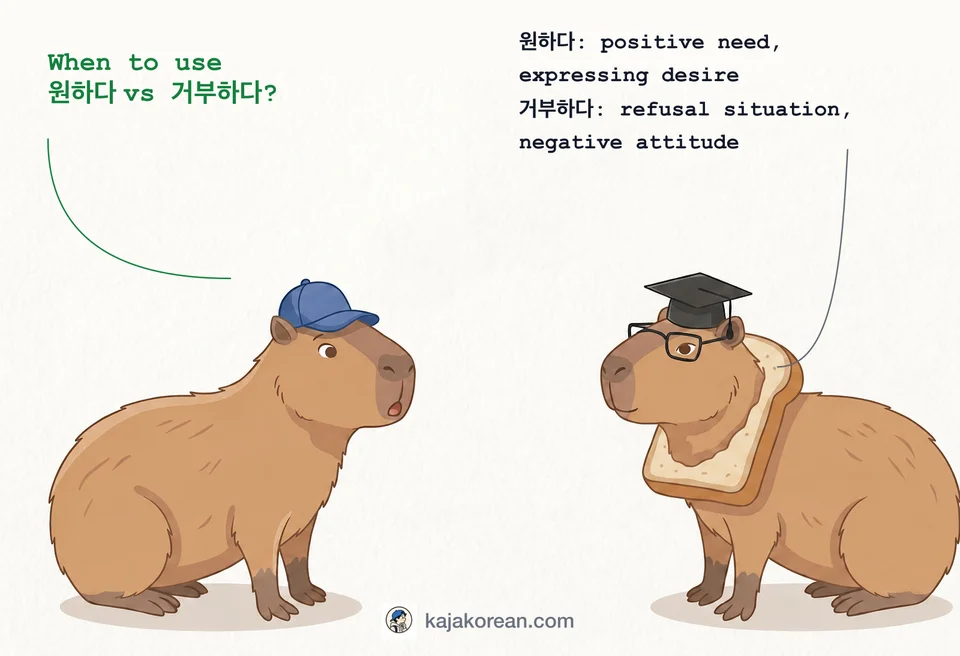
When to use

expressing desire, positive need, hopeful situation

The nuance

Use 원하다 to express positive desire or need for something, such as a person, object, or state. It never implies rejection or refusal.

거부하다(geo-bu-ha-da, geobuhada)

To refuse or reject a proposal, request, or offer.

When to use

refusal situation, negative attitude, rejecting requests

The nuance

Use 거부하다 to clearly express refusal or rejection of something like a request or proposal. It conveys a negative attitude and is the opposite of 원하다. It cannot express positive desire.

Real-world examples

  • 나는 새 차를 원한다.

    na-neun sae cha-reul won-han-da., na neun sae cha reul won han da.

    Expresses positive desire, so 원하다 is correct.

  • 나는 그 제안을 원한다.

    na-neun geu je-an-eul won-han-da., na neun geu je an eul won han da.

    Used for positively wanting a proposal.

  • 나는 그 제안을 거부한다.

    na-neun geu je-an-eul geo-bu-han-da., na neun geu je an eul geo bu han da.

    Appropriate to refuse a proposal.

  • 나는 새 차를 거부한다.

    na-neun sae cha-reul geo-bu-han-da., na neun sae cha reul geo bu han da.

    Refusing an object like a car is unnatural; 원하다 should be used.

  • 그는 내 도움을 원하지 않는다.

    geu-neun nae do-um-eul won-ha-ji an-neun-da., geu neun nae do um eul won ha ji an neun da.

    Negative form of 원하다 expresses lack of desire.

  • 그는 내 도움을 거부한다.

    geu-neun nae do-um-eul geo-bu-han-da., geu neun nae do um eul geo bu han da.

    Used to express refusal of help.

  • 나는 그의 의견을 원하지 않는다.

    na-neun geu-ui ui-gyeon-eul won-ha-ji an-neun-da., na neun geu ui ui gyeon eul won ha ji an neun da.

    Expresses lack of desire for opinion.

  • 나는 그의 의견을 거부한다.

    na-neun geu-ui ui-gyeon-eul geo-bu-han-da., na neun geu ui ui gyeon eul geo bu han da.

    Used to reject an opinion.

Quick quiz

  1. Which sentence expresses 'refusal'?

    다음 중 어떤 문장이 '거절'을 표현하는가?(da-eumjungeo-tteonmun-jang-i'geo-jeol'eulpyo-hyeon-ha-neun-ga?, daeumjungeotteonmunjangi'geojeol'eulpyohyeonhaneunga?)
  2. When should you use '원하다'?

    ‘원하다’를 써야 하는 경우는?(‘won-ha-da’reulsseo-yaha-neungyeong-u-neun?, ‘wonhada’reulsseoyahaneungyeonguneun?)
  3. Which sentence requires '거부하다'?

    ‘거부하다’를 써야 하는 문장은?(‘geo-bu-ha-da’reulsseo-yaha-neunmun-jang-eun?, ‘geobuhada’reulsseoyahaneunmunjangeun?)

More comparisons to explore

View all word comparisons →