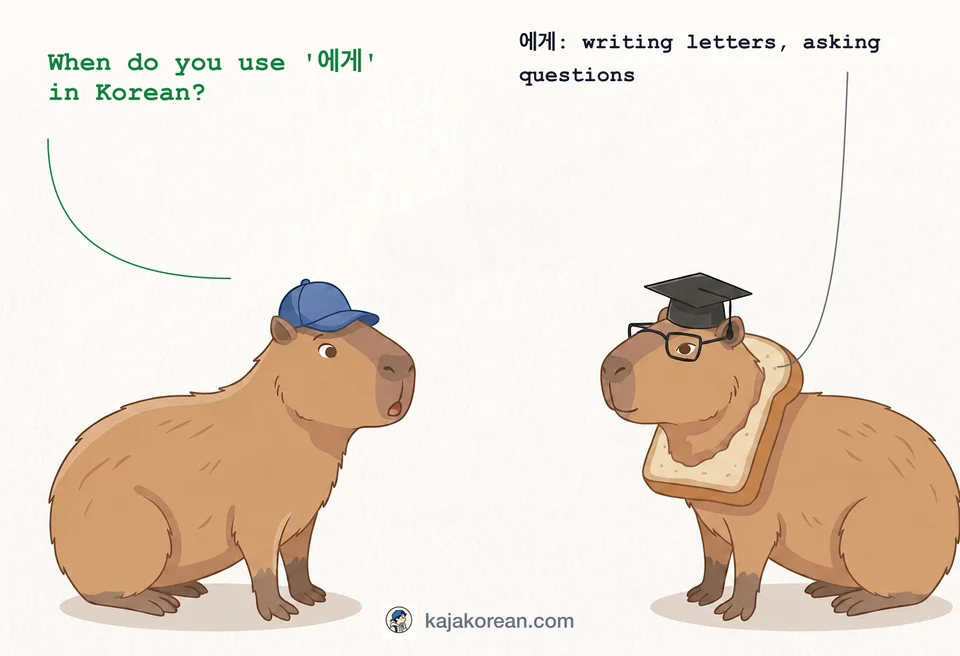
How to use 에게 in Korean

에게 (e-ge, ege)

에게 is a particle used mainly to indicate 'to' a person or animal. It's common in daily speech and writing.

Korean particle 에게 usage guide

Usage guide

When and how native speakers actually use it.

에게(e-ge, ege)

에게 is a particle that indicates 'to' a person or animal.

When to use

writing letters, expressing thanks, asking questions

The nuance

1. 에게 is mainly used to indicate to whom an action or feeling is directed, typically a person or animal. 2. It replaces the subject particle (이/가) when indicating the recipient or target. 3. It is more formal and literary; in spoken Korean, 한테 is more common. 4. It attaches directly to a noun without spacing. 5. Used with verbs to complete meanings like 'do something to someone.'

Real-world examples

  • 나는 친구에게 편지를 썼다.

    na-neun chin-gu-e-ge pyeon-ji-reul sseoss-da., na neun chin gu e ge pyeon ji reul sseoss da.

    에게 correctly marks the recipient of the action (the friend receiving the letter).

  • 고양이에게 밥을 줬다.

    go-yang-i-e-ge bap-eul jwoss-da., go yang i e ge bap eul jwoss da.

    에게 is appropriate for indicating the animal receiving the action.

  • 선생님에게 질문을 했다.

    seon-saeng-nim-e-ge jil-mun-eul haess-da., seon saeng nim e ge jil mun eul haess da.

    에게 correctly marks the target of the question.

  • 나는 친구한테 편지를 썼다.

    na-neun chin-gu-han-te pyeon-ji-reul sseoss-da., na neun chin gu han te pyeon ji reul sseoss da.

    In spoken Korean, 한테 is commonly used instead of 에게.

  • 나는 친구에게서 편지를 받았다.

    na-neun chin-gu-e-ge-seo pyeon-ji-reul bat-ass-da., na neun chin gu e ge seo pyeon ji reul bat ass da.

    에게서 indicates source, which is different from 에게.

  • 나는 친구에게 편지를 받았다.

    na-neun chin-gu-e-ge pyeon-ji-reul bat-ass-da., na neun chin gu e ge pyeon ji reul bat ass da.

    에게 marks the recipient of an action, so it cannot be used with 'receive' as the subject.

  • 나는 친구에게 책을 읽었다.

    na-neun chin-gu-e-ge chaek-eul ik-eoss-da., na neun chin gu e ge chaek eul ik eoss da.

    Reading a book to someone requires clear indirect object marking; '에게' can be used, but context matters. However, this sentence is unnatural because '읽다' with '에게' as indirect object is awkward without additional context.

Quick quiz

  1. To what kind of targets is '에게' mainly attached?

    에게는 주로 어떤 대상에 붙나요?(e-ge-neunju-roeo-tteondae-sang-ebut-na-yo?, egeneunjuroeotteondaesangebutnayo?)
  2. What expression is often used instead of '에게' in spoken Korean?

    구어체에서 에게 대신 자주 쓰이는 표현은?(gu-eo-che-e-seoe-gedae-sinja-jusseu-i-neunpyo-hyeon-eun?, gueocheeseoegedaesinjajusseuineunpyohyeoneun?)
  3. Which sentence is correct?

    다음 문장 중 올바른 문장은?(da-eummun-jangjungol-ba-reunmun-jang-eun?, daeummunjangjungolbareunmunjangeun?)

More usage guides

View all usage guides →