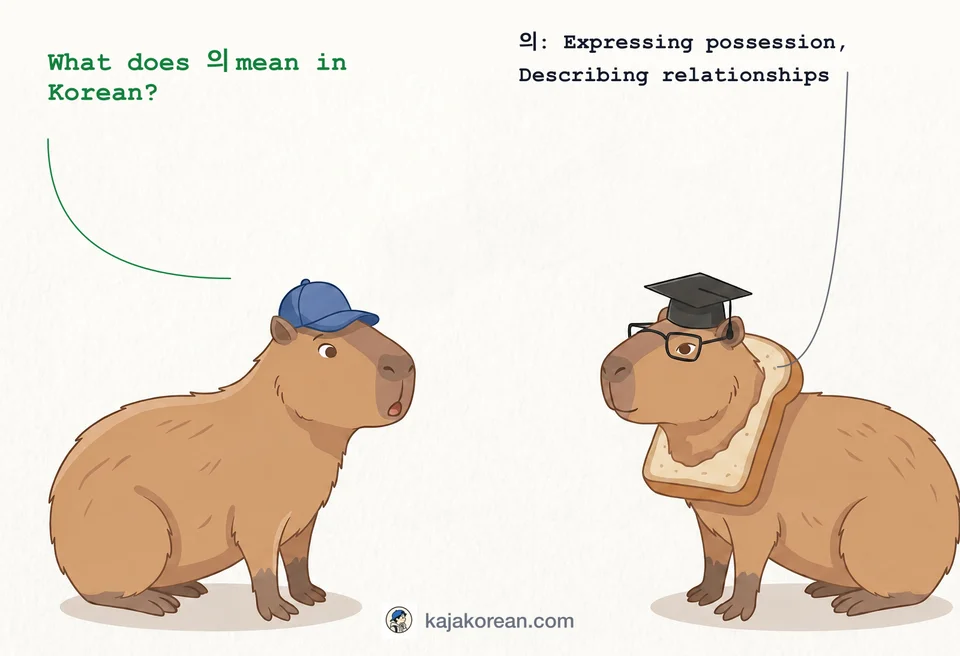
How to use 의 in Korean

의 (ui)

의 (ui) is a particle indicating possession, relation, or material, commonly used in Korean.

Korean particle 의 usage examples

Usage guide

When and how native speakers actually use it.

(ui)

의 mainly indicates possession, relation, or material as a particle.

When to use

Expressing possession, Describing relationships, Indicating material or origin

The nuance

의 connects nouns to indicate possession or relation, e.g., '철수의 책' means 'Chulsoo's book'. It also indicates material or origin. The noun before 의 is usually a person, object, or place, followed by another noun. 의 is always written as '의' regardless of the preceding consonant, and pronounced as 'ui' formally, but often sounds like 'e' or 'i' in casual speech.

Real-world examples

  • 철수의 가방이 어디에 있나요?

    cheol-su-ui ga-bang-i eo-di-e iss-na-yo?, cheol su ui ga bang i eo di e iss na yo?

    의 indicates possession, so '철수의 가방' is correct.

  • 서울의 날씨가 좋네요.

    seo-ul-ui nal-ssi-ga joh-ne-yo., seo ul ui nal ssi ga joh ne yo.

    의 is used to connect nouns related to places.

  • 이 책은 나의 책이다.

    i chaek-eun na-ui chaek-i-da., i chaek eun na ui chaek i da.

    의 indicates possession between 나 and 책, correct usage.

  • 철수 에 책이 있다.

    cheol-su e chaek-i iss-da., cheol su e chaek i iss da.

    에 indicates location, not possession, so this is incorrect.

  • 나무의 잎이 떨어졌다.

    na-mu-ui ip-i tteol-eo-jyeoss-da., na mu ui ip i tteol eo jyeoss da.

    의 also indicates parts or material, so this is correct.

  • 친구 의 집에 갔어요.

    chin-gu ui jip-e gass-eo-yo., chin gu ui jip e gass eo yo.

    의 expresses possession between 친구 and 집.

  • 이것은 플라스틱 의 병이다.

    i-geos-eun peul-ra-seu-tik ui byeong-i-da., i geos eun peul ra seu tik ui byeong i da.

    의 indicates material here, so correct.

  • 나는 의사 책을 읽었다.

    na-neun ui-sa chaek-eul ik-eoss-da., na neun ui sa chaek eul ik eoss da.

    Possessive 의 is missing; correct form is '의사 의 책'.

Quick quiz

  1. Which sentence correctly uses 의?

    다음 중 의를 올바르게 사용한 문장은?(da-eumjungui-reulol-ba-reu-gesa-yong-hanmun-jang-eun?, daeumjunguireulolbareugesayonghanmunjangeun?)
  2. What does 의 mainly indicate?

    의는 주로 어떤 의미로 쓰이나요?(ui-neunju-roeo-tteonui-mi-rosseu-i-na-yo?, uineunjuroeotteonuimirosseuinayo?)
  3. What role does 의 play in '나무의 잎'?

    '나무의 잎'에서 의는 어떤 역할을 하나요?('na-mu-uiip'e-seoui-neuneo-tteonyeok-hal-eulha-na-yo?, 'namuuiip'eseouineuneotteonyeokhaleulhanayo?)

More usage guides

View all usage guides →