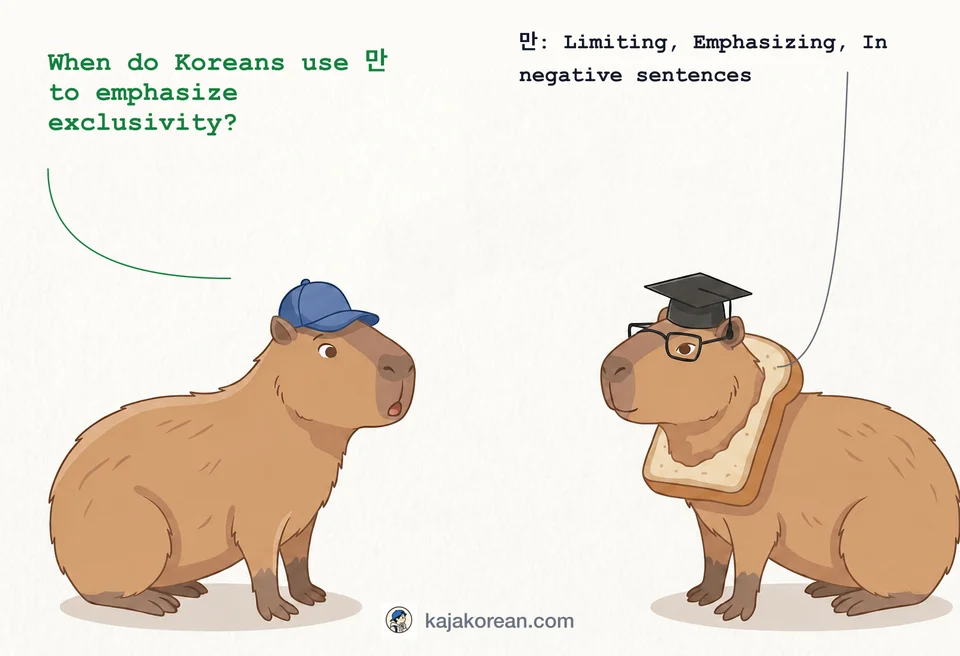
How to use 만 in Korean

만 (man)

만 (man) is a Korean particle meaning 'only' or 'just', used to limit or emphasize.

Korean particle 만 usage illustration

Usage guide

When and how native speakers actually use it.

(man)

'Only' or 'just', used to limit or specify a subject or range.

When to use

Limiting, Emphasizing, In negative sentences

The nuance

만 attaches to nouns to limit or emphasize that noun exclusively. For example, 나만 (only me), 이거만 (only this). It is often used in negative or comparative contexts to stress exclusivity, unlike '~뿐만 아니라' which means 'not only'.

Real-world examples

  • 나만 갔어요.

    na-man gass-eo-yo., na man gass eo yo.

    '나만' limits the subject to 'I' only, conveying exclusivity clearly.

  • 나도 갔어요.

    na-do gass-eo-yo., na do gass eo yo.

    '나도' means 'I also', which differs from 만's exclusivity.

  • 이것만 주세요.

    i-geos-man ju-se-yo., i geos man ju se yo.

    '이것만' limits the request to 'only this' clearly.

  • 나는 만 갔어요.

    na-neun man gass-eo-yo., na neun man gass eo yo.

    '만' must attach directly to a noun, so '나는 만' is incorrect.

  • 친구들만 왔어요.

    chin-gu-deul-man wass-eo-yo., chin gu deul man wass eo yo.

    '친구들만' correctly limits the subject to 'friends only'.

  • 저만 먹었어요.

    jeo-man meok-eoss-eo-yo., jeo man meok eoss eo yo.

    '저만' is a polite form of '나만', used correctly.

Quick quiz

  1. What role does '만' play?

    '만'은 어떤 역할을 하나요?('man'euneo-tteonyeok-hal-eulha-na-yo?, 'man'euneotteonyeokhaleulhanayo?)
  2. Difference between '나도' and '나만'?

    '나도'와 '나만'의 차이는?('na-do'wa'na-man'uicha-i-neun?, 'nado'wa'naman'uichaineun?)
  3. Which sentence uses '만' correctly?

    '만'이 올바르게 쓰인 문장은?('man'iol-ba-reu-gesseu-inmun-jang-eun?, 'man'iolbareugesseuinmunjangeun?)

More usage guides

View all usage guides →