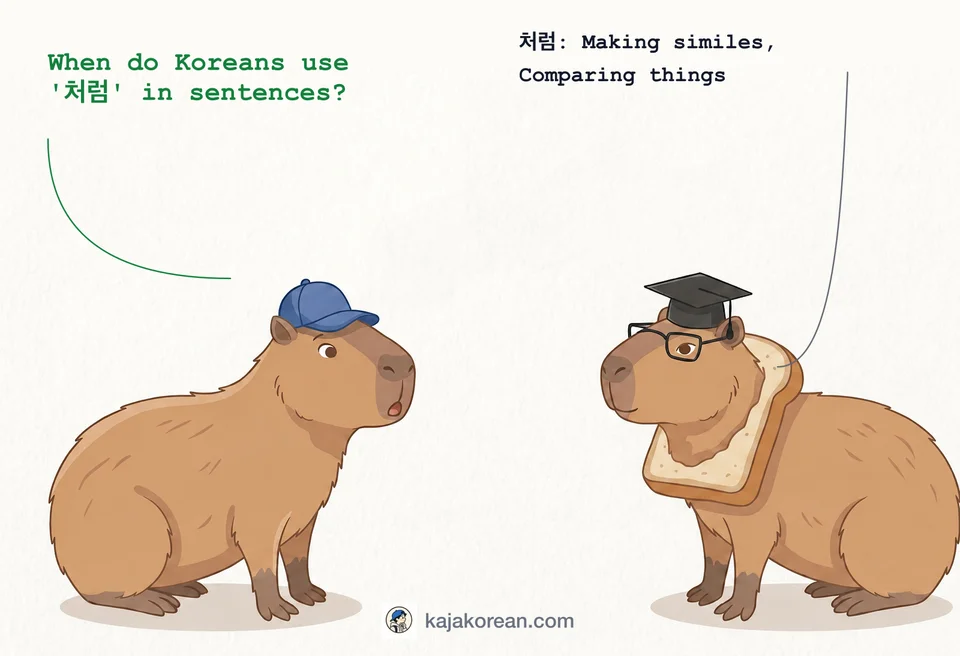
How to use 처럼 in Korean

처럼 (cheo-reom, cheoreom)

처럼 (cheoreom) means 'like' or 'as if' and is used to compare or describe similarity between things.

Korean word '처럼' usage guide

Usage guide

When and how native speakers actually use it.

처럼(cheo-reom, cheoreom)

‘처럼’ means 'like' or 'as if', used to compare or describe similarity.

When to use

Making similes, Comparing things, Describing states

The nuance

1. Attach ‘처럼’ after a noun to mean ‘like’ or ‘similar to’. Example: 고양이처럼 (like a cat), 친구처럼 (like a friend). 2. Do not attach ‘처럼’ directly after verbs or adjectives; use ‘듯이’ instead for those cases. 3. Mainly used for similes or comparisons.

Real-world examples

  • 그는 사자처럼 용감하다.

    geu-neun sa-ja-cheo-reom yong-gam-ha-da., geu neun sa ja cheo reom yong gam ha da.

    ‘처럼’ correctly follows the noun ‘lion’ to form a simile.

  • 아이처럼 웃는다.

    a-i-cheo-reom us-neun-da., a i cheo reom us neun da.

    ‘처럼’ properly follows the noun ‘child’ for comparison.

  • 그녀는 춤추는처럼 보인다.

    geu-nyeo-neun chum-chu-neun-cheo-reom bo-in-da., geu nyeo neun chum chu neun cheo reom bo in da.

    ‘처럼’ cannot follow a verb directly; ‘듯이’ is correct here.

  • 바람처럼 빠르게 달렸다.

    ba-ram-cheo-reom ppa-reu-ge dal-ryeoss-da., ba ram cheo reom ppa reu ge dal ryeoss da.

    ‘처럼’ correctly follows the noun ‘wind’ for simile.

  • 친구처럼 도와줘서 고마워.

    chin-gu-cheo-reom do-wa-jwo-seo go-ma-wo., chin gu cheo reom do wa jwo seo go ma wo.

    ‘처럼’ properly follows noun ‘friend’ for comparison.

  • 그는 빨리 달리는처럼 보인다.

    geu-neun ppal-ri dal-ri-neun-cheo-reom bo-in-da., geu neun ppal ri dal ri neun cheo reom bo in da.

    ‘처럼’ cannot follow verb phrases; use ‘듯이’ instead.

Quick quiz

  1. After which part of speech does ‘처럼’ attach?

    ‘처럼’은 어떤 품사 뒤에 붙나요?(‘cheo-reom’euneo-tteonpum-sadwi-ebut-na-yo?, ‘cheoreom’euneotteonpumsadwiebutnayo?)
  2. Which expression should be used after verbs instead of ‘처럼’?

    ‘처럼’ 대신 동사 뒤에 붙어야 하는 표현은?(‘cheo-reom’dae-sindong-sadwi-ebut-eo-yaha-neunpyo-hyeon-eun?, ‘cheoreom’daesindongsadwiebuteoyahaneunpyohyeoneun?)
  3. Which sentence uses ‘처럼’ correctly? 1) 고양이처럼 조용하다. 2) 고양이처럼 조용히 걷다.

    다음 문장에서 ‘처럼’ 사용이 올바른 문장은? 1) 고양이처럼 조용하다. 2) 고양이처럼 조용히 걷다.(da-eummun-jang-e-seo‘cheo-reom’sa-yong-iol-ba-reunmun-jang-eun?1)go-yang-i-cheo-reomjo-yong-ha-da.2)go-yang-i-cheo-reomjo-yong-higeot-da., daeummunjangeseo‘cheoreom’sayongiolbareunmunjangeun?1)goyangicheoreomjoyonghada.2)goyangicheoreomjoyonghigeotda.)

More usage guides

View all usage guides →