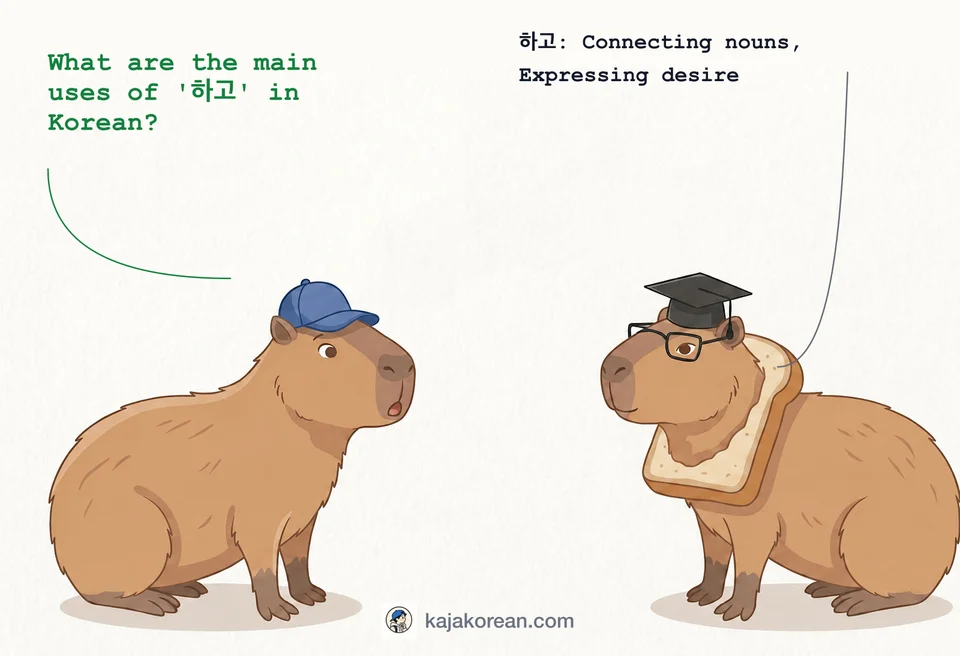
How to use 하고 in Korean

하고 (ha-go, hago)

'하고' in Korean serves multiple purposes, mainly as a connector and particle, essential for natural speech and writing.

Korean word 하고 usage examples

Usage guide

When and how native speakers actually use it.

하고(ha-go, hago)

'하고' means 'and' or functions like '~와/과', connecting nouns or indicating conversation.

When to use

Connecting nouns, Expressing conversation, Expressing desire, Informal exclamation/command

The nuance

1. Connects nouns: '사과하고 바나나' (apple and banana) 2. Indicates conversation or action: '친구하고 이야기했어' (talked with a friend) 3. Attached to verb stems to express desire: '~하고 싶다' (want to do) 4. Used at sentence end for exclamation or command (informal).

Real-world examples

  • 나는 사과하고 바나나를 샀어.

    na-neun sa-gwa-ha-go ba-na-na-reul sass-eo., na neun sa gwa ha go ba na na reul sass eo.

    '하고' correctly connects two nouns here.

  • 친구하고 영화를 봤어.

    chin-gu-ha-go yeong-hwa-reul bwass-eo., chin gu ha go yeong hwa reul bwass eo.

    '친구하고' naturally indicates the person involved in the action.

  • 나는 공부하고 싶어.

    na-neun gong-bu-ha-go sip-eo., na neun gong bu ha go sip eo.

    '하고 싶다' correctly expresses desire.

  • 밥 먹고 가자.

    bap meok-go ga-ja., bap meok go ga ja.

    This sentence uses '고' (not '하고') after verb stem to show sequence.

  • 나는 사과하고 그리고 바나나를 샀어.

    na-neun sa-gwa-ha-go geu-ri-go ba-na-na-reul sass-eo., na neun sa gwa ha go geu ri go ba na na reul sass eo.

    Using '하고' and '그리고' together is redundant and unnatural.

  • 친구하고 밥 먹었어.

    chin-gu-ha-go bap meok-eoss-eo., chin gu ha go bap meok eoss eo.

    '하고' correctly marks the companion in the action.

  • 나는 책하고 읽었어.

    na-neun chaek-ha-go ik-eoss-eo., na neun chaek ha go ik eoss eo.

    '하고' cannot connect a noun and a verb directly.

  • 이거 하고 저거 주세요.

    i-geo ha-go jeo-geo ju-se-yo., i geo ha go jeo geo ju se yo.

    Connecting two nouns naturally in a request.

Quick quiz

  1. What is the main role of '하고'?

    '하고'는 주로 어떤 역할을 하나요?('ha-go'neunju-roeo-tteonyeok-hal-eulha-na-yo?, 'hago'neunjuroeotteonyeokhaleulhanayo?)
  2. In '친구하고 이야기했어', what does '하고' mean?

    '친구하고 이야기했어' 문장에서 '하고'의 의미는?('chin-gu-ha-goi-ya-gi-haess-eo'mun-jang-e-seo'ha-go'uiui-mi-neun?, 'chinguhagoiyagihaesseo'munjangeseo'hago'uiuimineun?)
  3. What does '하고 싶다' express?

    '하고 싶다'는 어떤 의미인가요?('ha-gosip-da'neuneo-tteonui-mi-in-ga-yo?, 'hagosipda'neuneotteonuimiingayo?)

More usage guides

View all usage guides →