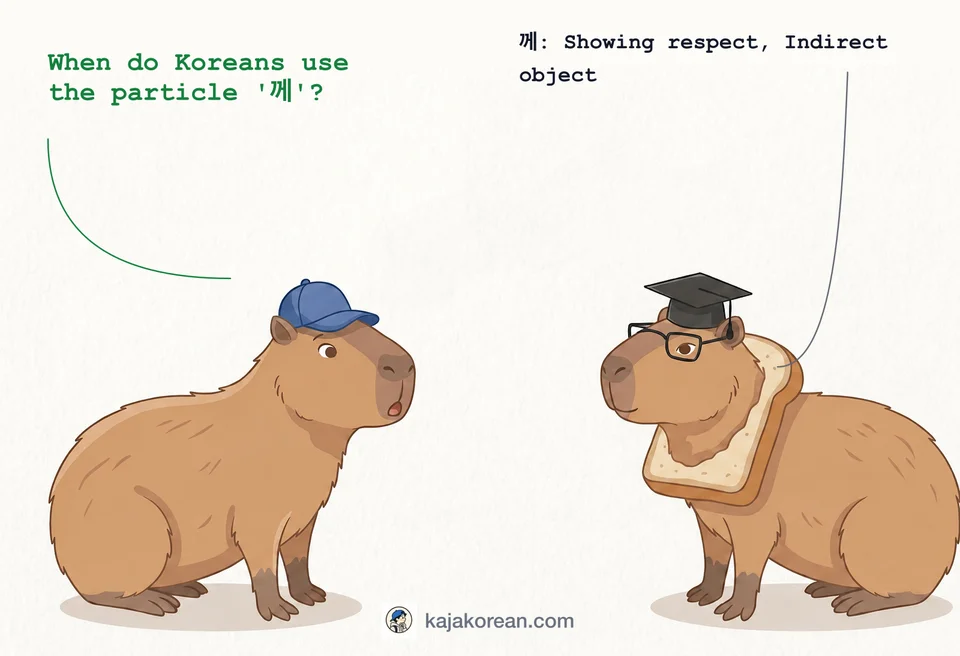
How to use 께 in Korean

께 (kke)

께 is an honorific particle used mainly to show respect towards people in Korean.

Korean honorific particle 께 usage illustration

Usage guide

When and how native speakers actually use it.

(kke)

An honorific particle indicating respect towards the subject or object in polite speech.

When to use

Honorific speech, Showing respect, Indirect object, Subject honorification

The nuance

께 replaces '에게' and is used in honorific speech to show respect towards people. It attaches to the subject or indirect object and is mostly used with verbs. Example: 할아버지께 편지를 썼다 (I wrote a letter to grandfather).

Real-world examples

  • 할아버지께 편지를 썼어요.

    hal-a-beo-ji-kke pyeon-ji-reul sseoss-eo-yo., hal a beo ji kke pyeon ji reul sseoss eo yo.

    ‘께’ replaces ‘에게’ in honorific speech to show respect.

  • 선생님께 질문을 드렸습니다.

    seon-saeng-nim-kke jil-mun-eul deu-ryeoss-seup-ni-da., seon saeng nim kke jil mun eul deu ryeoss seup ni da.

    ‘께’ attaches to the indirect object in honorific speech to show respect.

  • 친구께 선물을 줬어요.

    chin-gu-kke seon-mul-eul jwoss-eo-yo., chin gu kke seon mul eul jwoss eo yo.

    ‘께’ is not used for people you don’t use honorifics with, like friends.

  • 아버지께서 지금 집에 계십니다.

    a-beo-ji-kke-seo ji-geum jip-e gye-sip-ni-da., a beo ji kke seo ji geum jip e gye sip ni da.

    ‘께서’ is ‘께’ plus subject particle ‘서’, used to honor the subject.

  • 할머니에게서 편지를 받았어요.

    hal-meo-ni-e-ge-seo pyeon-ji-reul bat-ass-eo-yo., hal meo ni e ge seo pyeon ji reul bat ass eo yo.

    ‘께’ does not replace ‘에게서’; ‘께서’ is only for subjects.

  • 사장님께 보고서를 제출했습니다.

    sa-jang-nim-kke bo-go-seo-reul je-chul-haess-seup-ni-da., sa jang nim kke bo go seo reul je chul haess seup ni da.

    ‘께’ is used to show respect to superiors in honorific speech.

Quick quiz

  1. In which situation is ‘께’ mainly used?

    ‘께’는 어떤 상황에서 주로 사용되나요?(‘kke’neuneo-tteonsang-hwang-e-seoju-rosa-yong-doe-na-yo?, ‘kke’neuneotteonsanghwangeseojurosayongdoenayo?)
  2. Which sentence is correct?

    다음 중 올바른 문장은?(da-eumjungol-ba-reunmun-jang-eun?, daeumjungolbareunmunjangeun?)
  3. What particle does ‘께’ replace?

    ‘께’는 무엇을 대신하는 조사인가요?(‘kke’neunmu-eos-euldae-sin-ha-neunjo-sa-in-ga-yo?, ‘kke’neunmueoseuldaesinhaneunjosaingayo?)

More usage guides

View all usage guides →