How to use 마다 in Korean

마다 (ma-da, mada)

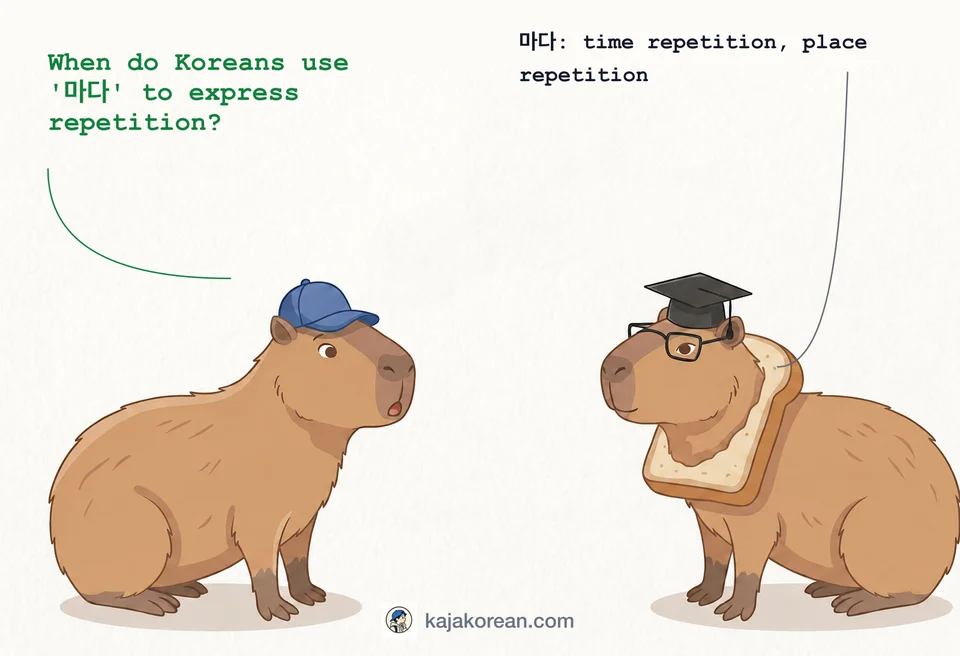
마다 is a particle used to indicate repetition in time, place, or objects.

Korean particle 마다 usage guide

Usage guide

When and how native speakers actually use it.

마다(ma-da, mada)

‘마다’ means ‘each’ or ‘every’, used to indicate repeated units or ranges in the form ‘~마다’.

When to use

time repetition, place repetition, subject repetition

The nuance

Used as ‘noun + 마다’, it indicates repeated units such as time (dates, hours), places, or subjects. Example: ‘매일마다’ (every day), ‘사람마다’ (each person).

Real-world examples

  • 매일마다 운동을 해요.

    mae-il-ma-da un-dong-eul hae-yo., mae il ma da un dong eul hae yo.

    Attaching ‘마다’ after ‘매일’ correctly indicates repeated time, so it is correct.

  • 사람마다 의견이 달라요.

    sa-ram-ma-da ui-gyeon-i dal-ra-yo., sa ram ma da ui gyeon i dal ra yo.

    Attaching ‘마다’ after ‘사람’ correctly indicates each subject, so it is correct.

  • 학교마다 교실이 많아요.

    hak-gyo-ma-da gyo-sil-i man-a-yo., hak gyo ma da gyo sil i man a yo.

    Attaching ‘마다’ after ‘학교’ correctly indicates repeated places, so it is appropriate.

  • 매시간마다 쉬어요.

    mae-si-gan-ma-da swi-eo-yo., mae si gan ma da swi eo yo.

    Attaching ‘마다’ after ‘매시간’ correctly indicates repeated time, so it is correct.

  • 매일 마다 운동해요.

    mae-il ma-da un-dong-hae-yo., mae il ma da un dong hae yo.

    There should be no space between ‘매일’ and ‘마다’. ‘매일마다’ must be written together to be correct.

  • 사람 마다 의견이 달라요.

    sa-ram ma-da ui-gyeon-i dal-ra-yo., sa ram ma da ui gyeon i dal ra yo.

    ‘사람마다’ must be written together; spacing is incorrect.

Quick quiz

  1. What does ‘마다’ mean?

    ‘마다’는 어떤 의미인가요?(‘ma-da’neuneo-tteonui-mi-in-ga-yo?, ‘mada’neuneotteonuimiingayo?)
  2. Which sentence is correct?

    다음 중 올바른 문장은?(da-eumjungol-ba-reunmun-jang-eun?, daeumjungolbareunmunjangeun?)
  3. When can you NOT use ‘마다’?

    ‘마다’를 사용할 수 없는 경우는?(‘ma-da’reulsa-yong-halsueop-neungyeong-u-neun?, ‘mada’reulsayonghalsueopneungyeonguneun?)

More usage guides

View all usage guides →