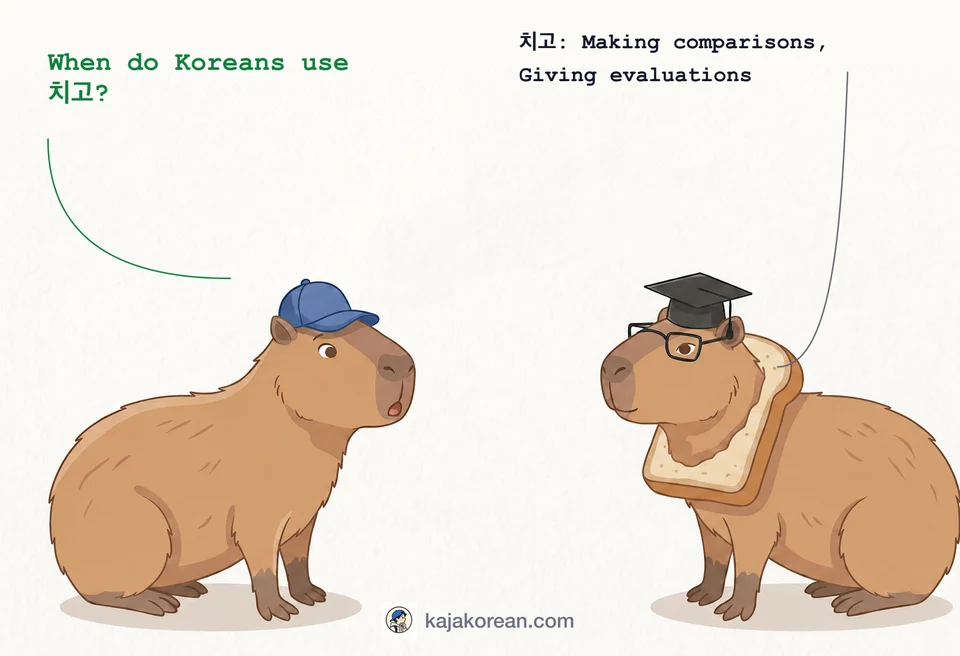
How to use 치고 in Korean

치고 (chi-go, chigo)

치고 (chigo) is often used to express comparison or exceptions. Learn its natural usage in everyday Korean.

Korean word 치고 usage guide

Usage guide

When and how native speakers actually use it.

치고(chi-go, chigo)

Expression indicating comparison or exception

When to use

Making comparisons, Pointing out exceptions, Giving evaluations

The nuance

치고 is mainly used in the pattern '누구/무엇 치고 ~하지 않다/않는 편이다' to indicate that a particular subject does not conform to a general expectation or tendency. It implies 'compared to' or 'for'. For example, '학생 치고 공부를 안 하는 편이다' means 'For a student, he/she tends not to study much.'

Real-world examples

  • 학생 치고 공부를 안 하는 편이다.

    hak-saeng chi-go gong-bu-reul an ha-neun pyeon-i-da., hak saeng chi go gong bu reul an ha neun pyeon i da.

    '치고' correctly implies 'among students' here.

  • 한국 사람 치고 김치를 모르는 사람 없다.

    han-guk sa-ram chi-go gim-chi-reul mo-reu-neun sa-ram eop-da., han guk sa ram chi go gim chi reul mo reu neun sa ram eop da.

    '치고' naturally means 'among Koreans' here.

  • 어른 치고 게임을 좋아하지 않는 사람은 없다.

    eo-reun chi-go ge-im-eul joh-a-ha-ji an-neun sa-ram-eun eop-da., eo reun chi go ge im eul joh a ha ji an neun sa ram eun eop da.

    '치고' correctly indicates 'among adults'.

  • 그 사람 치고 약속을 어긴 적이 없다.

    geu sa-ram chi-go yak-sok-eul eo-gin jeok-i eop-da., geu sa ram chi go yak sok eul eo gin jeok i eop da.

    '치고' here means 'for that person' appropriately.

  • 학생 치고 공부를 잘 하지 않는 편이다.

    hak-saeng chi-go gong-bu-reul jal ha-ji an-neun pyeon-i-da., hak saeng chi go gong bu reul jal ha ji an neun pyeon i da.

    The negative and positive expressions contradict, making it unnatural.

  • 한국 사람 치고 김치를 모르는 사람이 많다.

    han-guk sa-ram chi-go gim-chi-reul mo-reu-neun sa-ram-i man-da., han guk sa ram chi go gim chi reul mo reu neun sa ram i man da.

    '치고' implies exception/comparison, so 'many' is unnatural here.

Quick quiz

  1. What meaning does 치고 mainly express?

    치고는 주로 어떤 의미로 쓰이나요?(chi-go-neunju-roeo-tteonui-mi-rosseu-i-na-yo?, chigoneunjuroeotteonuimirosseuinayo?)
  2. Which sentence is correct?

    다음 문장 중 올바른 예는?(da-eummun-jangjungol-ba-reunye-neun?, daeummunjangjungolbareunyeneun?)
  3. What pattern does 치고 usually appear in?

    치고를 쓸 때 주로 어떤 형태가 많나요?(chi-go-reulsseulttaeju-roeo-tteonhyeong-tae-gaman-na-yo?, chigoreulsseulttaejuroeotteonhyeongtaegamannayo?)

More usage guides

View all usage guides →