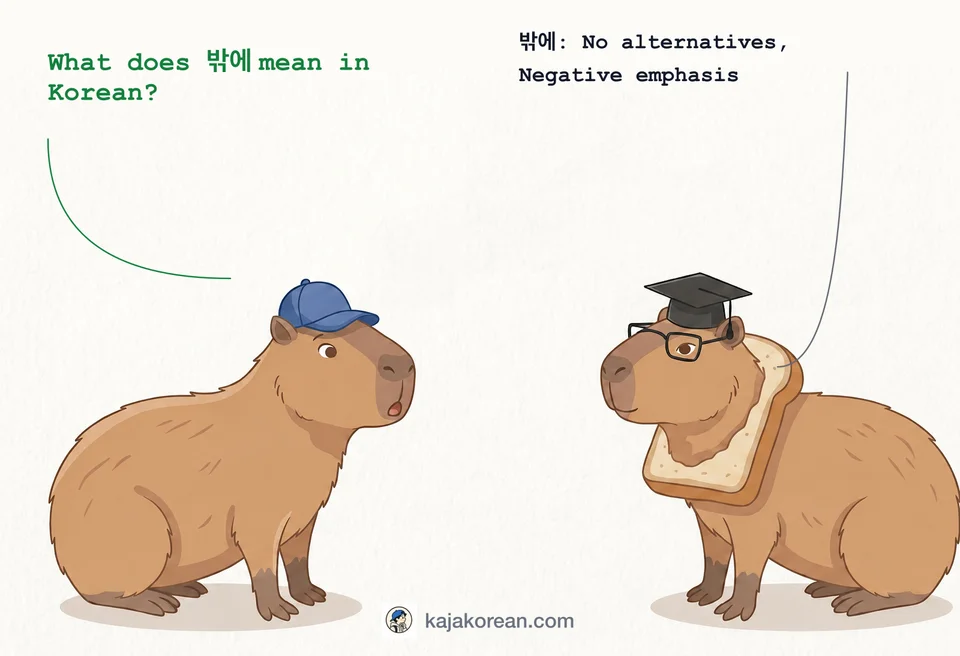
How to use 밖에 in Korean

밖에 (bakk-e, bakke)

밖에 (bakke) is used to express limitation or negative emphasis, mainly in the pattern '~밖에 없다' meaning 'only' or 'nothing but.'

Korean word 밖에 meaning only or nothing but

Usage guide

When and how native speakers actually use it.

밖에(bakk-e, bakke)

밖에: expresses limitation meaning 'only' or 'nothing but'

When to use

Expressing limitation, Negative emphasis, No alternatives

The nuance

밖에 attaches after a noun to mean 'only' or 'nothing but,' emphasizing limitation. It is mainly used in negative sentences or situations expressing restriction, commonly in the form '~밖에 없다/없다' (there is only ~). For example, '나밖에 없다' means 'only I am here.' It is rarely used in positive sentences.

Real-world examples

  • 나는 사과밖에 안 먹었어.

    na-neun sa-gwa-bakk-e an meok-eoss-eo., na neun sa gwa bakk e an meok eoss eo.

    '밖에' after '사과' clearly limits to 'only an apple'.

  • 그 사람밖에 친구가 없어요.

    geu sa-ram-bakk-e chin-gu-ga eop-eo-yo., geu sa ram bakk e chin gu ga eop eo yo.

    In a negative sentence, '밖에' limits 'friend' to only that person.

  • 커피밖에 좋아해요.

    keo-pi-bakk-e joh-a-hae-yo., keo pi bakk e joh a hae yo.

    Using '밖에' in positive sentences is unnatural.

  • 책밖에 없어요.

    chaek-bakk-e eop-eo-yo., chaek bakk e eop eo yo.

    '밖에' limits 'book' to only one present.

  • 저밖에 몰라요.

    jeo-bakk-e mol-ra-yo., jeo bakk e mol ra yo.

    '밖에' limits 'I' to only one who knows.

  • 음식밖에 많이 있어요.

    eum-sik-bakk-e man-i iss-eo-yo., eum sik bakk e man i iss eo yo.

    '밖에' cannot be used with '많이' as it contradicts limitation.

Quick quiz

  1. In what kind of sentences is '밖에' mainly used?

    '밖에'는 주로 어떤 문장에서 사용하나요?('bakk-e'neunju-roeo-tteonmun-jang-e-seosa-yong-ha-na-yo?, 'bakke'neunjuroeotteonmunjangeseosayonghanayo?)
  2. Which sentence is correct?

    다음 문장 중 올바른 문장은?(da-eummun-jangjungol-ba-reunmun-jang-eun?, daeummunjangjungolbareunmunjangeun?)
  3. What is the best meaning of '밖에'?

    '밖에'의 의미로 가장 알맞은 것은?('bakk-e'uiui-mi-roga-jangal-maj-eungeos-eun?, 'bakke'uiuimirogajangalmajeungeoseun?)

More usage guides

View all usage guides →