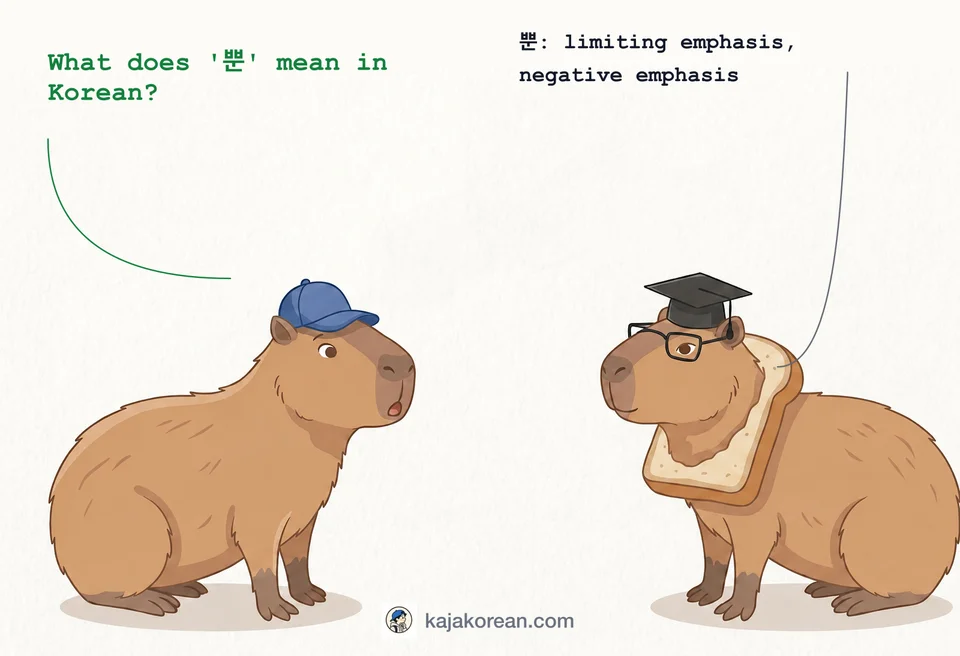
How to use 뿐 in Korean

뿐 (ppun)

뿐 (ppun) emphasizes that an action or state is 'only that and nothing else.'

Korean word 뿐 usage guide

Usage guide

When and how native speakers actually use it.

(ppun)

An adverb or particle used to emphasize exclusivity or limitation to one thing

When to use

limiting emphasis, negative emphasis, simple explanation

The nuance

1. '뿐' attaches to nouns to mean 'only' or 'just'. 2. Used as '뿐이다' to emphasize 'it's only ~'. 3. Often appears with negatives to mean 'just not ~'. 4. Usually placed at sentence end for emphasis.

Real-world examples

  • 그는 학생일 뿐이에요.

    geu-neun hak-saeng-il ppun-i-e-yo., geu neun hak saeng il ppun i e yo.

    '뿐' correctly attaches to noun 'student' to mean 'only a student'.

  • 나는 돈뿐 생각해.

    na-neun don-ppun saeng-gak-hae., na neun don ppun saeng gak hae.

    '뿐' properly follows noun 'money' to express limitation.

  • 그녀는 공부뿐 안 해요.

    geu-nyeo-neun gong-bu-ppun an hae-yo., geu nyeo neun gong bu ppun an hae yo.

    Used with negative '안 해요' to emphasize 'only studies'.

  • 이것뿐이 좋아요.

    i-geos-ppun-i joh-a-yo., i geos ppun i joh a yo.

    '뿐이' limits noun 'this' emphasizing exclusivity.

  • 그는 선생님 뿐이에요.

    geu-neun seon-saeng-nim ppun-i-e-yo., geu neun seon saeng nim ppun i e yo.

    '뿐' must be attached without space to the noun.

  • 나는 사과뿐만 먹었어.

    na-neun sa-gwa-ppun-man meok-eoss-eo., na neun sa gwa ppun man meok eoss eo.

    '뿐' combined with '만' strengthens the limitation meaning.

  • 그것뿐이 아니에요.

    geu-geos-ppun-i a-ni-e-yo., geu geos ppun i a ni e yo.

    '뿐이' used with negation to imply 'not only that'.

  • 나는 공부뿐만 해요.

    na-neun gong-bu-ppun-man hae-yo., na neun gong bu ppun man hae yo.

    '뿐만' clearly expresses 'only studying'.

Quick quiz

  1. Which part of speech does '뿐' usually attach to?

    '뿐'은 주로 어떤 품사 뒤에 붙나요?('ppun'eunju-roeo-tteonpum-sadwi-ebut-na-yo?, 'ppun'eunjuroeotteonpumsadwiebutnayo?)
  2. What does '뿐이다' mean?

    '뿐이다'는 어떤 의미인가요?('ppun-i-da'neuneo-tteonui-mi-in-ga-yo?, 'ppunida'neuneotteonuimiingayo?)
  3. Which sentence is correct?

    다음 문장 중 올바른 문장은?(da-eummun-jangjungol-ba-reunmun-jang-eun?, daeummunjangjungolbareunmunjangeun?)
  4. Which expression does NOT correctly use '뿐'?

    '뿐'과 함께 쓰이지 않는 표현은?('ppun'gwaham-kkesseu-i-jian-neunpyo-hyeon-eun?, 'ppun'gwahamkkesseuijianneunpyohyeoneun?)

More usage guides

View all usage guides →