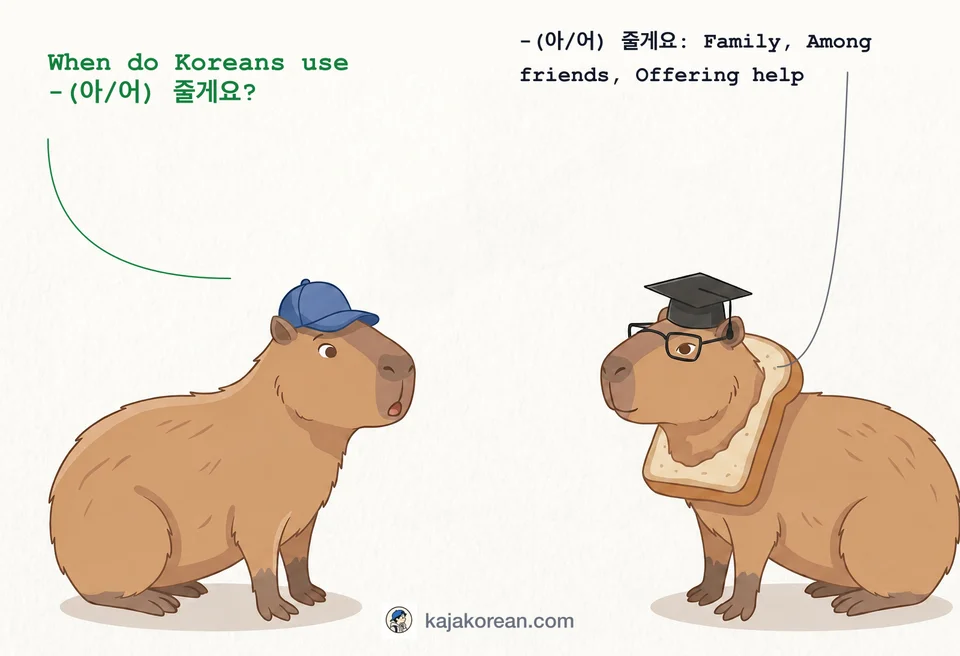
How to use 아/어 줄게요 in Korean

Pattern: -(아/어) 줄게요

-(아/어) 줄게요 (-(a, (a, eo)jul-ge-yo, eo)julgeyo)

-(아/어) 줄게요 expresses your willingness to do something for someone else.

Korean phrase -(아/어) 줄게요 usage guide

Usage guide

When and how native speakers actually use it.

-(아/어) 줄게요(-(a, (a, eo)jul-ge-yo, eo)julgeyo)

Expressing intention to do something for someone else

When to use

Among friends, Family, Everyday conversation, Offering help

The nuance

Attach '-아/어' to the verb stem, then add '줄게요' to express your intention to do something for the listener. Used mainly in informal or semi-formal contexts. E.g., '도와주다' → '도와줄게요'

Real-world examples

  • 내가 숙제 도와줄게요.

    nae-ga suk-je do-wa-jul-ge-yo., nae ga suk je do wa jul ge yo.

    The verb '도와주다' plus '-줄게요' expresses intention to help the listener.

  • 저녁 준비해 줄게요.

    jeo-nyeok jun-bi-hae jul-ge-yo., jeo nyeok jun bi hae jul ge yo.

    Verb stem '준비해' plus '-줄게요' shows willingness to help.

  • 너에게 책을 빌려줄게요.

    neo-e-ge chaek-eul bil-ryeo-jul-ge-yo., neo e ge chaek eul bil ryeo jul ge yo.

    Adding '-줄게요' to '빌려주다' expresses intention to lend.

  • 내가 그 일을 할게요.

    nae-ga geu il-eul hal-ge-yo., nae ga geu il eul hal ge yo.

    Sentence lacks '줄게요'; uses '-게요' which is a different intention form.

  • 문을 닫아 줄게요.

    mun-eul dat-a jul-ge-yo., mun eul dat a jul ge yo.

    Verb stem '닫아' plus '-줄게요' expresses intention to help.

  • 내가 너에게 말할게요.

    nae-ga neo-e-ge mal-hal-ge-yo., nae ga neo e ge mal hal ge yo.

    Uses '-게요' not '-줄게요'; does not express intention to do something for listener.

Quick quiz

  1. In what situation is -(아/어) 줄게요 mainly used?

    -(아/어) 줄게요는 어떤 상황에서 주로 쓰이나요?(-(a, (a, eo)jul-ge-yo-neuneo-tteonsang-hwang-e-seoju-rosseu-i-na-yo?, eo)julgeyoneuneotteonsanghwangeseojurosseuinayo?)
  2. Which sentence is correct?

    다음 중 올바른 문장은?(da-eumjungol-ba-reunmun-jang-eun?, daeumjungolbareunmunjangeun?)
  3. Which is the correct usage of -(아/어) 줄게요?

    -(아/어) 줄게요를 쓸 때 맞는 표현은?(-(a, (a, eo)jul-ge-yo-reulsseulttaemaj-neunpyo-hyeon-eun?, eo)julgeyoreulsseulttaemajneunpyohyeoneun?)

More usage guides

View all usage guides →