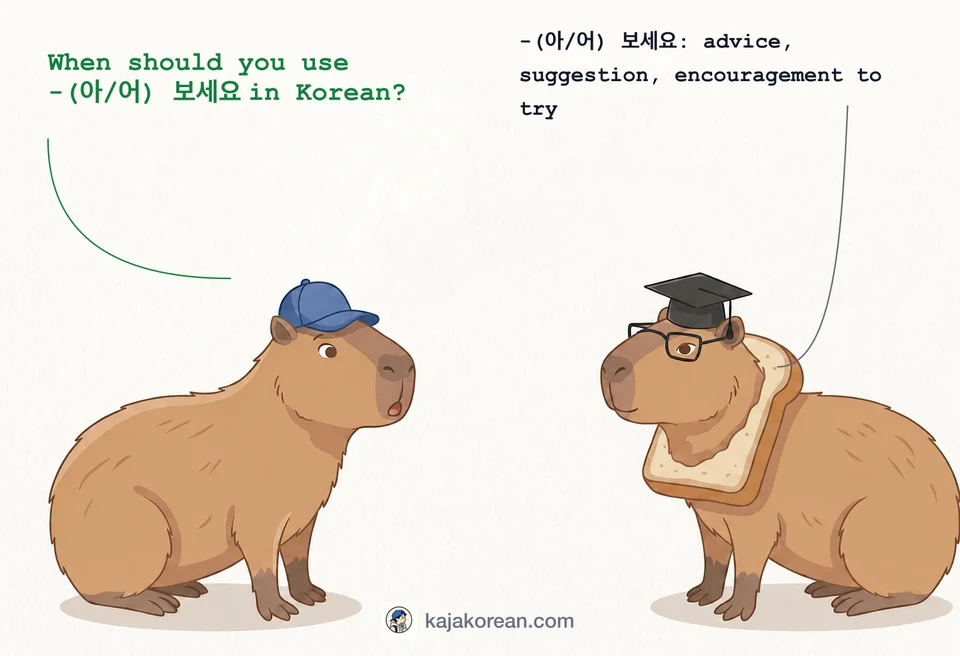
How to use 아/어 보세요 in Korean

Pattern: -(아/어) 보세요

-(아/어) 보세요 (-(a, (a, eo)bo-se-yo, eo)boseyo)

-(아/어) 보세요 is used to suggest or encourage someone to try doing something. It's common in daily conversation.

Korean verb ending -(아/어) 보세요 usage guide

Usage guide

When and how native speakers actually use it.

-(아/어) 보세요(-(a, (a, eo)bo-se-yo, eo)boseyo)

An expression used to suggest or encourage trying an action

When to use

suggestion, advice, encouragement to try

The nuance

Attach '-아 보세요' or '-어 보세요' to the verb stem to suggest someone try the action. Use '-아 보세요' if the last vowel of the stem is '아' or '오'; otherwise, use '-어 보세요'. Exception: 하다 becomes 해 보세요.

Real-world examples

  • 이 음식을 먹어 보세요.

    i eum-sik-eul meok-eo bo-se-yo., i eum sik eul meok eo bo se yo.

    Verb stem '먹-' ends with vowel '어', so '-어 보세요' is correct.

  • 이 책을 읽어 보세요.

    i chaek-eul ik-eo bo-se-yo., i chaek eul ik eo bo se yo.

    Verb stem '읽-' plus '-어 보세요' forms a proper suggestion.

  • 시험 전에 공부해 보세요.

    si-heom jeon-e gong-bu-hae bo-se-yo., si heom jeon e gong bu hae bo se yo.

    Verb '하다' changes to '해 보세요' for natural suggestion.

  • 이 문제를 풀아 보세요.

    i mun-je-reul pul-a bo-se-yo., i mun je reul pul a bo se yo.

    The stem '풀-' requires '-아 보세요', so '풀아' is incorrect.

  • 영화를 봐 보세요.

    yeong-hwa-reul bwa bo-se-yo., yeong hwa reul bwa bo se yo.

    Verb stem '보-' plus '-아 보세요' becomes '봐 보세요' correctly.

  • 운동을 해 보세요.

    un-dong-eul hae bo-se-yo., un dong eul hae bo se yo.

    Verb '하다' changes to '해 보세요' correctly.

Quick quiz

  1. Which sentence correctly uses '-(아/어) 보세요'?

    다음 중 '-(아/어) 보세요'를 올바르게 사용한 문장은?(da-eumjung'-(a, daeumjung'(a, eo)bo-se-yo'reulol-ba-reu-gesa-yong-hanmun-jang-eun?, eo)boseyo'reulolbareugesayonghanmunjangeun?)
  2. What is the correct form of '-(아/어) 보세요' with 하다?

    하다 동사에 '-(아/어) 보세요'를 붙이면?(ha-dadong-sa-e'-(a, hadadongsae'(a, eo)bo-se-yo'reulbut-i-myeon?, eo)boseyo'reulbutimyeon?)
  3. Which verb should take '-아 보세요'?

    '-아 보세요'를 붙여야 하는 동사는?('-abo-se-yo'reulbut-yeo-yaha-neundong-sa-neun?, 'aboseyo'reulbutyeoyahaneundongsaneun?)

More usage guides

View all usage guides →