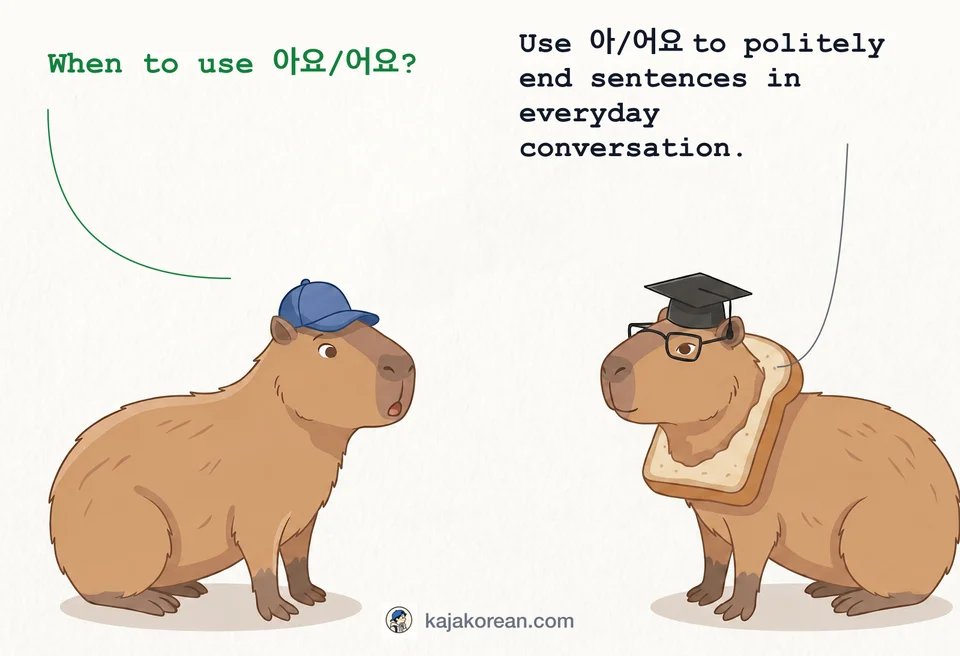
How to use 아요/어요 in Korean

Pattern: -(아/어)요

-(아/어)요 (-(a, (a, eo)yo)

-(아/어)요 is a basic polite sentence ending used frequently in everyday Korean conversations.

Example of polite sentence ending 아/어요 in Korean

Usage guide

When and how native speakers actually use it.

-(아/어)요(-(a, (a, eo)yo)

A polite sentence ending that expresses respect toward the listener.

When to use

Everyday conversation, Friendly polite speech, Casual requests or questions

The nuance

Attach -(아)요 or -(어)요 to the verb/adjective stem depending on the last vowel. If the stem ends with 아 or 오 without a final consonant, use -(아)요; otherwise, use -(어)요. The verb 하다 changes to 해요.

Real-world examples

  • 가다 → 가요

    ga-da → ga-yo, ga da → ga yo

    The stem '가' ends with 아, so attach '-아요'.

  • 먹다 → 먹어요

    meok-da → meok-eo-yo, meok da → meok eo yo

    The stem '먹' does not end with 아 or 오, so attach '-어요'.

  • 하다 → 해요

    ha-da → hae-yo, ha da → hae yo

    The verb 하다 is irregular and changes to '-해요'.

  • 가다 → 가어요

    ga-da → ga-eo-yo, ga da → ga eo yo

    Since '가다' ends with 아 or 오, use '-아요'. '-가어요' is incorrect.

  • 먹다 → 먹아요

    meok-da → meok-a-yo, meok da → meok a yo

    '먹다' does not end with 아 or 오, so use '-어요'. '-먹아요' is incorrect.

Quick quiz

  1. Which is the correct sentence ending?

    다음 중 올바른 문장 종결어미는?(da-eumjungol-ba-reunmun-jangjong-gyeol-eo-mi-neun?, daeumjungolbareunmunjangjonggyeoleomineun?)
  2. What is the correct present form of 하다?

    하다의 올바른 현재형은?(ha-da-uiol-ba-reunhyeon-jae-hyeong-eun?, hadauiolbareunhyeonjaehyeongeun?)
  3. Which polite ending attaches to '먹다'?

    '먹다'에 붙는 존댓말 종결어미는?('meok-da'ebut-neunjon-daes-maljong-gyeol-eo-mi-neun?, 'meokda'ebutneunjondaesmaljonggyeoleomineun?)

More usage guides

View all usage guides →