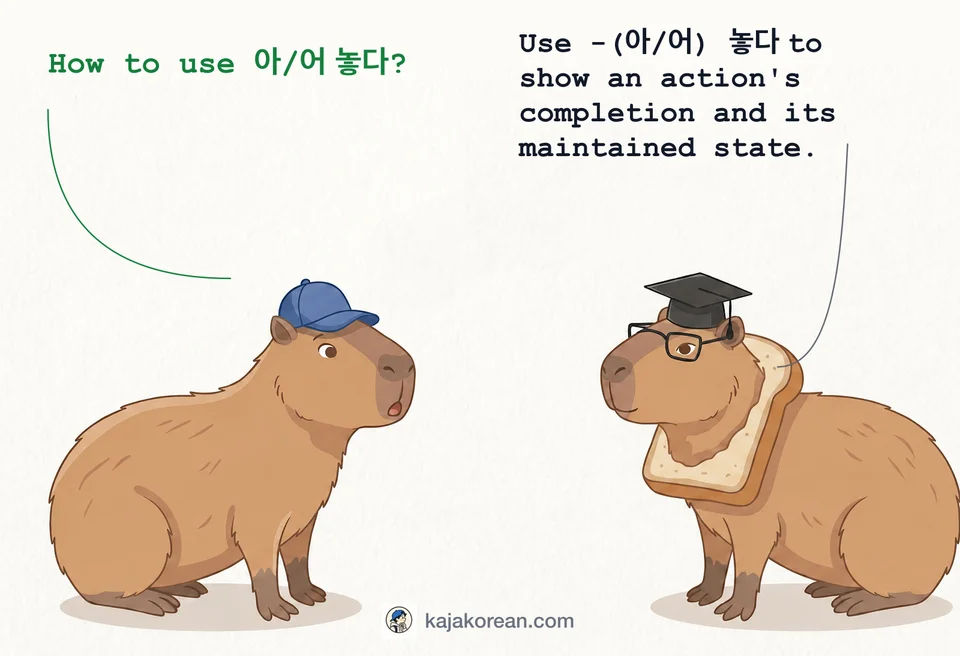
How to use 아/어 놓다 in Korean

Pattern: -(아/어) 놓다

-(아/어) 놓다 (-(a, (a, eo)noh-da, eo)nohda)

-(아/어) 놓다 shows that an action has been completed and its state is maintained. Common in daily and business Korean.

Korean grammar -(아/어) 놓다 usage explanation

Usage guide

When and how native speakers actually use it.

-(아/어) 놓다(-(a, (a, eo)noh-da, eo)nohda)

Indicates an action has been completed and its result/state is kept

When to use

Expressing preparation completion, Emphasizing state maintenance, Describing completed past actions

The nuance

Attach -(아/어) 놓다 to the verb stem to express completion of an action and maintaining that state. Can be used in past or imperative forms. Example: 먹어 놓다, 써 놓다.

Real-world examples

  • 문을 열어 놓았어요.

    mun-eul yeol-eo noh-ass-eo-yo., mun eul yeol eo noh ass eo yo.

    Clearly expresses the action is done and the state is kept.

  • 책을 읽어 놓았어요.

    chaek-eul ik-eo noh-ass-eo-yo., chaek eul ik eo noh ass eo yo.

    Properly conveys completion of reading and maintaining that state.

  • 창문을 닫아 놓으세요.

    chang-mun-eul dat-a noh-eu-se-yo., chang mun eul dat a noh eu se yo.

    Imperative form requests action completion and state maintenance.

  • 밥을 먹어 놓았어요.

    bap-eul meok-eo noh-ass-eo-yo., bap eul meok eo noh ass eo yo.

    Naturally expresses completion of eating and maintaining that state.

  • 옷을 입어 놓았어요.

    os-eul ip-eo noh-ass-eo-yo., os eul ip eo noh ass eo yo.

    Clearly shows completion of putting on clothes and keeping that state.

  • 물을 마셔 놓았어요.

    mul-eul ma-syeo noh-ass-eo-yo., mul eul ma syeo noh ass eo yo.

    Drinking water doesn't naturally imply maintaining a state after completion.

  • 편지를 써 놓았어요.

    pyeon-ji-reul sseo noh-ass-eo-yo., pyeon ji reul sseo noh ass eo yo.

    Properly expresses completion of writing and maintaining that state.

  • 음악을 듣어 놓았어요.

    eum-ak-eul deut-eo noh-ass-eo-yo., eum ak eul deut eo noh ass eo yo.

    Listening doesn't naturally imply maintaining a state after finishing.

Quick quiz

  1. Which sentence uses -(아/어) 놓다 correctly?

    다음 중 -(아/어) 놓다를 올바르게 사용한 문장은?(da-eumjung-(a, daeumjung(a, eo)noh-da-reulol-ba-reu-gesa-yong-hanmun-jang-eun?, eo)nohdareulolbareugesayonghanmunjangeun?)
  2. What is the most appropriate meaning of -(아/어) 놓다?

    -(아/어) 놓다의 의미로 가장 적절한 것은?(-(a, (a, eo)noh-da-uiui-mi-roga-jangjeok-jeol-hangeos-eun?, eo)nohdauiuimirogajangjeokjeolhangeoseun?)
  3. Which of the following sentences is incorrect?

    다음 중 잘못된 예문은?(da-eumjungjal-mos-doenye-mun-eun?, daeumjungjalmosdoenyemuneun?)

More usage guides

View all usage guides →