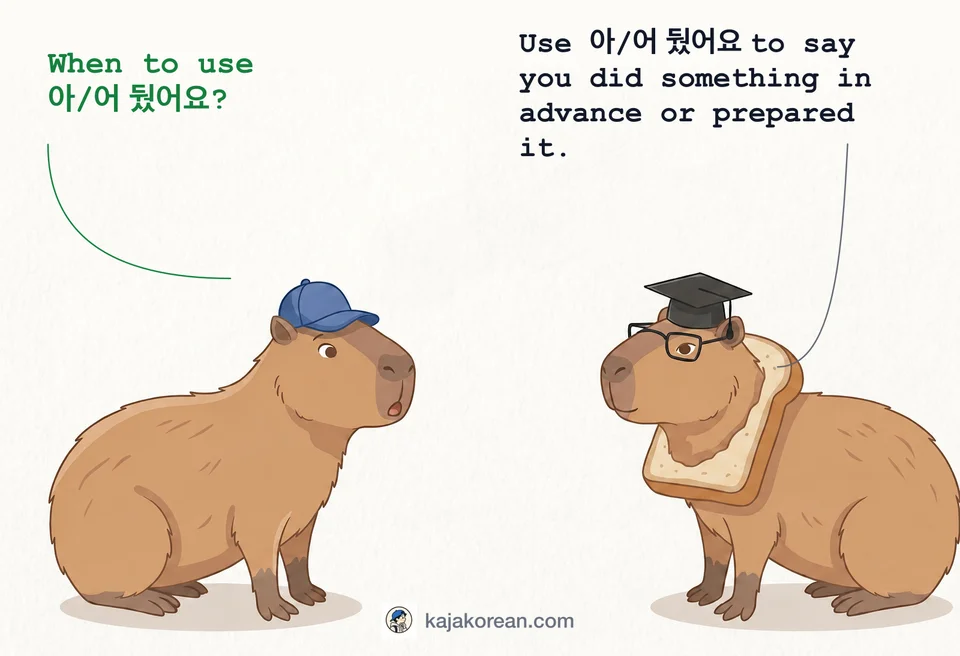
How to use 아/어 뒀어요 in Korean

Pattern: -(아/어) 뒀어요

-(아/어) 뒀어요 (-(a, (a, eo)dwoss-eo-yo, eo)dwosseoyo)

-(아/어) 뒀어요 expresses that an action was done in advance or something was prepared beforehand.

Example of using 아/어 뒀어요 in Korean

Usage guide

When and how native speakers actually use it.

-(아/어) 뒀어요(-(a, (a, eo)dwoss-eo-yo, eo)dwosseoyo)

It means that an action was done or something was prepared in advance.

When to use

preparation in advance, maintaining a state, for later use

The nuance

Attach '-아/어' to the verb stem, then add '뒀어요' to indicate that an action was completed in the past in preparation or in advance. It is mainly used when the action is done to maintain a state or for later use.

Real-world examples

  • 저녁 식사를 미리 만들어 뒀어요.

    jeo-nyeok sik-sa-reul mi-ri man-deul-eo dwoss-eo-yo., jeo nyeok sik sa reul mi ri man deul eo dwoss eo yo.

    The verb stem '만들-' plus '-어' and '뒀어요' expresses that the action was done in advance.

  • 문을 잠가 뒀어요.

    mun-eul jam-ga dwoss-eo-yo., mun eul jam ga dwoss eo yo.

    Using '잠그-' plus '-어' and '뒀어요' shows the door was locked and remains so.

  • 책을 책상 위에 놓아 뒀어요.

    chaek-eul chaek-sang wi-e noh-a dwoss-eo-yo., chaek eul chaek sang wi e noh a dwoss eo yo.

    '놓-' plus '-아' and '뒀어요' indicates the book was put and left there.

  • 내일 회의 자료를 준비해 뒀어요.

    nae-il hoe-ui ja-ryo-reul jun-bi-hae dwoss-eo-yo., nae il hoe ui ja ryo reul jun bi hae dwoss eo yo.

    Verb stem '준비하-' plus '-어' and '뒀어요' shows preparation done in advance.

  • 친구에게 선물을 사 뒀어요.

    chin-gu-e-ge seon-mul-eul sa dwoss-eo-yo., chin gu e ge seon mul eul sa dwoss eo yo.

    '사-' plus '-아' and '뒀어요' indicates the gift was bought beforehand.

  • 책을 읽어 뒀어요.

    chaek-eul ik-eo dwoss-eo-yo., chaek eul ik eo dwoss eo yo.

    Verb stem '읽-' plus '-어' and '뒀어요' means the book was read beforehand.

  • 음식을 먹어 뒀어요.

    eum-sik-eul meok-eo dwoss-eo-yo., eum sik eul meok eo dwoss eo yo.

    Using '-어 뒀어요' with '먹다' is unnatural because eating is not typically an action done in advance for later use or state maintenance.

  • 창문을 열어 뒀어요.

    chang-mun-eul yeol-eo dwoss-eo-yo., chang mun eul yeol eo dwoss eo yo.

    Verb stem '열-' plus '-어' and '뒀어요' indicates the window was opened and left open.

Quick quiz

  1. Which sentence uses '-아/어 뒀어요' correctly?

    다음 중 '-아/어 뒀어요'를 올바르게 사용한 문장은?(da-eumjung'-a, daeumjung'a, eodwoss-eo-yo'reulol-ba-reu-gesa-yong-hanmun-jang-eun?, eodwosseoyo'reulolbareugesayonghanmunjangeun?)
  2. What is the best meaning of '-아/어 뒀어요'?

    '-아/어 뒀어요'의 의미로 가장 적절한 것은?('-a, 'a, eodwoss-eo-yo'uiui-mi-roga-jangjeok-jeol-hangeos-eun?, eodwosseoyo'uiuimirogajangjeokjeolhangeoseun?)
  3. Which sentence is incorrect?

    다음 중 틀린 문장은?(da-eumjungteul-rinmun-jang-eun?, daeumjungteulrinmunjangeun?)

More usage guides

View all usage guides →