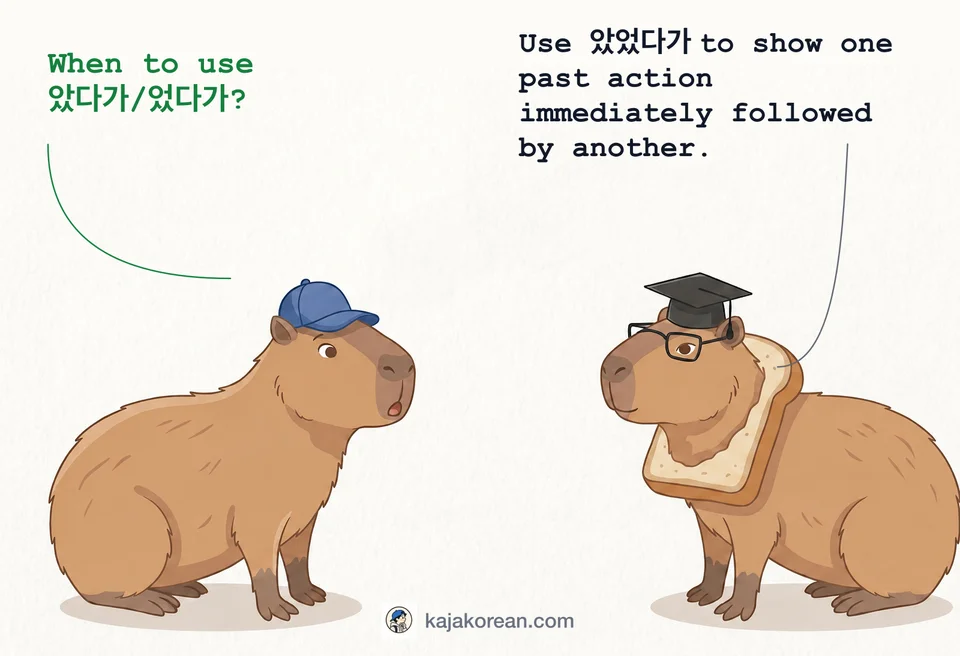
How to use 았다가/었다가 in Korean

Pattern: -(았/었다)가

-(았/었다)가 (-(ass, (ass, eoss-da)ga, eossda)ga)

-(았/었다)가 expresses that an action happened in the past but then quickly changed to another action.

Example of past action followed by another in Korean

Usage guide

When and how native speakers actually use it.

-(았/었다)가(-(ass, (ass, eoss-da)ga, eossda)ga)

Indicates that a past action happened and then immediately changed to another action

When to use

connecting past actions, expressing action change, mid-story transition

The nuance

Attach -(았/었다)가 to the verb stem to indicate that a past action was completed and then immediately changed to another action. It connects two sequential past actions. Examples include 먹었다가 (ate then), 갔다가 (went then), 봤다가 (saw then). It appears in the middle of a sentence, and both actions must be in past tense.

Real-world examples

  • 저는 밥을 먹었다가 바로 운동하러 갔어요.

    jeo-neun bap-eul meok-eoss-da-ga ba-ro un-dong-ha-reo gass-eo-yo., jeo neun bap eul meok eoss da ga ba ro un dong ha reo gass eo yo.

    Two past actions are clearly connected in order, making it natural.

  • 친구를 만났다 가 영화를 봤어요.

    chin-gu-reul man-nass-da ga yeong-hwa-reul bwass-eo-yo., chin gu reul man nass da ga yeong hwa reul bwass eo yo.

    Not using the correct -(았/었다)가 form and spacing is wrong, so it's ungrammatical.

  • 책을 읽었다가 잠이 들었어요.

    chaek-eul ik-eoss-da-ga jam-i deul-eoss-eo-yo., chaek eul ik eoss da ga jam i deul eoss eo yo.

    Two past actions are naturally connected in sequence.

  • 밖에 나갔다가 비가 오기 시작했어요.

    bakk-e na-gass-da-ga bi-ga o-gi si-jak-haess-eo-yo., bakk e na gass da ga bi ga o gi si jak haess eo yo.

    Same subject and actions follow immediately, so it's natural.

  • 노래를 불렀었다가 춤을 췄어요.

    no-rae-reul bul-reoss-eoss-da-ga chum-eul chwoss-eo-yo., no rae reul bul reoss eoss da ga chum eul chwoss eo yo.

    Past perfect and past tense are properly connected.

  • 학교에 갔었다가 집에 갔어요.

    hak-gyo-e gass-eoss-da-ga jip-e gass-eo-yo., hak gyo e gass eoss da ga jip e gass eo yo.

    Two past actions are naturally connected in order.

Quick quiz

  1. When do you use -(았/었다)가?

    -(았/었다)가는 어떤 상황에서 쓰이나요?(-(ass, (ass, eoss-da)ga-neuneo-tteonsang-hwang-e-seosseu-i-na-yo?, eossda)ganeuneotteonsanghwangeseosseuinayo?)
  2. Which sentence is correct?

    다음 문장 중 올바른 문장은?(da-eummun-jangjungol-ba-reunmun-jang-eun?, daeummunjangjungolbareunmunjangeun?)
  3. What does '책을 읽었다가 잠이 들었어요.' mean?

    "책을 읽었다가 잠이 들었어요." 문장의 의미는?("chaek-eulik-eoss-da-gajam-ideul-eoss-eo-yo."mun-jang-uiui-mi-neun?, "chaekeulikeossdagajamideuleosseoyo."munjanguiuimineun?)

More usage guides

View all usage guides →