
왜(wae)
The most common and casual interrogative asking for a reason or cause
When to use
casual conversation, asking friends, simple reason inquiry
The nuance
Used mainly in everyday conversation; concise and direct; suitable for spoken language.
왜 (wae) · 어째서 (eo-jjae-seo, eojjaeseo)
‘왜’ and ‘어째서’ both ask for reasons, but ‘왜’ is more casual and common while ‘어째서’ sounds more formal and literary.
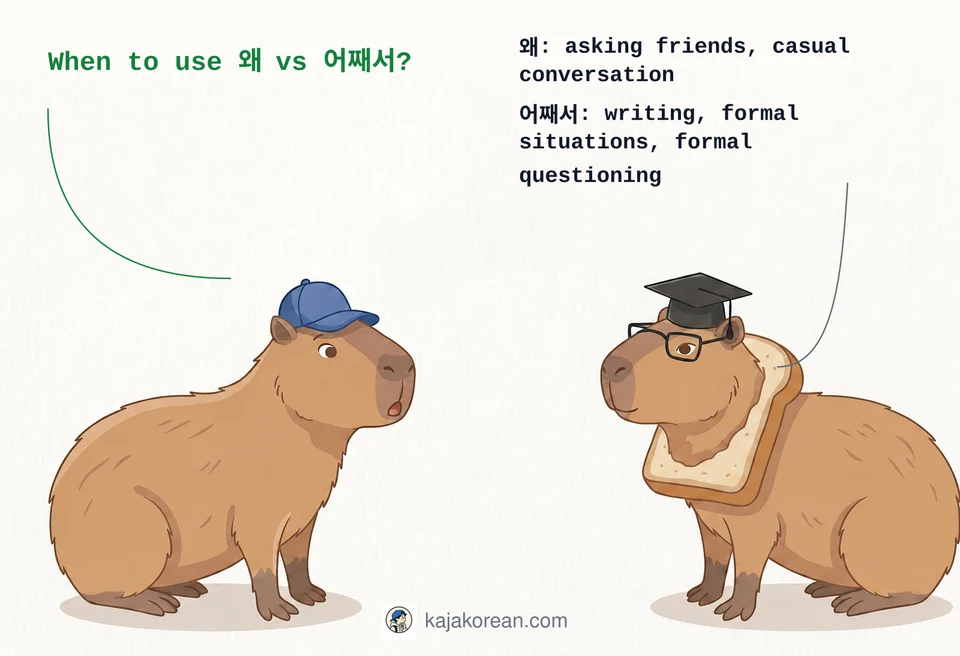
One lane per word — no nested boxes, just the gist.
The most common and casual interrogative asking for a reason or cause
When to use
casual conversation, asking friends, simple reason inquiry
The nuance
Used mainly in everyday conversation; concise and direct; suitable for spoken language.
An interrogative asking for reasons, somewhat more formal and literary than ‘왜’
When to use
writing, formal questioning, formal situations
The nuance
Used mainly in writing or formal situations; sounds more formal and serious.
왜 그렇게 늦었어요? ⭕
wae geu-reoh-ge neuj-eoss-eo-yo? ⭕, wae geu reoh ge neuj eoss eo yo? ⭕
A natural and concise question in casual conversation.
어째서 그렇게 늦었어요? ⭕
eo-jjae-seo geu-reoh-ge neuj-eoss-eo-yo? ⭕, eo jjae seo geu reoh ge neuj eoss eo yo? ⭕
Appropriate expression in formal situations or writing.
왜 그렇게 늦었습니까? ⭕
wae geu-reoh-ge neuj-eoss-seup-ni-kka? ⭕, wae geu reoh ge neuj eoss seup ni kka? ⭕
‘왜’ can be formal when combined with polite speech.
어째서 너 그렇게 늦었어? ❌
eo-jjae-seo neo geu-reoh-ge neuj-eoss-eo? ❌, eo jjae seo neo geu reoh ge neuj eoss eo? ❌
‘어째서’ is formal and sounds odd with informal speech.
왜 너 그렇게 늦었어? ⭕
wae neo geu-reoh-ge neuj-eoss-eo? ⭕, wae neo geu reoh ge neuj eoss eo? ⭕
Natural informal question among friends.
어째서 그가 그렇게 행동했는지 모르겠다. ⭕
eo-jjae-seo geu-ga geu-reoh-ge haeng-dong-haess-neun-ji mo-reu-gess-da. ⭕, eo jjae seo geu ga geu reoh ge haeng dong haess neun ji mo reu gess da. ⭕
Suitable for explaining reasons in writing or formal contexts.
왜 그가 그렇게 행동했는지 모르겠다. ⭕
wae geu-ga geu-reoh-ge haeng-dong-haess-neun-ji mo-reu-gess-da. ⭕, wae geu ga geu reoh ge haeng dong haess neun ji mo reu gess da. ⭕
Frequently used expression in everyday conversation.
왜 어째서 그렇게 했어요? ❌
wae eo-jjae-seo geu-reoh-ge haess-eo-yo? ❌, wae eo jjae seo geu reoh ge haess eo yo? ❌
Using both interrogatives together is redundant and unnatural.
Which expression is natural when casually asking a friend for a reason?
Which expression is suitable for asking reasons in formal writing?
How does ‘어째서’ sound when used with informal speech?
What does it mean?