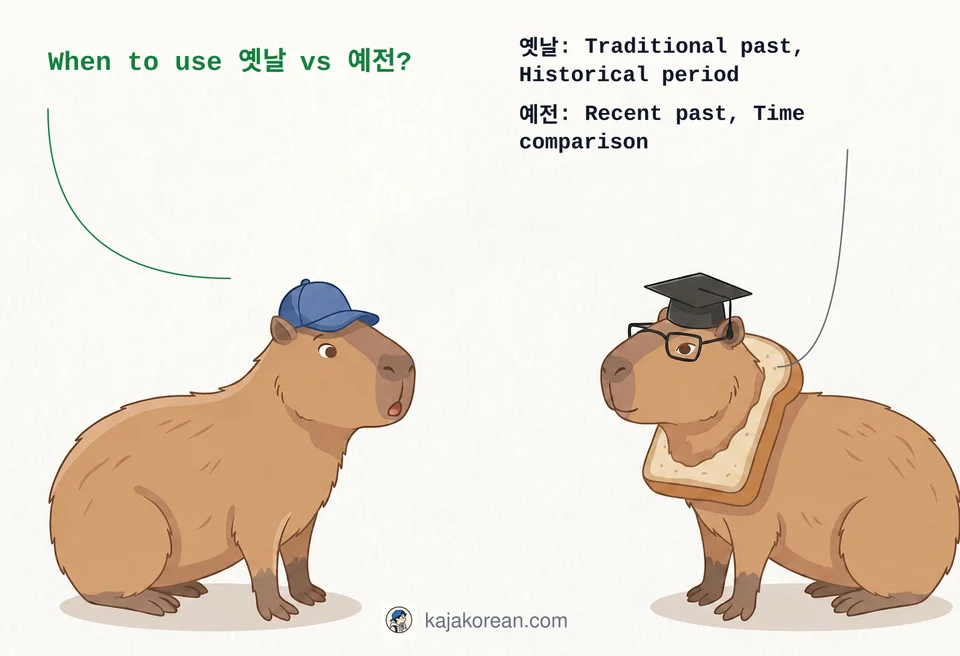
Refers to a long time ago, a distant past
When to use
Traditional past, Historical period, Childhood stories
The nuance
옛날 is mainly used to indicate a long time ago, often traditional or historical past, emphasizing a period far before the present.
옛날 (yes-nal, yesnal) · 예전 (ye-jeon, yejeon)
옛날 typically refers to a distant, traditional past, while 예전 is used for a relatively recent or general past.

One lane per word — no nested boxes, just the gist.
Refers to a long time ago, a distant past
When to use
Traditional past, Historical period, Childhood stories
The nuance
옛날 is mainly used to indicate a long time ago, often traditional or historical past, emphasizing a period far before the present.
Refers to a relatively recent or general past
When to use
Recent past, Time comparison, Describing everyday changes
The nuance
예전 is used to talk about the past compared to a certain time or a relatively recent past, less distant and more everyday than 옛날.
옛날에는 사람들이 말을 타고 다녔다. ⭕
yes-nal-e-neun sa-ram-deul-i mal-eul ta-go da-nyeoss-da. ⭕, yes nal e neun sa ram deul i mal eul ta go da nyeoss da. ⭕
옛날 appropriately indicates a very distant, traditional past.
예전에는 스마트폰이 없었다. ⭕
ye-jeon-e-neun seu-ma-teu-pon-i eop-eoss-da. ⭕, ye jeon e neun seu ma teu pon i eop eoss da. ⭕
예전 naturally refers to a relatively recent past.
옛날에는 어제 뭐 했어? ❌
yes-nal-e-neun eo-je mwo haess-eo? ❌, yes nal e neun eo je mwo haess eo? ❌
옛날 implies a distant past, so it doesn't fit with a near past like 'yesterday'; 예전 should be used.
예전 어린 시절이 그립다. ❌
ye-jeon eo-rin si-jeol-i geu-rip-da. ❌, ye jeon eo rin si jeol i geu rip da. ❌
Childhood is typically expressed with 옛날; 예전 is less appropriate.
예전보다 날씨가 많이 따뜻해졌다. ⭕
ye-jeon-bo-da nal-ssi-ga man-i tta-tteus-hae-jyeoss-da. ⭕, ye jeon bo da nal ssi ga man i tta tteus hae jyeoss da. ⭕
예전 fits well when comparing a recent past with the present.
옛날보다 스마트폰이 더 좋아졌다. ❌
yes-nal-bo-da seu-ma-teu-pon-i deo joh-a-jyeoss-da. ❌, yes nal bo da seu ma teu pon i deo joh a jyeoss da. ❌
Smartphones are recent inventions, so 옛날보다 sounds unnatural; 예전보다 is correct.
옛날 이야기 좀 해줘. ⭕
yes-nal i-ya-gi jom hae-jwo. ⭕, yes nal i ya gi jom hae jwo. ⭕
옛날 is natural when requesting traditional or old stories.
예전 이야기 좀 해줘. ❌
ye-jeon i-ya-gi jom hae-jwo. ❌, ye jeon i ya gi jom hae jwo. ❌
예전 refers to recent or relatively near past, so it's inappropriate for traditional story requests.
Which word indicates a distant, traditional past?
Which word is appropriate for a recent past?
Which word is natural for 'childhood'?
In the sentence '예전보다 날씨가 따뜻해졌다', what happens if you replace ‘예전’ with ‘옛날’?