
고(go)
Used to connect two actions or states sequentially.
When to use
Sequential actions, Common in daily speech, Simple listing
The nuance
Used when the first action finishes before the next begins.
고 (go) · 면서 (myeon-seo, myeonseo)
'고' connects sequential actions, while '면서' emphasizes simultaneous actions.
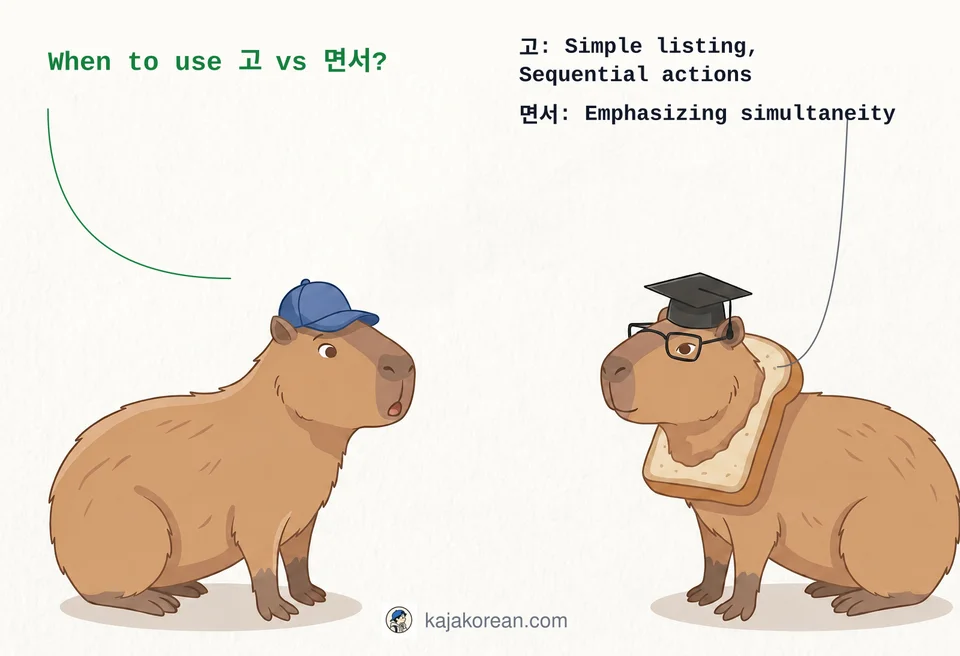
One lane per word — no nested boxes, just the gist.
Used to connect two actions or states sequentially.
When to use
Sequential actions, Common in daily speech, Simple listing
The nuance
Used when the first action finishes before the next begins.
Used when two actions happen simultaneously, emphasizing simultaneity.
When to use
Emphasizing simultaneity, Expressing complex feelings, Describing simultaneous behavior
The nuance
Used when both actions occur at the same time.
나는 밥을 먹고 텔레비전을 봤다.
na-neun bap-eul meok-go tel-re-bi-jeon-eul bwass-da., na neun bap eul meok go tel re bi jeon eul bwass da.
Sequential actions where eating finishes before watching TV starts.
나는 밥을 먹으면서 텔레비전을 봤다.
na-neun bap-eul meok-eu-myeon-seo tel-re-bi-jeon-eul bwass-da., na neun bap eul meok eu myeon seo tel re bi jeon eul bwass da.
Simultaneous actions of eating and watching TV.
나는 밥을 먹고 있으면서 텔레비전을 봤다.
na-neun bap-eul meok-go iss-eu-myeon-seo tel-re-bi-jeon-eul bwass-da., na neun bap eul meok go iss eu myeon seo tel re bi jeon eul bwass da.
'고 있으면서' is redundant; only '면서' should be used here.
그는 노래를 부르고 춤을 췄다.
geu-neun no-rae-reul bu-reu-go chum-eul chwoss-da., geu neun no rae reul bu reu go chum eul chwoss da.
Sequential connection where singing finishes before dancing.
그는 노래를 부르면서 춤을 췄다.
geu-neun no-rae-reul bu-reu-myeon-seo chum-eul chwoss-da., geu neun no rae reul bu reu myeon seo chum eul chwoss da.
Simultaneous actions of singing and dancing.
그는 노래를 부르고 있으면서 춤을 췄다.
geu-neun no-rae-reul bu-reu-go iss-eu-myeon-seo chum-eul chwoss-da., geu neun no rae reul bu reu go iss eu myeon seo chum eul chwoss da.
'고 있으면서' is grammatically awkward; use '면서' alone.
나는 숙제를 하고 친구를 만났다.
na-neun suk-je-reul ha-go chin-gu-reul man-nass-da., na neun suk je reul ha go chin gu reul man nass da.
Sequential actions: finishing homework then meeting friend.
나는 숙제를 하면서 친구를 만났다.
na-neun suk-je-reul ha-myeon-seo chin-gu-reul man-nass-da., na neun suk je reul ha myeon seo chin gu reul man nass da.
Unnatural because doing homework and meeting friend simultaneously is unlikely.
Which connector is appropriate when two actions happen simultaneously?
What is the role of '고' in "나는 책을 읽고 음악을 들었다."?
Why is the sentence "그는 전화하면서 걸었다." correct?