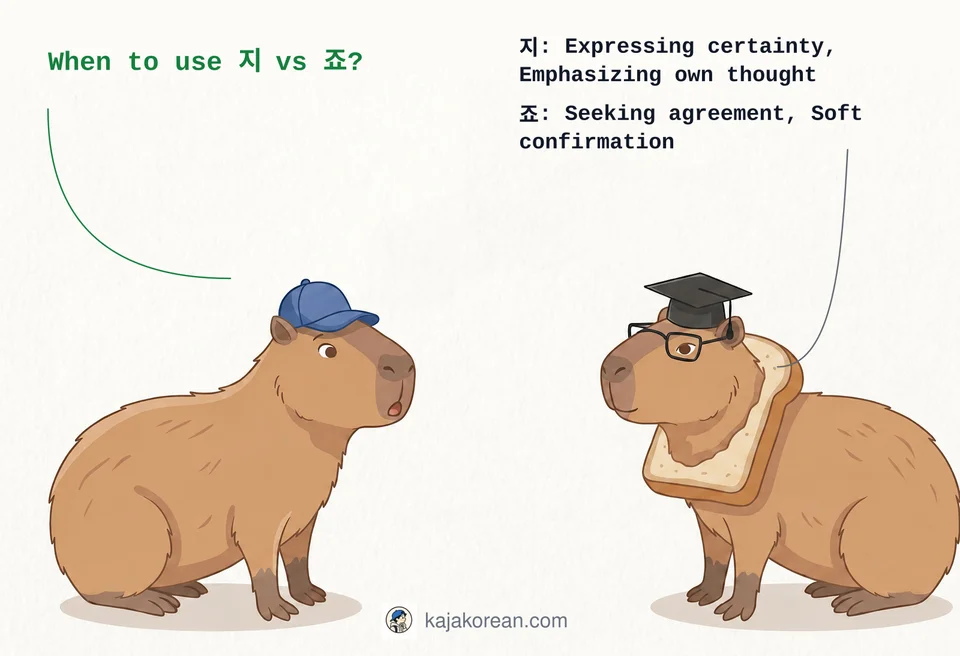
지 vs 죠: Expressing Certainty and Agreement

지 (ji) · 죠 (jyo)

'지' is used to express certainty or confirmation, while '죠' is used to seek agreement or softly confirm with the listener.

Comparison of Korean sentence endings 지 and 죠 for certainty and agreement

Word-by-word breakdown

One lane per word — no nested boxes, just the gist.

(ji)

Used to express certainty, confirmation, or shared understanding with the listener.

When to use

Expressing certainty, Emphasizing own thought, Confirming shared opinion

The nuance

Attached at the end of a sentence to emphasize the speaker's certainty or shared thought with the listener; mainly used in declarative sentences.

(jyo)

Used to seek the listener's agreement or to softly confirm something.

When to use

Seeking agreement, Soft confirmation, Polite situations

The nuance

A combination of '지' and polite ending '-요'; attached at the end of sentences to seek agreement or politely confirm with the listener.

Real-world examples

  • 오늘 날씨가 참 좋지.

    o-neul nal-ssi-ga cham joh-ji., o neul nal ssi ga cham joh ji.

    Natural when the speaker confidently states that the weather is good.

  • 오늘 날씨가 참 좋죠.

    o-neul nal-ssi-ga cham joh-jyo., o neul nal ssi ga cham joh jyo.

    Appropriate when softly confirming the good weather while expecting agreement from the listener.

  • 너도 그거 알지?

    neo-do geu-geo al-ji?, neo do geu geo al ji?

    Natural when confirming that the listener also knows the fact.

  • 너도 그거 알죠?

    neo-do geu-geo al-jyo?, neo do geu geo al jyo?

    Appropriate polite form to seek agreement or confirmation from the listener.

  • 그 영화 재미있죠?

    geu yeong-hwa jae-mi-iss-jyo?, geu yeong hwa jae mi iss jyo?

    Natural as a soft question seeking the listener's agreement.

  • 그 영화 재미있지?

    geu yeong-hwa jae-mi-iss-ji?, geu yeong hwa jae mi iss ji?

    Appropriate when the speaker is confident and expects the listener to agree.

  • 이거 맞지요?

    i-geo maj-ji-yo?, i geo maj ji yo?

    '맞지요?' is an awkward polite form; '맞죠?' is the natural polite expression.

  • 오늘은 바쁘지요?

    o-neul-eun ba-ppeu-ji-yo?, o neul eun ba ppeu ji yo?

    '지요' is standard but sounds stiff in daily conversation; '죠' is more natural.

Quick quiz

  1. Which expression is appropriate to softly seek agreement from the listener?

    상대방에게 동의를 부드럽게 구할 때 적절한 표현은?(sang-dae-bang-e-gedong-ui-reulbu-deu-reop-gegu-halttaejeok-jeol-hanpyo-hyeon-eun?, sangdaebangegedonguireulbudeureopgeguhalttaejeokjeolhanpyohyeoneun?)
  2. Which sentence ending is mainly used to express certainty?

    확신을 표현할 때 주로 사용하는 문장 끝 어미는?(hwak-sin-eulpyo-hyeon-halttaeju-rosa-yong-ha-neunmun-jangkkeuteo-mi-neun?, hwaksineulpyohyeonhalttaejurosayonghaneunmunjangkkeuteomineun?)
  3. Which expression is used for soft confirmation in polite situations?

    존댓말 상황에서 부드러운 확인을 하고 싶을 때 어떤 표현을 쓰는가?(jon-daes-malsang-hwang-e-seobu-deu-reo-unhwak-in-eulha-gosip-eulttaeeo-tteonpyo-hyeon-eulsseu-neun-ga?, jondaesmalsanghwangeseobudeureounhwakineulhagosipeulttaeeotteonpyohyeoneulsseuneunga?)

More comparisons to explore

View all word comparisons →