
듯(deus)
Used to express conjecture or an indirect feeling.
When to use
expressing conjecture, indirect feeling, literary expression
The nuance
Usually attaches to verbs or adjectives to express the speaker's conjecture or feeling.
듯 (deus) · 같다 (gat-da, gatda)
'듯' is mainly used to express conjecture or indirect feelings, while '같다' is used to indicate clear similarity or comparison.
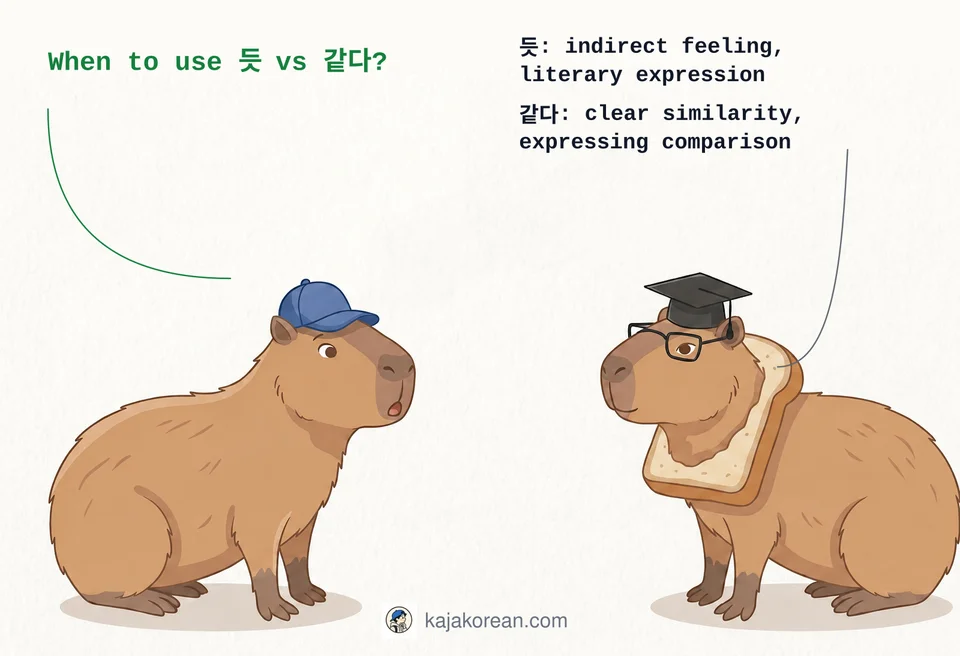
One lane per word — no nested boxes, just the gist.
Used to express conjecture or an indirect feeling.
When to use
expressing conjecture, indirect feeling, literary expression
The nuance
Usually attaches to verbs or adjectives to express the speaker's conjecture or feeling.
Used to indicate clear similarity or comparison.
When to use
expressing comparison, clear similarity, everyday conversation
The nuance
Attaches to nouns, verbs, or adjectives to directly express similarity between two things.
그는 어제 온 것 같다.
geu-neun eo-je on geos gat-da., geu neun eo je on geos gat da.
'같다' is appropriate here to express a clear conjecture or judgment.
그는 어제 온 듯.
geu-neun eo-je on deus., geu neun eo je on deus.
'듯' naturally expresses an indirect or softer conjecture.
그는 어제 온 듯 같다.
geu-neun eo-je on deus gat-da., geu neun eo je on deus gat da.
Using both '듯' and '같다' together is redundant and awkward; only one should be used.
비가 올 듯 하다.
bi-ga ol deus ha-da., bi ga ol deus ha da.
'듯 하다' is commonly used to express conjecture about the future.
그 사람은 사자 같다.
geu sa-ram-eun sa-ja gat-da., geu sa ram eun sa ja gat da.
'같다' is suitable for clear metaphorical comparisons.
그 사람은 사자 듯.
geu sa-ram-eun sa-ja deus., geu sa ram eun sa ja deus.
'듯' is more suitable for conjecture than metaphorical comparisons.
그가 화난 듯 보인다.
geu-ga hwa-nan deus bo-in-da., geu ga hwa nan deus bo in da.
'듯' naturally expresses conjecture about a state or feeling.
그가 화난 같다.
geu-ga hwa-nan gat-da., geu ga hwa nan gat da.
'같다' fits direct comparisons, but '화난 같다' is awkward; the correct form is '화난 것 같다'.
Which sentence correctly uses '듯'?
When should you use '같다'?
What does '그가 화난 듯 보인다.' mean?