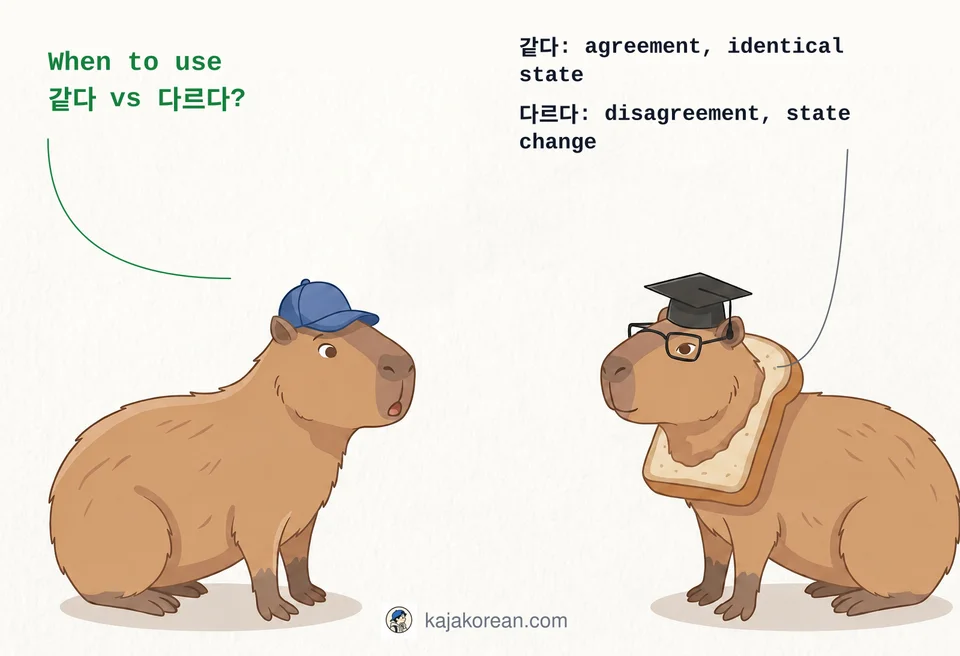
Indicates that one object or state is similar or identical to another
When to use
appearance comparison, agreement, identical state
The nuance
Use 같다 when two things are similar or identical, emphasizing similarity between compared objects.
같다 (gat-da, gatda) · 다르다 (da-reu-da, dareuda)
같다 and 다르다 are used to clearly express similarity and difference between things or situations.

One lane per word — no nested boxes, just the gist.
Indicates that one object or state is similar or identical to another
When to use
appearance comparison, agreement, identical state
The nuance
Use 같다 when two things are similar or identical, emphasizing similarity between compared objects.
Used when two objects or states are not the same and have differences
When to use
personality difference, disagreement, state change
The nuance
Use 다르다 to express differences or discrepancies between two things, emphasizing contrast.
이 두 그림은 색깔이 같다.
i du geu-rim-eun saek-kkal-i gat-da., i du geu rim eun saek kkal i gat da.
The colors of the two paintings are identical, so 같다 is naturally used.
우리 생각이 다르다.
u-ri saeng-gak-i da-reu-da., u ri saeng gak i da reu da.
Since opinions differ, using 다르다 is correct.
그 사람과 나는 다르다.
geu sa-ram-gwa na-neun da-reu-da., geu sa ram gwa na neun da reu da.
Use 다르다 to express difference between two people.
이 문제의 답은 같다.
i mun-je-ui dap-eun gat-da., i mun je ui dap eun gat da.
Saying ‘답은 같다’ is awkward; usually ‘정답이 같다’ or ‘정답이 동일하다’ is preferred.
그들의 의견이 같다.
geu-deul-ui ui-gyeon-i gat-da., geu deul ui ui gyeon i gat da.
Use 같다 when opinions agree.
이 두 사람은 성격이 같다.
i du sa-ram-eun seong-gyeok-i gat-da., i du sa ram eun seong gyeok i gat da.
Personality is usually described as different; saying 같다 is rare.
우리 집과 그 집은 구조가 다르다.
u-ri jip-gwa geu jip-eun gu-jo-ga da-reu-da., u ri jip gwa geu jip eun gu jo ga da reu da.
Since the structures differ, 다르다 is used.
이 옷과 저 옷은 색깔이 다르다.
i os-gwa jeo os-eun saek-kkal-i da-reu-da., i os gwa jeo os eun saek kkal i da reu da.
Use 다르다 when colors differ.
Which sentence should use ‘같다’?
When should you use ‘다르다’?
Which sentence incorrectly uses ‘같다’?