
생각하다(saeng-gak-ha-da, saenggakhada)
to intentionally think about or consider something
When to use
intentional thinking, making judgments, planning
The nuance
Used when the subject actively thinks or considers something.
생각하다 (saeng-gak-ha-da, saenggakhada) · 생각나다 (saeng-gak-na-da, saenggaknada)
생각하다 is used when the subject intentionally thinks about something, while 생각나다 is used when a memory or idea suddenly comes to mind.
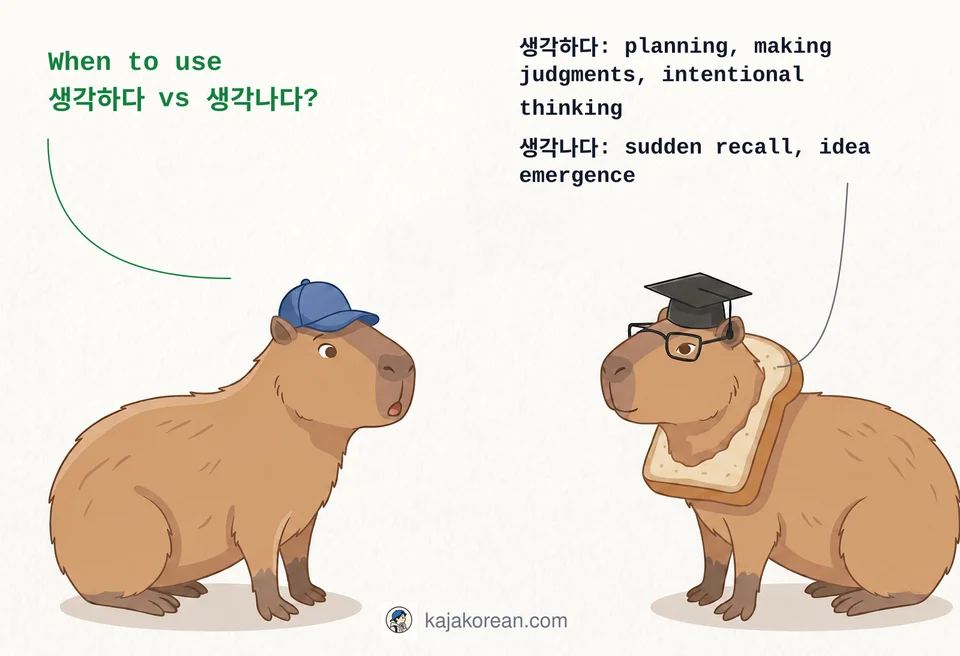
One lane per word — no nested boxes, just the gist.
to intentionally think about or consider something
When to use
intentional thinking, making judgments, planning
The nuance
Used when the subject actively thinks or considers something.
to suddenly recall or have an idea come to mind
When to use
sudden recall, idea emergence, remembering forgotten info
The nuance
Used when a memory or idea suddenly comes to the subject's mind.
나는 내일 여행 계획을 생각한다.
na-neun nae-il yeo-haeng gye-hoek-eul saeng-gak-han-da., na neun nae il yeo haeng gye hoek eul saeng gak han da.
The subject intentionally thinks about the plan, so 생각하다 is correct.
나는 갑자기 어렸을 때 일이 생각났다.
na-neun gap-ja-gi eo-ryeoss-eul ttae il-i saeng-gak-nass-da., na neun gap ja gi eo ryeoss eul ttae il i saeng gak nass da.
A memory suddenly came to mind, so 생각나다 is correct.
생각나서 그 사람에게 전화했다.
saeng-gak-na-seo geu sa-ram-e-ge jeon-hwa-haess-da., saeng gak na seo geu sa ram e ge jeon hwa haess da.
The action was triggered by sudden recall, so 생각나다 is used.
나는 내일 할 일을 생각났다.
na-neun nae-il hal il-eul saeng-gak-nass-da., na neun nae il hal il eul saeng gak nass da.
생각나다 is for sudden recall; here, intentional thinking requires 생각하다.
회의에서 좋은 아이디어를 생각했다.
hoe-ui-e-seo joh-eun a-i-di-eo-reul saeng-gak-haess-da., hoe ui e seo joh eun a i di eo reul saeng gak haess da.
The subject actively thought of an idea, so 생각하다 is correct.
어제 친구가 생각났다.
eo-je chin-gu-ga saeng-gak-nass-da., eo je chin gu ga saeng gak nass da.
The friend suddenly came to mind, so 생각나다 is correct.
나는 그 문제에 대해 생각났다.
na-neun geu mun-je-e dae-hae saeng-gak-nass-da., na neun geu mun je e dae hae saeng gak nass da.
When intentionally thinking about a problem, 생각하다 should be used.
갑자기 좋은 생각이 생각났다.
gap-ja-gi joh-eun saeng-gak-i saeng-gak-nass-da., gap ja gi joh eun saeng gak i saeng gak nass da.
When a good idea suddenly comes to mind, only 생각나다 is natural; using both is redundant.
Which word do you use when a past event suddenly comes to mind?
What is correct when intentionally thinking about a problem?
Fill in the blank: "Yesterday, I suddenly thought of a friend."
Which is correct: "Think about tomorrow's plan"?