
있다(iss-da, issda)
Indicates the existence or presence of something or someone
When to use
Expressing existence, Expressing possession, Describing location
The nuance
Used when something exists or is located at a certain place.
있다 (iss-da, issda) · 없다 (eop-da, eopda)
The core difference between 있다 and 없다 is whether something exists or not.
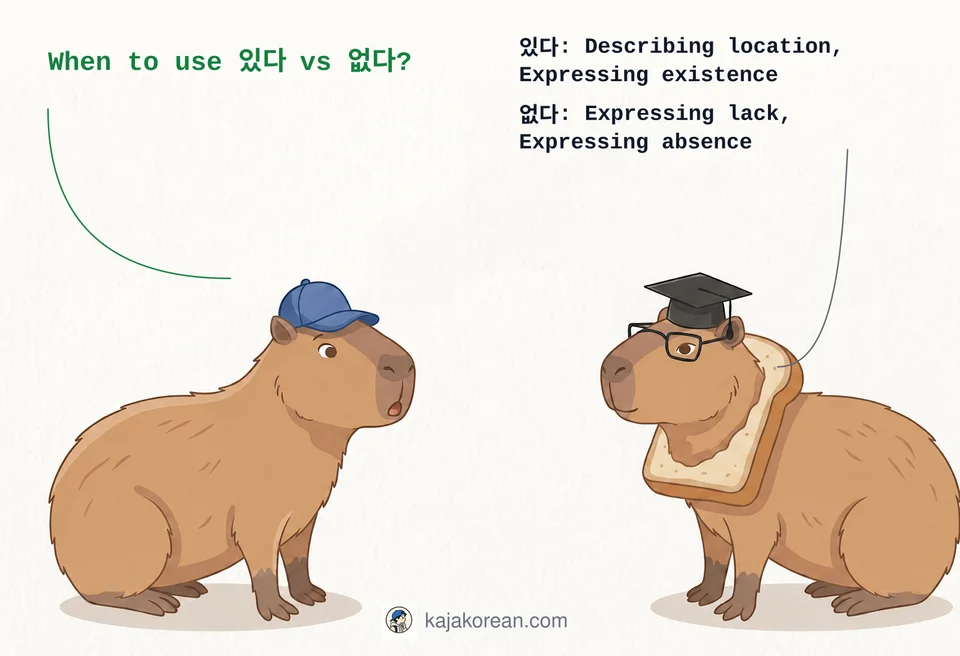
One lane per word — no nested boxes, just the gist.
Indicates the existence or presence of something or someone
When to use
Expressing existence, Expressing possession, Describing location
The nuance
Used when something exists or is located at a certain place.
Indicates the non-existence or absence of something or someone
When to use
Expressing absence, Expressing lack, Describing deficiency
The nuance
Used when something does not exist or is not present at a certain place.
책상이 방에 있다.
chaek-sang-i bang-e iss-da., chaek sang i bang e iss da.
The desk exists inside the room, so '있다' is correct.
책상이 방에 없다.
chaek-sang-i bang-e eop-da., chaek sang i bang e eop da.
The desk is not in the room, so '없다' is correct.
나는 돈이 있다.
na-neun don-i iss-da., na neun don i iss da.
'있다' is used to express possession.
나는 돈이 없다.
na-neun don-i eop-da., na neun don i eop da.
'없다' is used to express lack of money.
사람이 여기 없다.
sa-ram-i yeo-gi eop-da., sa ram i yeo gi eop da.
Indicates no person is at that place, so '없다' is correct.
사람이 여기 있다.
sa-ram-i yeo-gi iss-da., sa ram i yeo gi iss da.
Indicates a person is at that place, so '있다' is correct.
나는 시간이 없다.
na-neun si-gan-i eop-da., na neun si gan i eop da.
'없다' is used to express lack of time.
나는 시간이 있다.
na-neun si-gan-i iss-da., na neun si gan i iss da.
'있다' is used to express having enough time.
Which word to use when something exists in the room?
Which word to use when you have no money at all?
Correct expression when no person is at a place?