
읽다(ik-da, ikda)
The active act of reading a text or book directly
When to use
Reading books, Reading newspapers, Student reading, Active action
The nuance
Used when the subject actively performs the reading action.
읽다 (ik-da, ikda) · 읽히다 (ik-hi-da, ikhida)
읽다 means the subject actively reads a book or text, while 읽히다 expresses a passive or causative situation where someone or something is read by others.
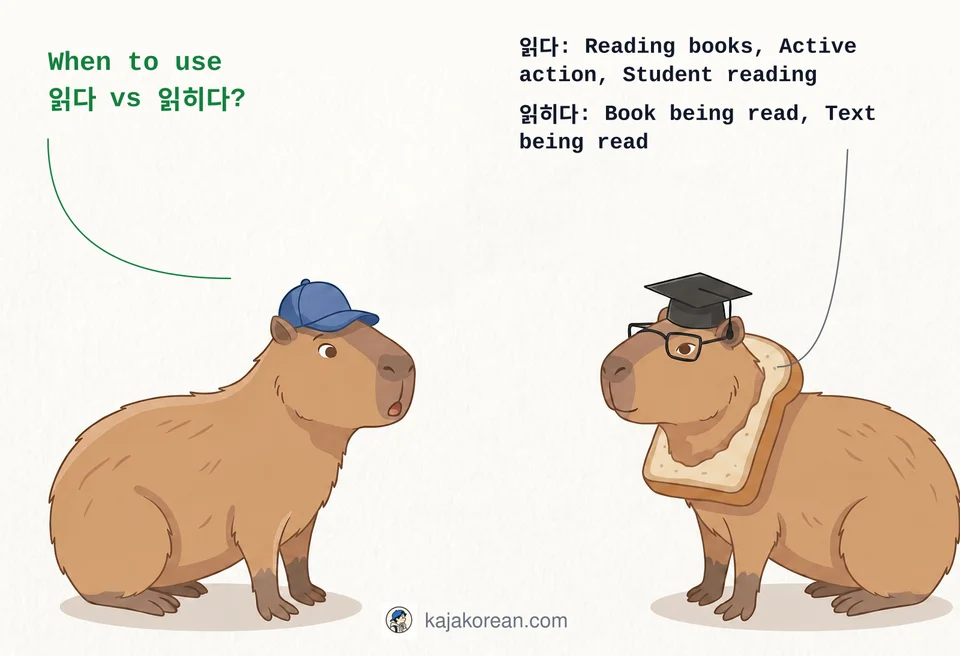
One lane per word — no nested boxes, just the gist.
The active act of reading a text or book directly
When to use
Reading books, Reading newspapers, Student reading, Active action
The nuance
Used when the subject actively performs the reading action.
Passive or causative meaning where someone or something is read by others
When to use
Book being read, Text being read, Read to a child, Passive situation
The nuance
Used when the subject is the object being read or when someone causes reading to happen.
나는 매일 책을 읽는다.
na-neun mae-il chaek-eul ik-neun-da., na neun mae il chaek eul ik neun da.
The subject actively reads, so '읽다' is appropriate.
책이 잘 읽힌다.
chaek-i jal ik-hin-da., chaek i jal ik hin da.
Natural passive form expressing the book being read well.
나는 아이에게 책을 읽힌다.
na-neun a-i-e-ge chaek-eul ik-hin-da., na neun a i e ge chaek eul ik hin da.
Mixing active subject 'I' with passive '읽힌다' is awkward; should use '읽어 준다' instead.
선생님이 학생에게 글을 읽힌다.
seon-saeng-nim-i hak-saeng-e-ge geul-eul ik-hin-da., seon saeng nim i hak saeng e ge geul eul ik hin da.
Appropriate causative passive meaning where teacher causes students to read.
나는 신문을 읽힌다.
na-neun sin-mun-eul ik-hin-da., na neun sin mun eul ik hin da.
When subject reads directly, use '읽다'; '읽힌다' is inappropriate.
그 글은 쉽게 읽힌다.
geu geul-eun swip-ge ik-hin-da., geu geul eun swip ge ik hin da.
A natural passive sentence expressing the text is easily read.
아이에게 책을 읽는다.
a-i-e-ge chaek-eul ik-neun-da., a i e ge chaek eul ik neun da.
With indirect object 'to a child,' '읽어 준다' is more natural.
아이에게 책을 읽어 준다.
a-i-e-ge chaek-eul ik-eo jun-da., a i e ge chaek eul ik eo jun da.
Natural active act of reading a book to a child.
Which sentence uses '읽다' actively?
Which sentence correctly uses '읽히다'?
What does '아이에게 책을 읽히다' mean?
What does it mean?