
있다(iss-da, issda)
Verb indicating basic existence or location
When to use
object existence, location, informal speech, everyday narration
The nuance
Used for people, things, and places in non-honorific contexts.
있다 (iss-da, issda) · 계시다 (gye-si-da, gyesida)
있다 expresses basic existence, while 계시다 is the honorific form used mainly to respectfully indicate a person's presence.
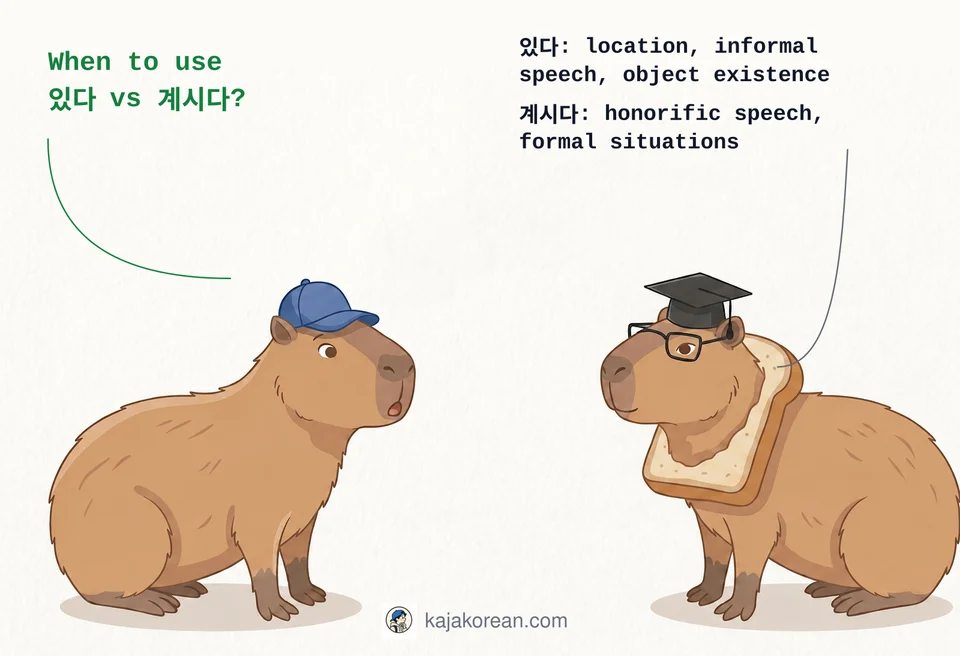
One lane per word — no nested boxes, just the gist.
Verb indicating basic existence or location
When to use
object existence, location, informal speech, everyday narration
The nuance
Used for people, things, and places in non-honorific contexts.
Honorific verb used to respectfully indicate a person's presence
When to use
honorific speech, respecting listener, respecting third party, formal situations
The nuance
Used only for people to show respect towards the listener or a third party.
책상이 방에 있다.
chaek-sang-i bang-e iss-da., chaek sang i bang e iss da.
Indicates location of an object, so '있다' is correct.
책상이 방에 계시다.
chaek-sang-i bang-e gye-si-da., chaek sang i bang e gye si da.
Using honorific for an object is inappropriate.
할아버지께서 집에 계세요.
hal-a-beo-ji-kke-seo jip-e gye-se-yo., hal a beo ji kke seo jip e gye se yo.
Honorific form for a person’s presence is correct.
할아버지께서 집에 있어요.
hal-a-beo-ji-kke-seo jip-e iss-eo-yo., hal a beo ji kke seo jip e iss eo yo.
In informal or less respectful contexts, '있다' is acceptable.
할아버지께서 집에 있다.
hal-a-beo-ji-kke-seo jip-e iss-da., hal a beo ji kke seo jip e iss da.
Using basic form '있다' for a person in honorific context is rude.
친구가 학교에 계세요.
chin-gu-ga hak-gyo-e gye-se-yo., chin gu ga hak gyo e gye se yo.
Use '계시다' to honor a friend in polite speech.
사장이 사무실에 있다.
sa-jang-i sa-mu-sil-e iss-da., sa jang i sa mu sil e iss da.
Using '있다' for a person in honorific context is rude.
When should you use '계시다'?
Which sentence correctly uses '있다'?
Which of the following sentences is incorrect?