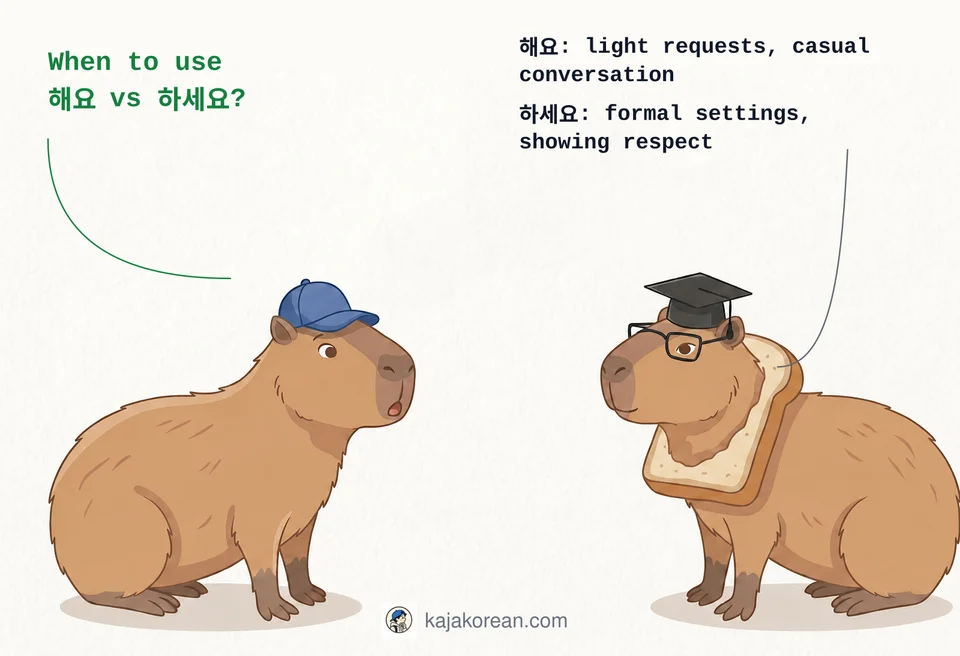
해요 vs 하세요: Natural Polite Speech Usage

해요 (hae-yo, haeyo) · 하세요 (ha-se-yo, haseyo)

'해요' and '하세요' are both polite forms, but '해요' sounds softer and friendlier, while '하세요' is more formal and respectful.

Comparison of Korean polite endings 해요 and 하세요

Word-by-word breakdown

One lane per word — no nested boxes, just the gist.

해요(hae-yo, haeyo)

A soft and friendly polite form used in everyday conversation or business when a casual but polite tone is appropriate.

When to use

casual conversation, friendly business setting, light requests

The nuance

Formed by attaching '-아요/어요' to the verb stem, used when the speaker wants to be polite yet friendly and less formal.

하세요(ha-se-yo, haseyo)

A more polite and formal form used to show respect or in official/formal situations.

When to use

formal settings, showing respect, formal requests

The nuance

Formed by attaching '-세요' to the verb stem, used to express respect or in formal/official contexts.

Real-world examples

  • 오늘 뭐 해요?

    o-neul mwo hae-yo?, o neul mwo hae yo?

    Using '해요' in casual, friendly conversation is appropriate.

  • 오늘 뭐 하세요?

    o-neul mwo ha-se-yo?, o neul mwo ha se yo?

    Polite question showing respect, suitable for formal or respectful situations.

  • 회의는 몇 시에 해요?

    hoe-ui-neun myeoch si-e hae-yo?, hoe ui neun myeoch si e hae yo?

    Naturally used in friendly business contexts.

  • 회의는 몇 시에 하세요?

    hoe-ui-neun myeoch si-e ha-se-yo?, hoe ui neun myeoch si e ha se yo?

    Appropriate for formal business settings.

  • 숙제 하세요!

    suk-je ha-se-yo!, suk je ha se yo!

    Suitable when politely commanding or instructing.

  • 숙제 해요!

    suk-je hae-yo!, suk je hae yo!

    Not appropriate as a command; better for requests or questions.

  • 저녁 먹어요?

    jeo-nyeok meok-eo-yo?, jeo nyeok meok eo yo?

    Natural friendly question.

  • 저녁 먹으세요?

    jeo-nyeok meok-eu-se-yo?, jeo nyeok meok eu se yo?

    Polite question showing respect.

Quick quiz

  1. Which expression is mainly used in friendly everyday conversation?

    친근한 일상 대화에서 주로 사용하는 표현은?(chin-geun-hanil-sangdae-hwa-e-seoju-rosa-yong-ha-neunpyo-hyeon-eun?, chingeunhanilsangdaehwaeseojurosayonghaneunpyohyeoneun?)
  2. Which expression is appropriate when speaking respectfully in formal settings?

    공식적인 자리에서 상대방을 존중하며 말할 때 적절한 표현은?(gong-sik-jeok-inja-ri-e-seosang-dae-bang-euljon-jung-ha-myeomal-halttaejeok-jeol-hanpyo-hyeon-eun?, gongsikjeokinjarieseosangdaebangeuljonjunghamyeomalhalttaejeokjeolhanpyohyeoneun?)
  3. Which expression is natural for making a light request?

    가벼운 부탁을 할 때 자연스러운 표현은?(ga-byeo-unbu-tak-eulhalttaeja-yeon-seu-reo-unpyo-hyeon-eun?, gabyeounbutakeulhalttaejayeonseureounpyohyeoneun?)
  4. Which expression is a polite way to command someone?

    상대방에게 명령할 때 공손한 표현은?(sang-dae-bang-e-gemyeong-ryeong-halttaegong-son-hanpyo-hyeon-eun?, sangdaebangegemyeongryeonghalttaegongsonhanpyohyeoneun?)

More comparisons to explore

View all word comparisons →