
봄(bom)
The season after winter when the weather becomes warm
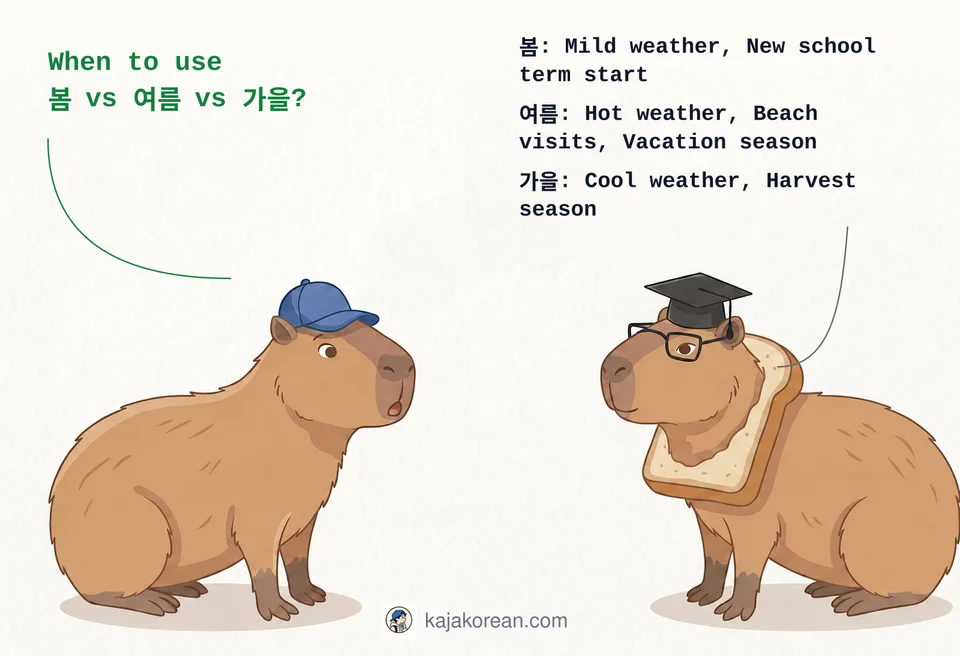
When to use
Flower blooming period, Mild weather, New school term start
The nuance
봄 refers to the season from March to May, used when flowers bloom and the weather is mild.
봄 (bom) · 여름 (yeo-reum, yeoreum) · 가을 (ga-eul, gaeul)
봄, 여름, and 가을 represent warmth, heat, and coolness respectively, with clear usage distinctions based on seasonal context.
One lane per word — no nested boxes, just the gist.
The season after winter when the weather becomes warm
When to use
Flower blooming period, Mild weather, New school term start
The nuance
봄 refers to the season from March to May, used when flowers bloom and the weather is mild.
The hottest season, usually from June to August
When to use
Hot weather, Vacation season, Beach visits
The nuance
여름 is used when temperatures and humidity are high, often associated with vacations and holidays.
The season after summer when the weather becomes cool
When to use
Fall foliage viewing, Cool weather, Harvest season
The nuance
가을 refers to the period from September to November, used when leaves change color and the weather cools down.
봄에는 꽃이 많이 핀다.
bom-e-neun kkoch-i man-i pin-da., bom e neun kkoch i man i pin da.
Spring is the season when flowers bloom, so this sentence is natural.
여름에 눈이 많이 온다.
yeo-reum-e nun-i man-i on-da., yeo reum e nun i man i on da.
Summer is hot season, so snow is unlikely and this usage is incorrect.
가을에는 단풍이 아름답다.
ga-eul-e-neun dan-pung-i a-reum-dap-da., ga eul e neun dan pung i a reum dap da.
Autumn is when leaves change color, so this expression fits perfectly.
봄에 바닷가에서 수영을 한다.
bom-e ba-das-ga-e-seo su-yeong-eul han-da., bom e ba das ga e seo su yeong eul han da.
Spring water is usually cold, so swimming at the beach is uncommon then.
여름 휴가는 보통 7월이나 8월에 간다.
yeo-reum hyu-ga-neun bo-tong 7wol-i-na 8wol-e gan-da., yeo reum hyu ga neun bo tong 7wol i na 8wol e gan da.
Summer is vacation season, so this timing is appropriate.
가을에 눈이 많이 내린다.
ga-eul-e nun-i man-i nae-rin-da., ga eul e nun i man i nae rin da.
Autumn is not a snowy season, so this sentence is unnatural.
봄에는 새 학기가 시작된다.
bom-e-neun sae hak-gi-ga si-jak-doen-da., bom e neun sae hak gi ga si jak doen da.
In Korea, the new school term starts in spring, making this sentence natural.
여름은 단풍이 예쁘다.
yeo-reum-eun dan-pung-i ye-ppeu-da., yeo reum eun dan pung i ye ppeu da.
Fall foliage occurs in autumn, so it does not fit with summer.
Which sentence best fits '가을'?
Which sentence does NOT fit '여름'?
Which is correct about '봄'?