
앞(ap)
The front side or space in front of an object
When to use
Person's front, In front of building entrance, Front seat at desk
The nuance
앞 is used to indicate the front or frontal space of an object, usually based on the viewer's perspective.
앞 (ap) · 뒤 (dwi) · 옆 (yeop)
앞 (ap), 뒤 (dwi), and 옆 (yeop) all indicate location but differ: 앞 means 'front side,' 뒤 means 'back side,' and 옆 means 'side,' each with distinct spatial use.
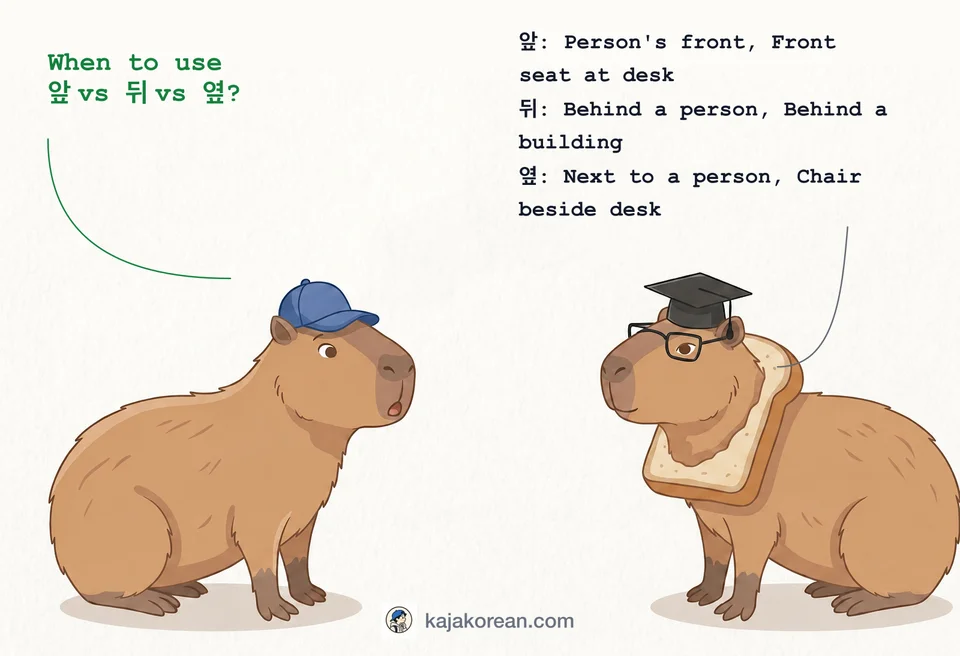
One lane per word — no nested boxes, just the gist.
The front side or space in front of an object
When to use
Person's front, In front of building entrance, Front seat at desk
The nuance
앞 is used to indicate the front or frontal space of an object, usually based on the viewer's perspective.
The back side or space behind an object
When to use
Behind a person, Behind a building, Back seat at desk
The nuance
뒤 is used to indicate the back or rear space of an object, opposite to 앞.
The side area next to an object, either left or right
When to use
Next to a person, Side space of building, Chair beside desk
The nuance
옆 indicates the lateral side space of an object, meaning left or right side, not front or back.
그는 나의 앞에 서 있다.
geu-neun na-ui ap-e seo iss-da., geu neun na ui ap e seo iss da.
앞 correctly indicates the front position.
그는 나의 뒤에 서 있다.
geu-neun na-ui dwi-e seo iss-da., geu neun na ui dwi e seo iss da.
뒤 correctly indicates the back position.
그는 나의 옆에 서 있다.
geu-neun na-ui yeop-e seo iss-da., geu neun na ui yeop e seo iss da.
옆 correctly indicates the side position.
나는 건물 뒤에 입구가 있다.
na-neun geon-mul dwi-e ip-gu-ga iss-da., na neun geon mul dwi e ip gu ga iss da.
뒤 is used for the back side of the building.
나는 건물 앞에 입구가 있다.
na-neun geon-mul ap-e ip-gu-ga iss-da., na neun geon mul ap e ip gu ga iss da.
앞 is used for the front side of the building.
나는 건물 옆에 입구가 있다.
na-neun geon-mul yeop-e ip-gu-ga iss-da., na neun geon mul yeop e ip gu ga iss da.
옆 is used for the side of the building.
책상 뒤에 앉았다.
chaek-sang dwi-e an-ass-da., chaek sang dwi e an ass da.
옆 is more natural for sitting next to a desk, 뒤 implies behind which is unusual.
책상 앞에 앉았다.
chaek-sang ap-e an-ass-da., chaek sang ap e an ass da.
앞 is natural for sitting facing the desk.
Which word describes standing on the right side of a person?
Which word fits a space located at the building's front?
Which word is used for a chair located behind the desk?
What does it mean?