
직접(jik-jeop, jikjeop)
Doing or experiencing something personally
When to use
personal action, direct experience, self-expression
The nuance
Use when the subject personally performs the action or experiences something without intermediaries.
직접 (jik-jeop, jikjeop) · 간접 (gan-jeop, ganjeop) · 대리 (dae-ri, daeri)
직접 (jikjeop) means doing something yourself, 간접 (ganjeop) involves an indirect process, and 대리 (daeri) means someone else acts on your behalf.
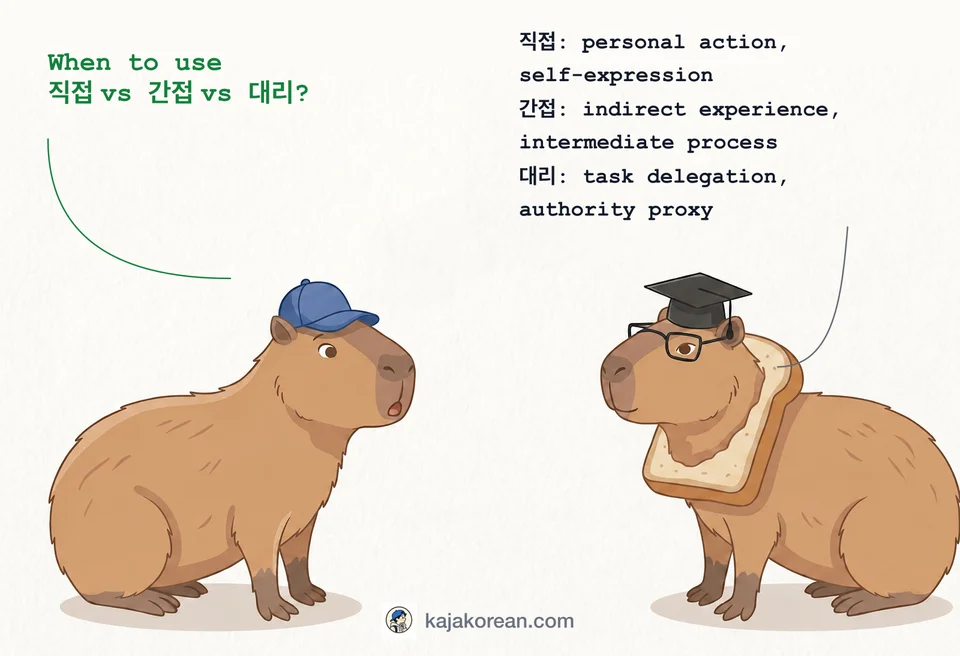
One lane per word — no nested boxes, just the gist.
Doing or experiencing something personally
When to use
personal action, direct experience, self-expression
The nuance
Use when the subject personally performs the action or experiences something without intermediaries.
Not direct; involves intermediaries or processes
When to use
intermediate process, indirect experience, indirect communication
The nuance
Used when the action is not direct but happens through intermediaries or processes.
Someone acts or handles something on behalf of another
When to use
acting on behalf, task delegation, authority proxy
The nuance
Used when someone else acts or handles something in place of the original person.
나는 직접 보고 싶다.
na-neun jik-jeop bo-go sip-da., na neun jik jeop bo go sip da.
The speaker wants to experience it personally, so 직접 is correct.
나는 간접 보고 싶다.
na-neun gan-jeop bo-go sip-da., na neun gan jeop bo go sip da.
'간접' alone doesn't fit with 'want to see'; '간접적으로 보고 싶다' is correct.
그는 대리로 회의에 참석했다.
geu-neun dae-ri-ro hoe-ui-e cham-seok-haess-da., geu neun dae ri ro hoe ui e cham seok haess da.
Since he attended on someone else's behalf, 대리 is appropriate.
그는 직접로 회의에 참석했다.
geu-neun jik-jeop-ro hoe-ui-e cham-seok-haess-da., geu neun jik jeop ro hoe ui e cham seok haess da.
'직접' cannot be followed by '로'; '직접 참석했다' is correct.
그녀는 간접 경험을 통해 배웠다.
geu-nyeo-neun gan-jeop gyeong-heom-eul tong-hae bae-woss-da., geu nyeo neun gan jeop gyeong heom eul tong hae bae woss da.
Since the experience was indirect, 간접 is correct.
그녀는 대리 경험을 통해 배웠다.
geu-nyeo-neun dae-ri gyeong-heom-eul tong-hae bae-woss-da., geu nyeo neun dae ri gyeong heom eul tong hae bae woss da.
'대리 경험' is unnatural; use 간접 경험 instead.
나는 직접 작성했다.
na-neun jik-jeop jak-seong-haess-da., na neun jik jeop jak seong haess da.
The subject wrote it personally, so 직접 is correct.
나는 대리 작성했다.
na-neun dae-ri jak-seong-haess-da., na neun dae ri jak seong haess da.
대리 means someone else acts; if you wrote it yourself, 직접 is correct.
When is '대리' appropriate?
Which sentence requires '간접'?
Which sentence incorrectly uses '직접'?