Formal written language used in writing or official contexts
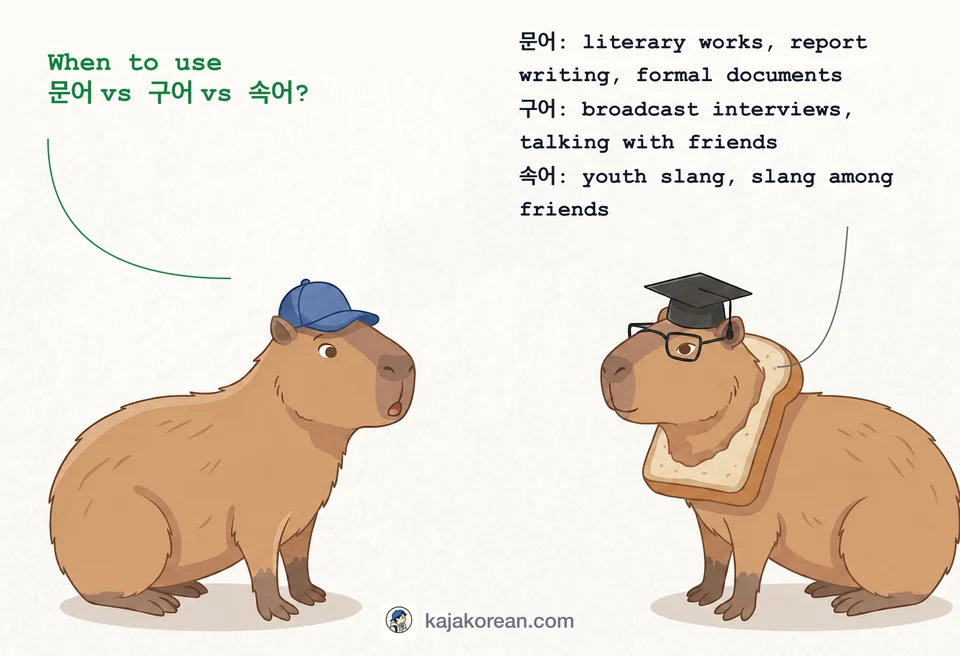
When to use
formal documents, literary works, report writing
The nuance
Mun-eo is mainly used in books, newspapers, reports, or literary works and rarely in everyday conversation.
문어 (mun-eo, muneo) · 구어 (gu-eo, gueo) · 속어 (sok-eo, sokeo)
Mun-eo (문어) is for writing or formal contexts, Gu-eo (구어) for everyday speech, and Sok-eo (속어) for informal slang or jargon.

One lane per word — no nested boxes, just the gist.
Formal written language used in writing or official contexts
When to use
formal documents, literary works, report writing
The nuance
Mun-eo is mainly used in books, newspapers, reports, or literary works and rarely in everyday conversation.
Spoken language used naturally in everyday life
When to use
everyday conversation, broadcast interviews, talking with friends
The nuance
Gu-eo is used in conversations, broadcasts, interviews, and other natural speaking situations, less formal than Mun-eo.
Slang, jargon, or informal language used within specific groups or classes
When to use
slang among friends, youth slang, professional jargon
The nuance
Sok-eo is mainly used among friends, specific professions, or youth, and is inappropriate in formal settings.
이 보고서는 문어체로 작성되어야 한다.
i bo-go-seo-neun mun-eo-che-ro jak-seong-doe-eo-ya han-da., i bo go seo neun mun eo che ro jak seong doe eo ya han da.
Report writing is formal, so Mun-eo is appropriate.
친구랑 문어체로 대화했어.
chin-gu-rang mun-eo-che-ro dae-hwa-haess-eo., chin gu rang mun eo che ro dae hwa haess eo.
Mun-eo is not used in everyday conversation; Gu-eo should be used.
뉴스 앵커는 구어체로 말한다.
nyu-seu aeng-keo-neun gu-eo-che-ro mal-han-da., nyu seu aeng keo neun gu eo che ro mal han da.
News anchors use formal language close to Mun-eo; Gu-eo is inappropriate.
친구들과 속어를 많이 사용해.
chin-gu-deul-gwa sok-eo-reul man-i sa-yong-hae., chin gu deul gwa sok eo reul man i sa yong hae.
Using slang among friends is natural and common.
보고서에 속어를 쓰면 안 된다.
bo-go-seo-e sok-eo-reul sseu-myeon an doen-da., bo go seo e sok eo reul sseu myeon an doen da.
Reports are formal documents; slang is inappropriate.
인터뷰에서 속어를 많이 썼다.
in-teo-byu-e-seo sok-eo-reul man-i sseoss-da., in teo byu e seo sok eo reul man i sseoss da.
Interviews are formal or semi-formal; slang is inappropriate.
일상 대화에서는 구어체가 자연스럽다.
il-sang dae-hwa-e-seo-neun gu-eo-che-ga ja-yeon-seu-reop-da., il sang dae hwa e seo neun gu eo che ga ja yeon seu reop da.
Gu-eo is standard in everyday conversation.
문학 작품에서 구어체만 쓰인다.
mun-hak jak-pum-e-seo gu-eo-che-man sseu-in-da., mun hak jak pum e seo gu eo che man sseu in da.
Literary works mainly use Mun-eo; only Gu-eo is inappropriate.
Which language is suitable for official reports?
Which language is mainly used when chatting comfortably with friends?
What is the slang used informally within specific groups?
Which language is mainly used in broadcast interviews?