Mun-eo vs Gu-eo vs Sok-eo: When to Use Each?

문어 (mun-eo, muneo) · 구어 (gu-eo, gueo) · 속어 (sok-eo, sokeo)

Mun-eo (문어) is for writing or formal contexts, Gu-eo (구어) for everyday speech, and Sok-eo (속어) for informal slang or jargon.

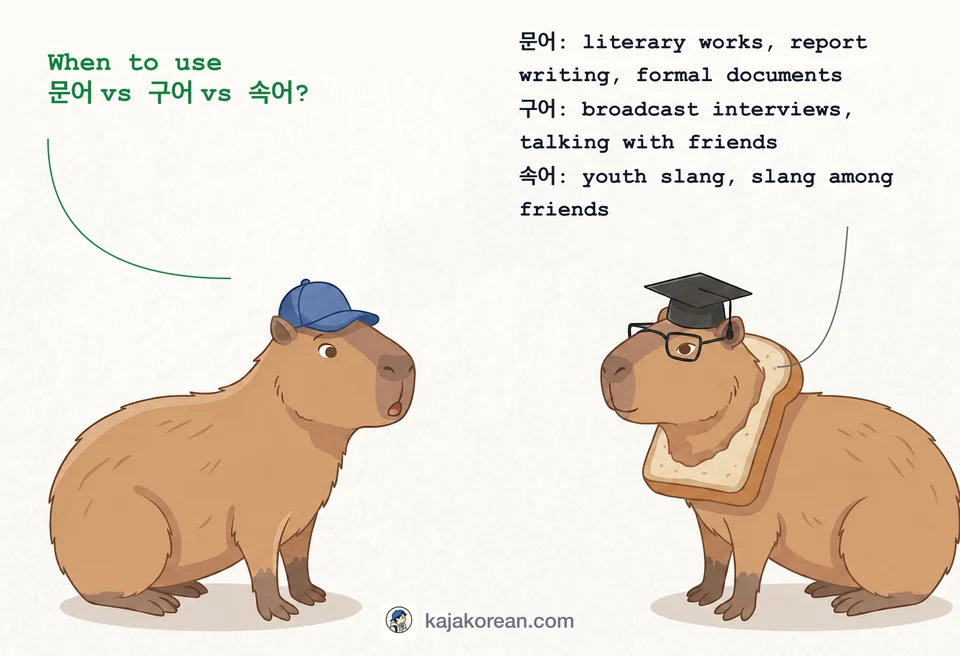
Comparison of 문어, 구어, and 속어 usage in Korean

Word-by-word breakdown

One lane per word — no nested boxes, just the gist.

문어(mun-eo, muneo)

Formal written language used in writing or official contexts

When to use

formal documents, literary works, report writing

The nuance

Mun-eo is mainly used in books, newspapers, reports, or literary works and rarely in everyday conversation.

구어(gu-eo, gueo)

Spoken language used naturally in everyday life

When to use

everyday conversation, broadcast interviews, talking with friends

The nuance

Gu-eo is used in conversations, broadcasts, interviews, and other natural speaking situations, less formal than Mun-eo.

속어(sok-eo, sokeo)

Slang, jargon, or informal language used within specific groups or classes

When to use

slang among friends, youth slang, professional jargon

The nuance

Sok-eo is mainly used among friends, specific professions, or youth, and is inappropriate in formal settings.

Real-world examples

  • 이 보고서는 문어체로 작성되어야 한다.

    i bo-go-seo-neun mun-eo-che-ro jak-seong-doe-eo-ya han-da., i bo go seo neun mun eo che ro jak seong doe eo ya han da.

    Report writing is formal, so Mun-eo is appropriate.

  • 친구랑 문어체로 대화했어.

    chin-gu-rang mun-eo-che-ro dae-hwa-haess-eo., chin gu rang mun eo che ro dae hwa haess eo.

    Mun-eo is not used in everyday conversation; Gu-eo should be used.

  • 뉴스 앵커는 구어체로 말한다.

    nyu-seu aeng-keo-neun gu-eo-che-ro mal-han-da., nyu seu aeng keo neun gu eo che ro mal han da.

    News anchors use formal language close to Mun-eo; Gu-eo is inappropriate.

  • 친구들과 속어를 많이 사용해.

    chin-gu-deul-gwa sok-eo-reul man-i sa-yong-hae., chin gu deul gwa sok eo reul man i sa yong hae.

    Using slang among friends is natural and common.

  • 보고서에 속어를 쓰면 안 된다.

    bo-go-seo-e sok-eo-reul sseu-myeon an doen-da., bo go seo e sok eo reul sseu myeon an doen da.

    Reports are formal documents; slang is inappropriate.

  • 인터뷰에서 속어를 많이 썼다.

    in-teo-byu-e-seo sok-eo-reul man-i sseoss-da., in teo byu e seo sok eo reul man i sseoss da.

    Interviews are formal or semi-formal; slang is inappropriate.

  • 일상 대화에서는 구어체가 자연스럽다.

    il-sang dae-hwa-e-seo-neun gu-eo-che-ga ja-yeon-seu-reop-da., il sang dae hwa e seo neun gu eo che ga ja yeon seu reop da.

    Gu-eo is standard in everyday conversation.

  • 문학 작품에서 구어체만 쓰인다.

    mun-hak jak-pum-e-seo gu-eo-che-man sseu-in-da., mun hak jak pum e seo gu eo che man sseu in da.

    Literary works mainly use Mun-eo; only Gu-eo is inappropriate.

Quick quiz

  1. Which language is suitable for official reports?

    공식 보고서에 적합한 언어는?(gong-sikbo-go-seo-ejeok-hap-haneon-eo-neun?, gongsikbogoseoejeokhaphaneoneoneun?)
  2. Which language is mainly used when chatting comfortably with friends?

    친구들과 편하게 대화할 때 주로 쓰는 언어는?(chin-gu-deul-gwapyeon-ha-gedae-hwa-halttaeju-rosseu-neuneon-eo-neun?, chingudeulgwapyeonhagedaehwahalttaejurosseuneuneoneoneun?)
  3. What is the slang used informally within specific groups?

    특정 집단 내에서 비공식적으로 쓰이는 은어는?(teuk-jeongjip-dannae-e-seobi-gong-sik-jeok-eu-rosseu-i-neuneun-eo-neun?, teukjeongjipdannaeeseobigongsikjeokeurosseuineuneuneoneun?)
  4. Which language is mainly used in broadcast interviews?

    방송 인터뷰에서 주로 사용하는 언어는?(bang-songin-teo-byu-e-seoju-rosa-yong-ha-neuneon-eo-neun?, bangsonginteobyueseojurosayonghaneuneoneoneun?)

More comparisons to explore

View all word comparisons →