
운동(un-dong, undong)
Physical activity to improve health or fitness
When to use
fitness improvement, health maintenance, sports participation
The nuance
운동 is used only for physical activities; not for studying or hobbies.
운동 (un-dong, undong) · 공부 (gong-bu, gongbu) · 취미 (chwi-mi, chwimi)
운동, 공부, and 취미 all refer to activities but differ as physical exercise, learning, and leisure enjoyment respectively.
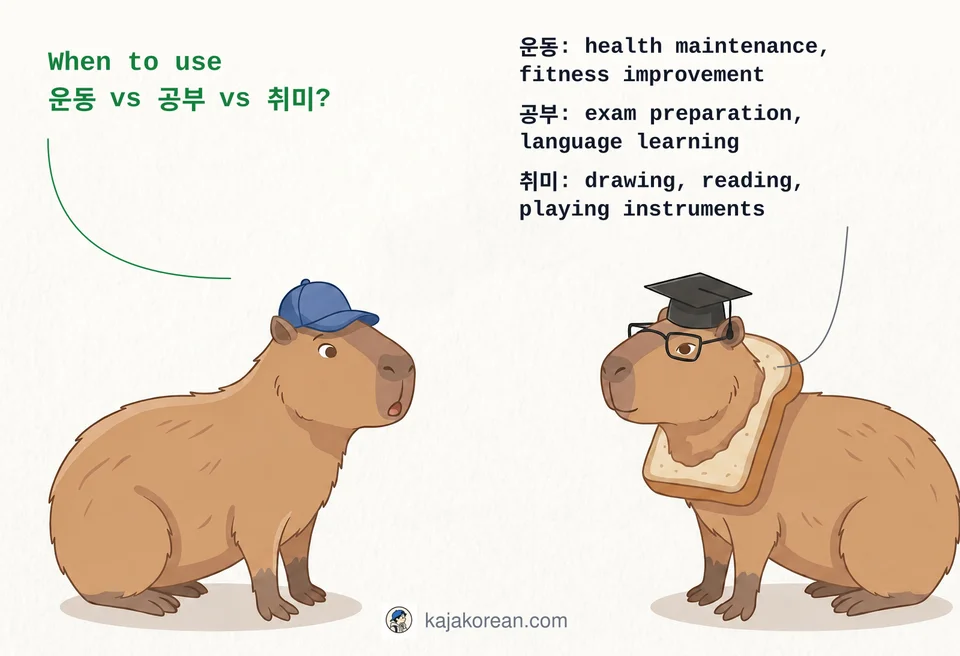
One lane per word — no nested boxes, just the gist.
Physical activity to improve health or fitness
When to use
fitness improvement, health maintenance, sports participation
The nuance
운동 is used only for physical activities; not for studying or hobbies.
Activity of learning and acquiring knowledge or skills
When to use
exam preparation, language learning, subject comprehension
The nuance
공부 is used only for learning-related activities; not for exercise or hobbies.
Activity done for pleasure or leisure
When to use
drawing, playing instruments, reading
The nuance
취미 is used only for enjoyable leisure activities, not for obligatory or goal-oriented exercise or study.
나는 매일 아침 운동을 한다.
na-neun mae-il a-chim un-dong-eul han-da., na neun mae il a chim un dong eul han da.
운동 fits physical activity correctly.
나는 매일 아침 공부를 한다.
na-neun mae-il a-chim gong-bu-reul han-da., na neun mae il a chim gong bu reul han da.
공부 suits learning activities.
나는 매일 아침 취미를 한다.
na-neun mae-il a-chim chwi-mi-reul han-da., na neun mae il a chim chwi mi reul han da.
취미 should refer to a specific activity; '취미를 한다' is unnatural. Example: 'I draw as a hobby.'
운동으로 책을 읽는다.
un-dong-eu-ro chaek-eul ik-neun-da., un dong eu ro chaek eul ik neun da.
Reading is study or hobby, not exercise.
취미로 축구를 한다.
chwi-mi-ro chuk-gu-reul han-da., chwi mi ro chuk gu reul han da.
Soccer is exercise but can be a hobby if done for fun.
공부로 건강을 유지한다.
gong-bu-ro geon-gang-eul yu-ji-han-da., gong bu ro geon gang eul yu ji han da.
Health maintenance relates to exercise, not studying.
나는 취미로 기타를 연주한다.
na-neun chwi-mi-ro gi-ta-reul yeon-ju-han-da., na neun chwi mi ro gi ta reul yeon ju han da.
Playing guitar fits as a leisure hobby.
운동으로 시험 준비를 한다.
un-dong-eu-ro si-heom jun-bi-reul han-da., un dong eu ro si heom jun bi reul han da.
Exam preparation is study-related, not exercise.
Which sentence cannot use '운동'?
Which sentence uses '취미' correctly?
Which situation fits '공부' best?