Indicates that two subjects resemble each other or have many common points
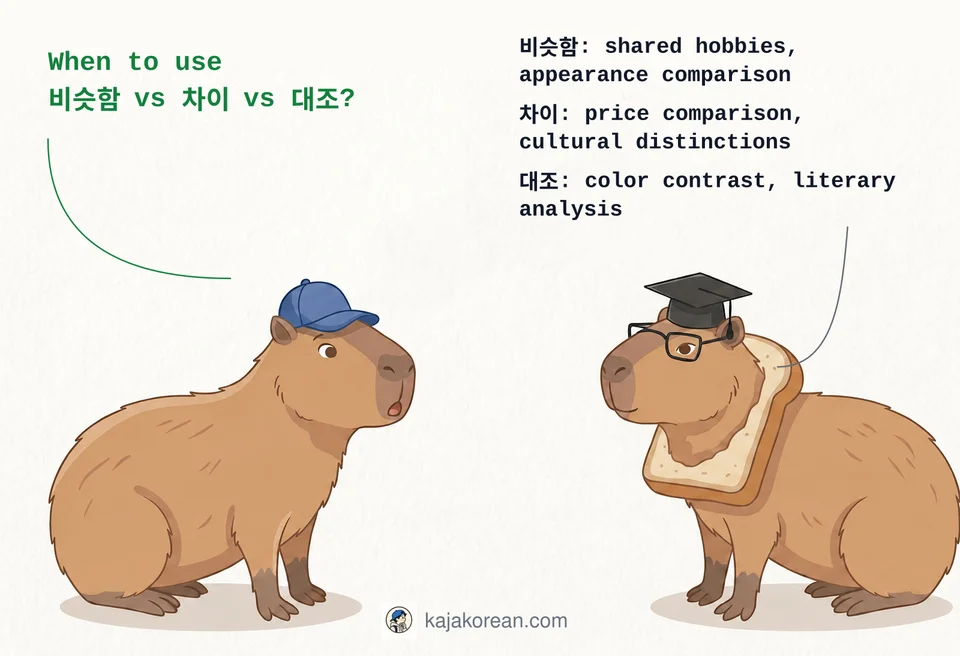
When to use
appearance comparison, personality similarity, shared hobbies
The nuance
Use 비슷함 when referring to similarity or commonality, often with a positive nuance.
비슷함 (bi-seus-ham, biseusham) · 차이 (cha-i, chai) · 대조 (dae-jo, daejo)
비슷함 focuses on commonalities, 차이 denotes differences between two things, and 대조 emphasizes contrasting differences through comparison.

One lane per word — no nested boxes, just the gist.
Indicates that two subjects resemble each other or have many common points
When to use
appearance comparison, personality similarity, shared hobbies
The nuance
Use 비슷함 when referring to similarity or commonality, often with a positive nuance.
Indicates the differences or distinguishing features between two subjects
When to use
price comparison, performance difference, cultural distinctions
The nuance
Use 차이 to objectively express the differences between two subjects.
Comparing two subjects by contrasting to highlight their differences
When to use
literary analysis, color contrast, personality contrast
The nuance
Use 대조 to strongly emphasize contrasts, often used in literature or analysis.
그 두 사람은 얼굴이 많이 비슷해 보여요.
geu du sa-ram-eun eol-gul-i man-i bi-seus-hae bo-yeo-yo., geu du sa ram eun eol gul i man i bi seus hae bo yeo yo.
비슷함 is appropriate to express resemblance in appearance.
그 두 사람은 얼굴이 많이 차이 나요.
geu du sa-ram-eun eol-gul-i man-i cha-i na-yo., geu du sa ram eun eol gul i man i cha i na yo.
Using 차이 for faces sounds unnatural; 비슷함 is correct for resemblance.
이 두 제품의 성능 차이를 비교해 보자.
i du je-pum-ui seong-neung cha-i-reul bi-gyo-hae bo-ja., i du je pum ui seong neung cha i reul bi gyo hae bo ja.
차이 is used to objectively describe performance differences.
이 두 제품은 성능이 대조된다.
i du je-pum-eun seong-neung-i dae-jo-doen-da., i du je pum eun seong neung i dae jo doen da.
대조 is too strong for product performance; 차이 is natural.
이 소설은 두 주인공의 성격 대조가 뚜렷하다.
i so-seol-eun du ju-in-gong-ui seong-gyeok dae-jo-ga ttu-ryeos-ha-da., i so seol eun du ju in gong ui seong gyeok dae jo ga ttu ryeos ha da.
대조 emphasizes clear contrasting personalities.
이 소설은 두 주인공의 성격 차이가 뚜렷하다.
i so-seol-eun du ju-in-gong-ui seong-gyeok cha-i-ga ttu-ryeos-ha-da., i so seol eun du ju in gong ui seong gyeok cha i ga ttu ryeos ha da.
For strong contrasts, 대조 fits better than 차이.
우리 취미가 비슷해서 친구가 되었어요.
u-ri chwi-mi-ga bi-seus-hae-seo chin-gu-ga doe-eoss-eo-yo., u ri chwi mi ga bi seus hae seo chin gu ga doe eoss eo yo.
비슷함 expresses shared hobbies naturally.
우리 취미가 차이가 많아서 친해졌어요.
u-ri chwi-mi-ga cha-i-ga man-a-seo chin-hae-jyeoss-eo-yo., u ri chwi mi ga cha i ga man a seo chin hae jyeoss eo yo.
Saying '차이가 많아서 친해졌다' is unnatural; use 비슷함.
Which is most natural to express similar appearance?
Which word is used to objectively compare product performance?
Which word fits to describe clear contrast between characters in literature?