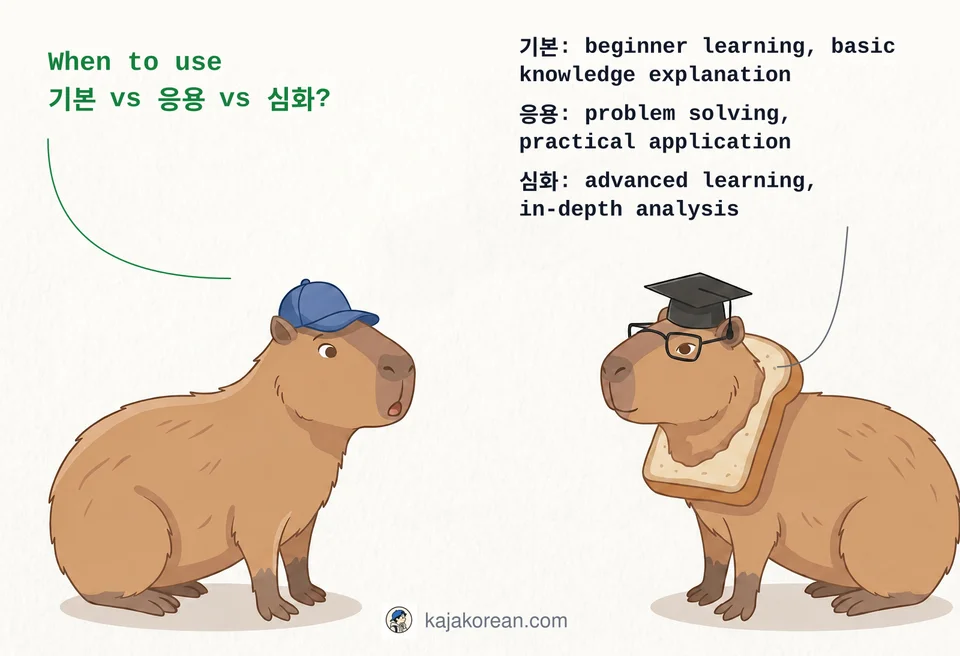
기본 vs 응용 vs 심화: Differences in Learning Stages

기본 (gi-bon, gibon) · 응용 (eung-yong, eungyong) · 심화 (sim-hwa, simhwa)

기본 refers to the fundamental level, 응용 to applying the basics, and 심화 to deepening and specializing knowledge.

Comparison of Korean words 기본, 응용, 심화 for learning stages

Word-by-word breakdown

One lane per word — no nested boxes, just the gist.

기본(gi-bon, gibon)

The most basic and essential stage or content

When to use

beginner learning, basic knowledge explanation, introducing fundamental concepts

The nuance

Refers to the foundational knowledge or skills that must be learned first in study or work.

응용(eung-yong, eungyong)

The stage of applying basic knowledge to solve problems or real-life situations

When to use

problem solving, practical application, using basic knowledge

The nuance

Means using the basics as a foundation to adapt and apply in practical contexts.

심화(sim-hwa, simhwa)

The stage of learning or researching at a deeper, more specialized level beyond basics and application

When to use

specialized research, advanced learning, in-depth analysis

The nuance

Involves handling more complex or specialized content requiring in-depth understanding.

Real-world examples

  • 기본부터 차근차근 배우는 게 중요해.

    gi-bon-bu-teo cha-geun-cha-geun bae-u-neun ge jung-yo-hae., gi bon bu teo cha geun cha geun bae u neun ge jung yo hae.

    기본 fits perfectly for the initial foundational learning stage.

  • 응용을 먼저 배우고 나서 기본을 공부해야 해.

    eung-yong-eul meon-jeo bae-u-go na-seo gi-bon-eul gong-bu-hae-ya hae., eung yong eul meon jeo bae u go na seo gi bon eul gong bu hae ya hae.

    응용 requires basic knowledge first, so 기본 must be learned before 응용.

  • 심화 과정에서는 더 복잡한 문제를 다룹니다.

    sim-hwa gwa-jeong-e-seo-neun deo bok-jap-han mun-je-reul da-rup-ni-da., sim hwa gwa jeong e seo neun deo bok jap han mun je reul da rup ni da.

    심화 is suitable for advanced learning stages handling complex problems.

  • 기본 과정에서 전문 연구를 진행한다.

    gi-bon gwa-jeong-e-seo jeon-mun yeon-gu-reul jin-haeng-han-da., gi bon gwa jeong e seo jeon mun yeon gu reul jin haeng han da.

    Basic stage (기본) is not for specialized research, which belongs to 심화.

  • 응용 문제를 풀면서 실생활에 적용하는 연습을 한다.

    eung-yong mun-je-reul pul-myeon-seo sil-saeng-hwal-e jeok-yong-ha-neun yeon-seup-eul han-da., eung yong mun je reul pul myeon seo sil saeng hwal e jeok yong ha neun yeon seup eul han da.

    응용 involves practicing real-life application of basic knowledge.

  • 심화는 초보자를 위한 단계이다.

    sim-hwa-neun cho-bo-ja-reul wi-han dan-gye-i-da., sim hwa neun cho bo ja reul wi han dan gye i da.

    심화 is for advanced learners, not beginners.

  • 응용 단계에서만 기초적인 내용을 다룬다.

    eung-yong dan-gye-e-seo-man gi-cho-jeok-in nae-yong-eul da-run-da., eung yong dan gye e seo man gi cho jeok in nae yong eul da run da.

    Basic content is covered in 기본, not 응용 which focuses on application.

Quick quiz

  1. Which stage fits 'solving real-life problems' best?

    기본, 응용, 심화 중 '실생활 문제 해결'에 가장 적합한 단계는?(gi-bon,eung-yong,sim-hwajung'sil-saeng-hwalmun-jehae-gyeol'ega-jangjeok-hap-handan-gye-neun?, gibon,eungyong,simhwajung'silsaenghwalmunjehaegyeol'egajangjeokhaphandangyeneun?)
  2. Which stage corresponds to 'specialized research'?

    '전문 연구'에 해당하는 단계는?('jeon-munyeon-gu'ehae-dang-ha-neundan-gye-neun?, 'jeonmunyeongu'ehaedanghaneundangyeneun?)
  3. Which word is suitable for explaining initial basic content?

    처음 배우는 기초 내용을 설명할 때 적합한 단어는?(cheo-eumbae-u-neungi-chonae-yong-eulseol-myeong-halttaejeok-hap-handan-eo-neun?, cheoeumbaeuneungichonaeyongeulseolmyeonghalttaejeokhaphandaneoneun?)

More comparisons to explore

View all word comparisons →