
밖(bakk)
Everyday term for the 'outside space' of a building or place
When to use
everyday talk, concrete outside space, weather expression
The nuance
Used when referring to a concrete, physical outside space; common in everyday conversation.
밖 (bakk) · 외부 (oe-bu, oebu) · 밖쪽 (bakk-jjok, bakkjjok)
밖 refers to everyday, concrete 'outside space'; 외부 is formal and abstract 'external area'; 밖쪽 emphasizes direction toward the outside.
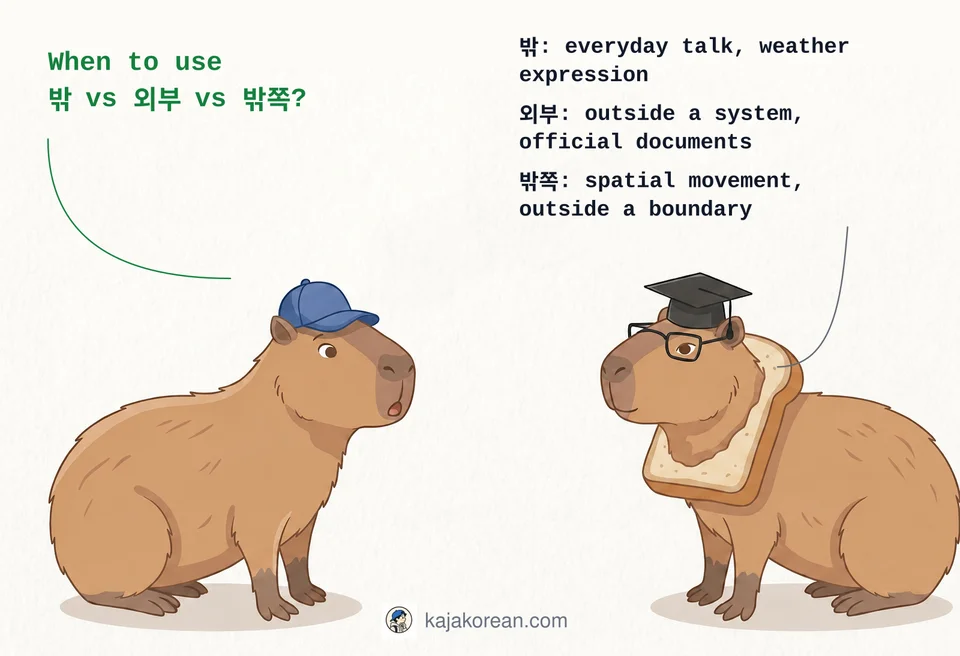
One lane per word — no nested boxes, just the gist.
Everyday term for the 'outside space' of a building or place
When to use
everyday talk, concrete outside space, weather expression
The nuance
Used when referring to a concrete, physical outside space; common in everyday conversation.
Formal or abstract term for the 'external area' of organizations, buildings, or systems
When to use
official documents, outside an organization, outside a system
The nuance
Used in official documents or explanations to indicate abstract external areas, emphasizing scope or relationships more than physical space.
Indicates 'outside direction' from a boundary or center, emphasizing directionality
When to use
direction indication, outside a boundary, spatial movement
The nuance
Used when pointing outward from a boundary or center, emphasizing the direction outward.
오늘은 날씨가 좋아서 밖에 나가고 싶어요.
o-neul-eun nal-ssi-ga joh-a-seo bakk-e na-ga-go sip-eo-yo., o neul eun nal ssi ga joh a seo bakk e na ga go sip eo yo.
밖 naturally refers to everyday outside space, making this sentence correct.
오늘은 날씨가 좋아서 외부에 나가고 싶어요.
o-neul-eun nal-ssi-ga joh-a-seo oe-bu-e na-ga-go sip-eo-yo., o neul eun nal ssi ga joh a seo oe bu e na ga go sip eo yo.
외부 is formal/abstract and unsuitable with weather context here.
회의는 외부에서 진행됩니다.
hoe-ui-neun oe-bu-e-seo jin-haeng-doep-ni-da., hoe ui neun oe bu e seo jin haeng doep ni da.
Appropriate for formal expression that meeting is held outside or in an external area.
회의는 밖에서 진행됩니다.
hoe-ui-neun bakk-e-seo jin-haeng-doep-ni-da., hoe ui neun bakk e seo jin haeng doep ni da.
밖 is too casual for formal meeting context.
문 밖쪽으로 나가세요.
mun bakk-jjok-eu-ro na-ga-se-yo., mun bakk jjok eu ro na ga se yo.
밖쪽 emphasizes direction outward from the door boundary, making this natural.
문 외부로 나가세요.
mun oe-bu-ro na-ga-se-yo., mun oe bu ro na ga se yo.
외부 is not used to indicate direction from a physical boundary here.
건물 외부에 CCTV가 설치되어 있다.
geon-mul oe-bu-e cctvga seol-chi-doe-eo iss-da., geon mul oe bu e cctvga seol chi doe eo iss da.
외부 is suitable for official external area of a building.
건물 밖쪽에 CCTV가 설치되어 있다.
geon-mul bakk-jjok-e cctvga seol-chi-doe-eo iss-da., geon mul bakk jjok e cctvga seol chi doe eo iss da.
밖쪽 emphasizes direction, not location description like CCTV placement.
Which word is appropriate for formally describing meeting location?
Which word indicates direction outward from a door?
Which word is natural when talking about playing outside in a park?
What does it mean?