Regular vs Irregular vs Exception Conjugation: Key Differences

규칙활용 (gyu-chik-hwal-yong, gyuchikhwalyong) · 불규칙활용 (bul-gyu-chik-hwal-yong, bulgyuchikhwalyong) · 예외활용 (ye-oe-hwal-yong, yeoehwalyong)

Regular conjugation follows fixed grammar rules, irregular conjugation breaks those rules, and exception conjugation refers to irregular cases that are separately categorized.

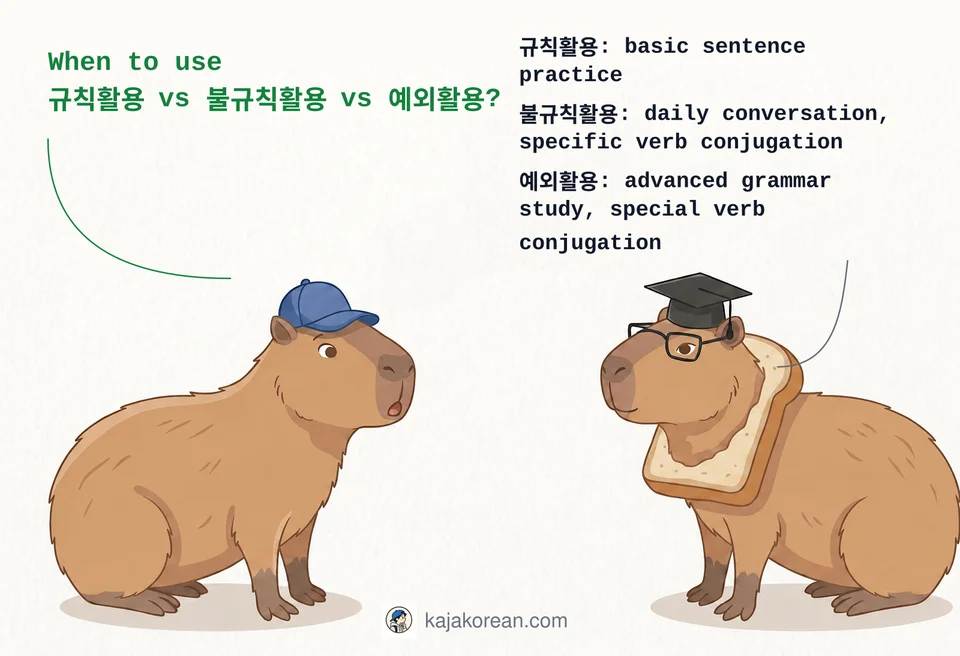
Comparison of Korean regular, irregular, and exception verb conjugations

Word-by-word breakdown

One lane per word — no nested boxes, just the gist.

규칙활용(gyu-chik-hwal-yong, gyuchikhwalyong)

Conjugating verbs or adjectives according to fixed grammar rules

When to use

regular verb conjugation, standard grammar teaching, basic sentence practice

The nuance

Attach endings to the stem without stem changes, following grammar rules.

불규칙활용(bul-gyu-chik-hwal-yong, bulgyuchikhwalyong)

Conjugating verbs or adjectives where the stem changes irregularly, not following standard rules

When to use

specific verb conjugation, daily conversation, explaining non-standard conjugation

The nuance

The stem changes or drops parts irregularly, deviating from standard rules.

예외활용(ye-oe-hwal-yong, yeoehwalyong)

A subset of irregular conjugation that is uniquely categorized in grammar books or dictionaries

When to use

special verb conjugation, advanced grammar study, memorizing exception verbs

The nuance

Belongs to irregular conjugation but requires distinct rules or memorization, separate from general irregulars.

Real-world examples

  • 가다의 과거형은 갔다이다.

    ga-da-ui gwa-geo-hyeong-eun gass-da-i-da., ga da ui gwa geo hyeong eun gass da i da.

    The verb 가다 is regular, and 갔다 is the correct past tense conjugation.

  • 걷다의 과거형은 걷었다이다.

    geot-da-ui gwa-geo-hyeong-eun geot-eoss-da-i-da., geot da ui gwa geo hyeong eun geot eoss da i da.

    걷다 is irregular; the correct past tense is 걸었다, not 걷었다.

  • 돕다의 현재형은 도와이다.

    dop-da-ui hyeon-jae-hyeong-eun do-wa-i-da., dop da ui hyeon jae hyeong eun do wa i da.

    돕다 is irregular; the correct present form is 도와, not 도와이다.

  • 하다의 과거형은 했다이다.

    ha-da-ui gwa-geo-hyeong-eun haess-da-i-da., ha da ui gwa geo hyeong eun haess da i da.

    하다 is regular; 했다 is the correct past tense form.

  • 듣다의 과거형은 들었다이다.

    deut-da-ui gwa-geo-hyeong-eun deul-eoss-da-i-da., deut da ui gwa geo hyeong eun deul eoss da i da.

    듣다 is irregular; 들었다 is the correct past tense form.

  • 웃다의 과거형은 우었다이다.

    us-da-ui gwa-geo-hyeong-eun u-eoss-da-i-da., us da ui gwa geo hyeong eun u eoss da i da.

    웃다 is irregular; the correct past tense is 웃었다, not 우었다.

  • 걷다의 현재형은 걸어이다.

    geot-da-ui hyeon-jae-hyeong-eun geol-eo-i-da., geot da ui hyeon jae hyeong eun geol eo i da.

    걸어이다 is incorrect; the present polite form is 걸어요.

  • 듣다의 예외 활용 중 하나는 들으러 가다이다.

    deut-da-ui ye-oe hwal-yong jung ha-na-neun deul-eu-reo ga-da-i-da., deut da ui ye oe hwal yong jung ha na neun deul eu reo ga da i da.

    들으러 가다 is accepted as an example of exception conjugation from 듣다.

Quick quiz

  1. Which of the following is a regular conjugation?

    다음 중 규칙활용에 해당하는 것은?(da-eumjunggyu-chik-hwal-yong-ehae-dang-ha-neungeos-eun?, daeumjunggyuchikhwalyongehaedanghaneungeoseun?)
  2. Which is NOT irregular conjugation?

    불규칙 활용에 해당하지 않는 것은?(bul-gyu-chikhwal-yong-ehae-dang-ha-jian-neungeos-eun?, bulgyuchikhwalyongehaedanghajianneungeoseun?)
  3. Which verb shows exception conjugation?

    예외 활용에 해당하는 동사는?(ye-oehwal-yong-ehae-dang-ha-neundong-sa-neun?, yeoehwalyongehaedanghaneundongsaneun?)

More comparisons to explore

View all word comparisons →