
짐(jim)
Casual term for luggage, belongings, or stuff in everyday life
When to use
travel prep, moving house, everyday talk
The nuance
Used broadly and casually for belongings or luggage, whether moving house or traveling.
짐 (jim) · 수하물 (su-ha-mul, suhamul)
Both 짐 and 수하물 mean 'luggage,' but 짐 is a casual, general term, while 수하물 is used formally, especially in travel contexts.
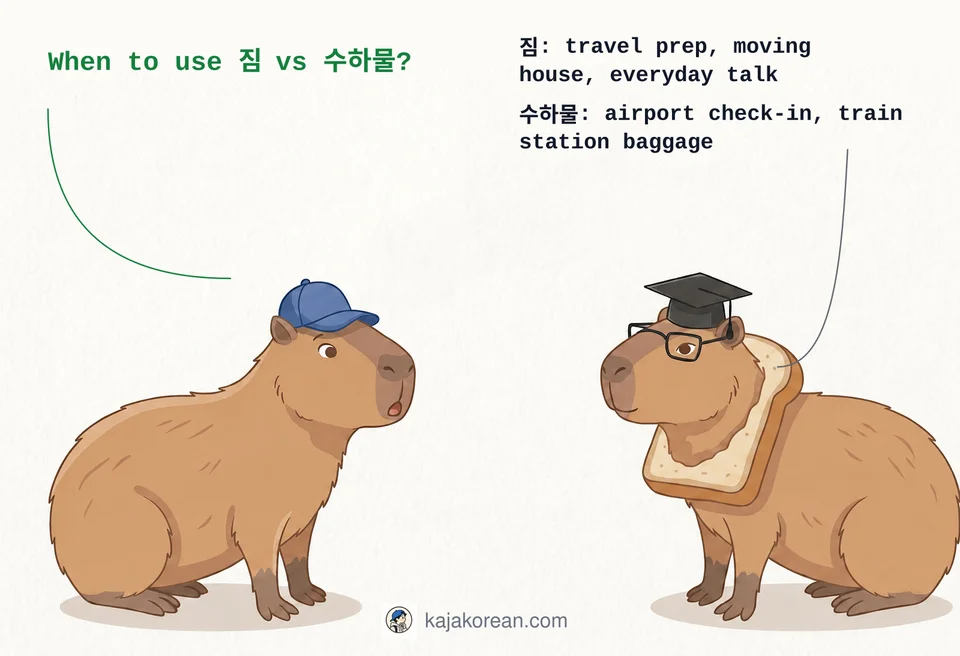
One lane per word — no nested boxes, just the gist.
Casual term for luggage, belongings, or stuff in everyday life
When to use
travel prep, moving house, everyday talk
The nuance
Used broadly and casually for belongings or luggage, whether moving house or traveling.
Official term for luggage handled at airports, train stations, etc.
When to use
airport check-in, train station baggage, official travel documents
The nuance
Used specifically for luggage checked or handled officially during travel at airports or stations.
여행 갈 때 짐을 잘 챙겨야 해.
yeo-haeng gal ttae jim-eul jal chaeng-gyeo-ya hae., yeo haeng gal ttae jim eul jal chaeng gyeo ya hae.
Natural everyday expression referring to luggage when preparing for a trip.
공항에서 수하물을 부쳤다.
gong-hang-e-seo su-ha-mul-eul bu-chyeoss-da., gong hang e seo su ha mul eul bu chyeoss da.
Appropriate use of 수하물 in official context of checking luggage at the airport.
이사할 때 수하물을 많이 가져갔어요.
i-sa-hal ttae su-ha-mul-eul man-i ga-jyeo-gass-eo-yo., i sa hal ttae su ha mul eul man i ga jyeo gass eo yo.
수하물 is not used for moving house; 짐 is correct here.
기차역에서 내 짐을 찾았다.
gi-cha-yeok-e-seo nae jim-eul chaj-ass-da., gi cha yeok e seo nae jim eul chaj ass da.
짐 is natural for personal belongings found at a train station.
수하물을 싸다.
su-ha-mul-eul ssa-da., su ha mul eul ssa da.
수하물 refers to checked luggage, so 'packing' (싸다) is unnatural here.
짐이 너무 많아서 택시를 불렀다.
jim-i neo-mu man-a-seo taek-si-reul bul-reoss-da., jim i neo mu man a seo taek si reul bul reoss da.
Natural to say 짐 is heavy in casual conversation.
수하물 무게 제한을 확인하세요.
su-ha-mul mu-ge je-han-eul hwak-in-ha-se-yo., su ha mul mu ge je han eul hwak in ha se yo.
Appropriate in official announcements about luggage weight limits.
짐을 수하물에 넣었다.
jim-eul su-ha-mul-e neoh-eoss-da., jim eul su ha mul e neoh eoss da.
Mixing 짐 and 수하물 in one sentence like this sounds unnatural.
What do you call luggage checked at the airport?
What do you usually call belongings moved during a house move?
Which word fits packing luggage when preparing for a trip?
Which word is appropriate for announcing luggage weight limits at the airport?